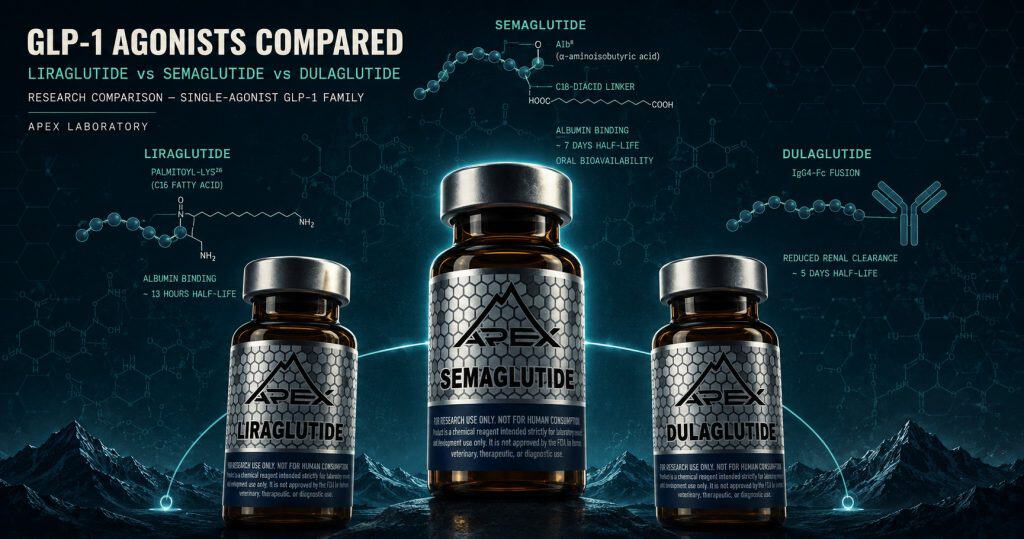
Three single-agonist GLP-1 receptor agonists — Liraglutide, Semaglutide, and Dulaglutide — share a target receptor and a therapeutic class, but their research bases are not symmetric. Semaglutide carries the largest Phase 3 evidence corpus among the three (the SUSTAIN type-2 diabetes program, the STEP obesity program, and the SUSTAIN-6 cardiovascular outcomes trial) and three FDA-approved formulations (Ozempic, Wegovy, Rybelsus). Liraglutide is established and FDA-approved across two formulations (Victoza, January 25, 2010; Saxenda, December 23, 2014) with the LEADER cardiovascular outcomes trial as anchor. Dulaglutide (Trulicity, September 18, 2014) carries the AWARD registrational program and the REWIND cardiovascular outcomes trial — meaningful, mid-volume.
Researchers comparing these three monoagonists must calibrate citation depth to the evidence-base differential. This guide treats the asymmetry as data, not hierarchy: each compound’s research footprint reflects developmental timing and program scale, not therapeutic ranking.
This guide is the focused 3-way comparison of single-agonist GLP-1 receptor agonists (Family 1 per the GLP-1 / Metabolic Research Peptides pillar). It covers regulatory positions across six FDA approvals, three structurally distinct half-life-extension engineering approaches, the LEAD / SCALE / LEADER trial program for Liraglutide, the SUSTAIN / STEP / PIONEER program for Semaglutide, the AWARD / REWIND program for Dulaglutide, the SUSTAIN-7 head-to-head Phase 3 trial as the only direct comparison among the three, and the Apex catalog framing for three research-grade chemical reagents.
Liraglutide vs Semaglutide vs Dulaglutide at a Glance
- Three single-agonist GLP-1 receptor agonists share GLP-1R as their target but differ in molecular engineering, trial-program scale, and FDA-approval footprint — Liraglutide (Victoza, January 25, 2010, type 2 diabetes; Saxenda, December 23, 2014, chronic weight management), Semaglutide (Ozempic, December 5, 2017; Rybelsus, September 20, 2019; Wegovy, June 4, 2021), and Dulaglutide (Trulicity, September 18, 2014, type 2 diabetes)
- Their research bases are not symmetric: Semaglutide carries the flagship Phase 3 corpus (SUSTAIN, STEP, SUSTAIN-6, PIONEER), Liraglutide is established and LEADER-anchored, and Dulaglutide carries the AWARD program and REWIND cardiovascular outcomes — the asymmetry is the article’s organizing logic, not therapeutic ranking
- The three compounds use three distinct molecular-engineering solutions to the same DPP-IV-degradation problem — Liraglutide’s palmitoyl-Lys26 albumin-binding (~13-hour half-life, daily SC), Semaglutide’s Aib8 + C18 fatty diacid + linker dual stabilization (~7-day half-life, weekly SC, also oral via SNAC), and Dulaglutide’s IgG4-Fc fusion via flexible linker (~5-day half-life, weekly SC)
- SUSTAIN-7 (Pratley et al., 2018, Lancet Diabetes Endocrinol) is the only Phase 3 trial directly comparing two of the three monoagonists — Semaglutide vs Dulaglutide over 40 weeks; both Semaglutide doses produced superior HbA1c and weight reductions versus the corresponding Dulaglutide doses, the trial’s own primary-endpoint language
- Three Phase 3 cardiovascular outcomes trials — LEADER (Liraglutide, 2016), SUSTAIN-6 (Semaglutide, 2016), and REWIND (Dulaglutide, 2019) — used different patient populations, durations, and primary-endpoint definitions; head-to-head efficacy claims across the three are not directly supportable by the published literature
- Apex Laboratory’s research-grade Liraglutide, Semaglutide, and Dulaglutide are classified as chemical research reagents intended exclusively for in-vitro and preclinical research use, distinct from the six FDA-approved pharmaceutical formulations across the three compounds
The Research-Volume Asymmetry Defining This Comparison
Single-agonist GLP-1 receptor agonists are routinely presented in retailer SERPs as if Liraglutide, Semaglutide, and Dulaglutide carry symmetric evidence bases — three peers in a class. They do not. The contemporary retrospective on the field, 17 Drucker (2024) in the Journal of Clinical Investigation, traces the GLP-1 development arc from 1987 cloning through 2005 first approval (Exenatide) through 2014 obesity-indication landmarks (Saxenda, Trulicity) into the Wegovy 2021 era. That arc is asymmetric by construction: each compound entered registrational programs at a different developmental window, and the cumulative Phase 3 corpus reflects program scale, indication breadth, and time-on-market rather than within-class therapeutic ranking.
Semaglutide’s SUSTAIN, STEP, PIONEER, and SUSTAIN-6 programs collectively comprise ten-plus Phase 3 trials across two indications and two routes (subcutaneous and oral). Liraglutide’s LEAD program (six Phase 3 trials, 2008–2010), SCALE obesity program, and LEADER cardiovascular outcomes trial constitute a mature mid-volume corpus across two indications. Dulaglutide’s AWARD program and REWIND cardiovascular outcomes trial constitute a mid-volume corpus around a single indication with cardiovascular risk-reduction added post-REWIND.
The mechanism-side review by 16 Drucker (2018) in Cell Metabolism synthesizes the class-level pharmacology — GLP-1R-positive cell types, neural circuits, and therapeutic formulations — under which the three compounds operate. Class membership is shared; corpus depth is not. Researchers comparing Liraglutide, Semaglutide, and Dulaglutide must calibrate citation depth to the evidence-base differential. The asymmetry is data, not ranking.
Liraglutide: Established Daily Single-Agonist (Victoza, Saxenda)
Liraglutide is the active ingredient in two FDA-approved formulations from Novo Nordisk: Victoza, FDA-approved January 25, 2010 for adults with type 2 diabetes, and Saxenda, FDA-approved December 23, 2014 for chronic weight management. Apex Laboratory’s research-grade Liraglutide is classified as a chemical research reagent and is distinct from these approved pharmaceutical formulations.
Molecular Structure and Engineering
Liraglutide is built on the human GLP-1(7-37) backbone with two modifications: a Lys34 to Arg34 substitution and a palmitoyl C16 fatty acid attached to Lys26 via a γ-glutamyl spacer. The palmitoyl chain mediates non-covalent reversible binding to serum albumin, reducing renal clearance and delaying DPP-IV degradation. Plasma half-life is approximately 13 hours, supporting daily subcutaneous dosing.
LEAD Registrational Program
The Victoza approval rested on the six-trial LEAD program. The LEAD-1 SU trial — 3 Marre et al. (2009) in Diabetic Medicine — randomized type 2 diabetes patients to Liraglutide 0.6, 1.2, or 1.8 mg daily added to glimepiride versus rosiglitazone or placebo over 26 weeks, reporting greater glycemic and weight improvements with Liraglutide. The LEAD program collectively established Liraglutide’s efficacy across monotherapy, add-on, and combination contexts.
SCALE Obesity Registrational and Saxenda Approval
The Saxenda approval rested on the SCALE obesity program. The SCALE Obesity and Prediabetes trial — 2 Pi-Sunyer et al. (2015) in NEJM — randomized 3,731 adults with body mass index of at least 30, or at least 27 with comorbidity, to Liraglutide 3.0 mg daily subcutaneous versus placebo at 56 weeks, reporting body weight reductions of −8.4 kg versus −2.8 kg. The trial supported the December 23, 2014 FDA approval of Saxenda for chronic weight management.
LEADER Cardiovascular Outcomes
The LEADER trial — 1 Marso et al. (2016) in NEJM — randomized 9,340 type 2 diabetes patients with high cardiovascular risk to Liraglutide 1.8 mg daily versus placebo, reporting a primary composite outcome (cardiovascular death, nonfatal myocardial infarction, nonfatal stroke) of 13.0% versus 14.9%, hazard ratio 0.87, P=0.01 for superiority over a median 3.8 years. LEADER established Liraglutide’s cardiovascular outcomes evidence base.
Semaglutide: Flagship Research Base (Ozempic, Wegovy, Rybelsus)
Semaglutide is the active ingredient in three FDA-approved formulations from Novo Nordisk: Ozempic, FDA-approved December 5, 2017 for type 2 diabetes (subcutaneous); Rybelsus, FDA-approved September 20, 2019 for type 2 diabetes (oral, the first oral GLP-1 receptor agonist); and Wegovy, FDA-approved June 4, 2021 for chronic weight management. Apex Laboratory’s research-grade Semaglutide is classified as a chemical research reagent and is distinct from these approved pharmaceutical formulations. Across two indications and two routes, Semaglutide’s research footprint is the largest among the three compounds in this comparison.
Molecular Discovery and Dual Stabilization
The Semaglutide molecular-engineering paper — 11 Lau et al. (2015) in the Journal of Medicinal Chemistry — documents the dual-stabilization design: an α-aminoisobutyric acid (Aib) substitution at position 8 protecting against DPP-IV cleavage, plus a Lys26 acylated with a C18 fatty diacid via a γGlu-2xOEG (oligoethylene glycol) linker for albumin binding, plus a Lys34 to Arg34 substitution. The result is approximately 7-day plasma half-life supporting weekly subcutaneous administration. Knudsen LB co-authored the discovery paper.
SUSTAIN T2D Program
The Ozempic approval rested on the SUSTAIN program. SUSTAIN-1 — 8 Sorli et al. (2017) in Lancet Diabetes Endocrinol — was the foundational monotherapy Phase 3a trial of once-weekly Semaglutide versus placebo, anchoring the December 5, 2017 FDA approval. SUSTAIN extended across head-to-head trials (SUSTAIN-7, below) and the cardiovascular outcomes trial SUSTAIN-6.
STEP Obesity Program
The Wegovy approval rested on the STEP program. STEP-1 — 5 Wilding et al. (2021) in NEJM — randomized 1,961 adults with overweight or obesity to Semaglutide 2.4 mg weekly subcutaneous versus placebo over 68 weeks, reporting body weight reductions of −14.9% versus −2.4% and 86.4% achieving at least 5% weight loss versus 31.5%. STEP-2 — 6 Davies et al. (2021) in Lancet — extended the STEP program into adults with overweight or obesity and type 2 diabetes, broadening the evidence base across the obesity-T2D overlap. STEP-3 — 7 Wadden et al. (2021) in JAMA — added the intensive-behavioral-therapy arm, demonstrating Semaglutide 2.4 mg plus IBT versus placebo plus IBT.
PIONEER Oral Semaglutide Program
The Rybelsus approval rested on the PIONEER program. PIONEER-1 — 10 Aroda et al. (2019) in Diabetes Care — established oral Semaglutide monotherapy versus placebo, supporting the September 20, 2019 FDA approval of the first oral GLP-1 receptor agonist (the SNAC absorption-enhancer technology overcoming peptide gastrointestinal lability). PIONEER-8 — 18 Zinman et al. (2019) in Diabetes Care — extended PIONEER into the insulin-background-therapy population, demonstrating oral Semaglutide added to insulin with or without metformin.
SUSTAIN-6 Cardiovascular Outcomes
SUSTAIN-6 — 4 Marso et al. (2016) in NEJM — randomized 3,297 high-risk type 2 diabetes patients to Semaglutide 0.5 or 1.0 mg weekly versus placebo over 104 weeks, reporting a primary composite outcome of 6.6% versus 8.9%, hazard ratio 0.74, with P less than 0.001 for non-inferiority and P=0.02 for superiority. The trial reported a retinopathy signal at hazard ratio 1.76 — surfaced for compliance-aware framing.
Dulaglutide: Lilly Fc-Fusion Weekly (Trulicity)
Dulaglutide is the active ingredient in Trulicity, FDA-approved September 18, 2014 for type 2 diabetes (weekly subcutaneous). A cardiovascular risk reduction indication was added in 2020 following REWIND. Apex Laboratory’s research-grade Dulaglutide is classified as a chemical research reagent and is distinct from the approved Trulicity formulation.
Molecular Construct: IgG4-Fc Fusion
The Dulaglutide molecular-engineering paper — 12 Glaesner et al. (2010) in Diabetes/Metabolism Research and Reviews — characterizes LY2189265 as two GLP-1(7-37) analog peptides covalently fused to a human IgG4-Fc via a flexible 16-amino-acid linker (Gly-Gly-Gly-Gly-Ser repeats). The IgG4-Fc carries the S228P stabilization mutation to prevent half-antibody exchange. Half-life extension is mediated by FcRn (neonatal Fc receptor) recycling on endothelial cells; plasma half-life is approximately 5 days, supporting weekly subcutaneous administration. Dulaglutide is structurally distinct from the small-peptide design of Liraglutide and Semaglutide — it is an Fc-fusion biologic.
AWARD Registrational Program
The Trulicity approval rested on the AWARD program. AWARD-1 — 13 Wysham et al. (2014) in Diabetes Care — compared Dulaglutide 0.75 or 1.5 mg added to pioglitazone and metformin versus exenatide twice daily plus pioglitazone and metformin versus placebo. AWARD-3 — 14 Umpierrez et al. (2014) in Diabetes Care — randomized 807 patients to Dulaglutide 1.5 mg monotherapy versus metformin at 26 weeks, reporting Dulaglutide superior in HbA1c reduction. The AWARD program collectively supported the September 18, 2014 FDA approval.
REWIND Cardiovascular Outcomes
REWIND — 15 Gerstein et al. (2019) in Lancet — randomized 9,901 type 2 diabetes patients to Dulaglutide 1.5 mg weekly versus placebo, reporting a primary composite outcome (cardiovascular death, nonfatal myocardial infarction, nonfatal stroke) of 12.0% versus 13.4%, hazard ratio 0.88, P=0.026 over a median 5.4 years. REWIND was distinct from LEADER and SUSTAIN-6 in its broader cardiovascular-risk inclusion criteria — patients without established cardiovascular disease at baseline were included alongside those with established disease, expanding the eligible population beyond the secondary-prevention focus of LEADER and SUSTAIN-6.
Mechanism Engineering: Three Approaches to Half-Life Extension
All three compounds are GLP-1 monoagonists. None reaches a clinically useful half-life on the native GLP-1 backbone alone — native GLP-1(7-36) carries a 1–2 minute half-life under DPP-IV cleavage and renal clearance. The three compounds in this comparison adopt three structurally distinct engineering solutions to the same problem.
Liraglutide: Palmitoyl-Lys26 Albumin Binding (~13 hours, daily SC)
Liraglutide attaches a palmitoyl C16 fatty acid to Lys26 via a γ-glutamyl spacer; the palmitoyl chain non-covalently binds serum albumin, slowing renal clearance and delaying DPP-IV degradation. Plasma half-life is approximately 13 hours. The design supports daily subcutaneous administration but not weekly.
Semaglutide: Aib8 + C18 Diacid + Linker Dual Stabilization (~7 days, weekly SC, also oral)
Semaglutide combines two engineering elements: an Aib substitution at position 8 protects the N-terminus against DPP-IV cleavage, and a C18 fatty diacid attached to Lys26 via a γGlu-2xOEG linker mediates strong reversible albumin binding. 11 Lau et al. (2015) document this dual stabilization. Plasma half-life is approximately 7 days, supporting weekly subcutaneous administration. Rybelsus uses sodium N-(8-(2-hydroxybenzoyl)amino)caprylate (SNAC) as an absorption enhancer to enable oral dosing despite peptide gastrointestinal lability.
Dulaglutide: IgG4-Fc Fusion via Flexible Linker (~5 days, weekly SC)
Dulaglutide replaces the small-peptide-with-acylation strategy entirely with a biologic construct: two GLP-1(7-37) analog peptides fused to an IgG4-Fc via a Gly-Gly-Gly-Gly-Ser flexible linker. 12 Glaesner et al. (2010) characterized this construct. FcRn-mediated recycling extends plasma half-life to approximately 5 days, supporting weekly subcutaneous administration.
The class-level mechanism review by 16 Drucker (2018) frames GLP-1 receptor pharmacology under which all three engineering solutions operate — same target receptor, three distinct strategies for clinical-grade pharmacokinetics. No SERP competitor surfaces this depth.
Trial-Program Contrast: LEAD/SCALE/LEADER vs SUSTAIN/STEP/PIONEER vs AWARD/REWIND
The trial-program contrast across the three compounds reflects developmental timing and indication breadth.
Liraglutide: LEAD (T2D), SCALE (obesity), LEADER (cardiovascular)
The Liraglutide registrational arc spans LEAD-1 through LEAD-6 for type 2 diabetes (2008–2010, supporting Victoza), the SCALE program for chronic weight management (supporting Saxenda 2014), and LEADER as the cardiovascular outcomes anchor (Marso 2016). Two indications, two formulations, one cardiovascular outcomes trial.
Semaglutide: SUSTAIN (T2D), STEP (obesity), PIONEER (oral), SUSTAIN-6 (CV)
The Semaglutide registrational arc spans SUSTAIN-1 through SUSTAIN-7 (and beyond) for type 2 diabetes (subcutaneous, supporting Ozempic 2017), STEP-1 through STEP-8 (and beyond) for chronic weight management (supporting Wegovy 2021), PIONEER-1 through PIONEER-10 (and beyond) for oral type 2 diabetes (supporting Rybelsus 2019), and SUSTAIN-6 as the cardiovascular outcomes anchor. Three formulations across two indications and two routes — the largest registrational footprint in the GLP-1 monoagonist class.
Dulaglutide: AWARD (T2D), REWIND (cardiovascular)
The Dulaglutide registrational arc spans AWARD-1 through AWARD-11 for type 2 diabetes (supporting Trulicity 2014) and REWIND as the cardiovascular outcomes anchor. One indication initially, with cardiovascular risk reduction added in 2020 following REWIND.
The trial-program asymmetry maps directly to the FDA-approval asymmetry — six approvals across the three compounds, with Semaglutide accounting for three. Trial-program naming is research-context attribution only; the approved-pharmaceutical trade names appear here only to anchor each program to its corresponding FDA approval.
Liraglutide vs Semaglutide vs Dulaglutide
| Attribute | Liraglutide | Semaglutide | Dulaglutide |
|---|---|---|---|
| Origin / discovery | Novo Nordisk; LEAD program 2008–2010 | Novo Nordisk; Lau et al. 2015 J Med Chem discovery (Knudsen co-author) | Eli Lilly; Glaesner et al. 2010 Diabetes Metab Res Rev (LY2189265) |
| Structural class | Modified GLP-1(7-37) with palmitoyl-Lys26 + γ-glutamyl spacer (albumin-binding small peptide) | Modified GLP-1(7-37) with Aib8 + C18 diacid + γGlu-2xOEG linker (dual-stabilized small peptide) | IgG4-Fc fusion: 2× GLP-1(7-37) analog + flexible (Gly-Gly-Gly-Gly-Ser) linker + IgG4-Fc S228P (biologic) |
| Sequence / construct | Native GLP-1 backbone + Lys34→Arg + palmitoyl-Lys26 conjugate | Modified GLP-1(7-37) + Aib8 + Lys34→Arg + C18 diacid acylation | Two GLP-1(7-37) analog peptides covalently fused to human IgG4-Fc |
| Half-life | ~13 hours | ~7 days (also oral via SNAC) | ~5 days |
| Dosing frequency | Daily subcutaneous | Weekly subcutaneous (Ozempic, Wegovy); daily oral (Rybelsus) | Weekly subcutaneous |
| Trial program | LEAD (T2D); SCALE (obesity); LEADER (cardiovascular) | SUSTAIN (T2D); STEP (obesity); PIONEER (oral T2D); SUSTAIN-6 (cardiovascular) | AWARD (T2D); REWIND (cardiovascular) |
| FDA approval timing | Victoza, January 25, 2010 (T2D); Saxenda, December 23, 2014 (obesity) | Ozempic, December 5, 2017 (T2D); Rybelsus, September 20, 2019 (oral T2D); Wegovy, June 4, 2021 (obesity) | Trulicity, September 18, 2014 (T2D); cardiovascular risk-reduction added 2020 following REWIND |
| CV outcomes trial | LEADER (Marso 2016, NEJM) — 9,340 patients, HR 0.87, P=0.01 | SUSTAIN-6 (Marso 2016, NEJM) — 3,297 patients, HR 0.74, P=0.02 | REWIND (Gerstein 2019, Lancet) — 9,901 patients, HR 0.88, P=0.026 |
| Apex catalog | Research-grade; distinct from Victoza and Saxenda | Research-grade; distinct from Ozempic, Wegovy, Rybelsus | Research-grade; distinct from Trulicity |
| Research-volume tier | Established / mid-volume | Flagship / largest Phase 3 corpus | Mid-volume |
Head-to-Head Evidence: SUSTAIN-7 (Sema vs Dula); No Liraglutide Phase 3 H2H
The 3-way comparison of Liraglutide, Semaglutide, and Dulaglutide rests on a single Phase 3 head-to-head trial.
SUSTAIN-7: The Only Direct Phase 3 Head-to-Head
SUSTAIN-7 — 9 Pratley et al. (2018) in Lancet Diabetes Endocrinol — randomized 1,201 type 2 diabetes patients on metformin to Semaglutide 0.5 or 1.0 mg weekly versus Dulaglutide 0.75 or 1.5 mg weekly over 40 weeks. The trial reported that both Semaglutide doses produced superior HbA1c reductions and weight reductions versus the corresponding Dulaglutide doses — the trial’s own primary-endpoint language. SUSTAIN-7 is the only Phase 3 trial directly comparing two of the three monoagonists in this guide.
No Liraglutide-vs-Semaglutide or Liraglutide-vs-Dulaglutide Phase 3 Head-to-Head Exists
No Phase 3 registrational trial directly compares Liraglutide against Semaglutide, and no Phase 3 registrational trial directly compares Liraglutide against Dulaglutide. The available cross-comparisons are network meta-analyses and indirect treatment comparisons; both methods carry methodological assumptions that registrational head-to-head designs do not impose. Researchers comparing Liraglutide with either Semaglutide or Dulaglutide on a head-to-head basis must read across this gap explicitly.
The SUSTAIN-7 head-to-head is the load-bearing Phase 3 evidence anchor for this comparison, and the absence of equivalent trials for Liraglutide is itself a load-bearing fact about the evidence base.
Cardiovascular Outcomes: LEADER, SUSTAIN-6, REWIND
Three Phase 3 cardiovascular outcomes trials anchor the cardiovascular-risk reduction evidence for the three compounds.
- LEADER (Marso 2016, NEJM): Liraglutide 1.8 mg daily, 9,340 high-CV-risk T2D patients; primary composite outcome 13.0% vs 14.9%, HR 0.87, P=0.01 superior over a median 3.8 years.
- SUSTAIN-6 (Marso 2016, NEJM): Semaglutide 0.5/1.0 mg weekly, 3,297 high-CV-risk T2D patients; primary composite outcome 6.6% vs 8.9%, HR 0.74, P=0.02 superior over 104 weeks.
- REWIND (Gerstein 2019, Lancet): Dulaglutide 1.5 mg weekly, 9,901 T2D patients (broader CV-risk inclusion); primary composite outcome 12.0% vs 13.4%, HR 0.88, P=0.026 superior over a median 5.4 years.
Discipline-boundary qualifier (load-bearing): These three cardiovascular outcomes trials (LEADER, SUSTAIN-6, REWIND) used different patient populations, durations, and primary-endpoint definitions; head-to-head efficacy claims across the three trials are not directly supportable by the published literature. LEADER and SUSTAIN-6 enrolled high-cardiovascular-risk type 2 diabetes patients with established cardiovascular disease or significant risk; REWIND broadened inclusion to patients without established disease alongside those with established disease. Trial durations ranged from approximately 2 to 5 years. Hazard-ratio comparisons across the three trials are reported in network meta-analyses but are not directly supportable from the registrational data.
Apex Catalog: Three Research-Grade Reagents Distinct From Approved Formulations
Apex Laboratory’s catalog includes Liraglutide, Semaglutide, and Dulaglutide as research-grade chemical reagents — the same active ingredients that appear in six FDA-approved pharmaceutical formulations across two indications and two routes, supplied here at ≥99% purity verified by HPLC and mass spectrometry on every batch and documented in the lab-verified COA archive under the editorial standards framework, intended exclusively for in-vitro and preclinical research use. Apex’s research-grade Liraglutide, Semaglutide, and Dulaglutide are classified as chemical research reagents, distinct from the Victoza, Saxenda, Ozempic, Wegovy, Rybelsus, and Trulicity pharmaceutical formulations under the Cerebrolysin-precedent regulatory framing pattern. Catalog routing for the three compounds runs through the Apex research library under the GLP-1 / Metabolic Research category.
Research-Grade Compounds for This Comparison
Liraglutide
Apex Laboratory Liraglutide is supplied as a research-grade chemical reagent at ≥99% purity, verified by HPLC and mass spectrometry on every batch. Single-agonist GLP-1 receptor agonist with palmitoyl-Lys26 albumin-binding chemistry; daily subcutaneous half-life class. Distinct from the FDA-approved Victoza and Saxenda pharmaceutical formulations. For in-vitro and preclinical research only — not for human consumption.
View Product →Semaglutide
Apex Laboratory Semaglutide is supplied as a research-grade chemical reagent at ≥99% purity, verified by HPLC and mass spectrometry on every batch. Single-agonist GLP-1 receptor agonist with Aib8 plus C18 fatty diacid linker dual-stabilization chemistry; weekly subcutaneous class. Distinct from the FDA-approved Ozempic, Wegovy, and Rybelsus pharmaceutical formulations. For in-vitro and preclinical research only — not for human consumption.
View Product →Dulaglutide
Apex Laboratory Dulaglutide is supplied as a research-grade chemical reagent at ≥99% purity, verified by HPLC and mass spectrometry on every batch. Single-agonist GLP-1 receptor agonist with IgG4-Fc fusion construct mediating FcRn recycling; weekly subcutaneous class. Distinct from the FDA-approved Trulicity pharmaceutical formulation. For in-vitro and preclinical research only — not for human consumption.
View Product →Frequently Asked Questions
What is the difference between liraglutide, semaglutide, and dulaglutide?
All three are single-agonist GLP-1 receptor agonists, but they differ structurally and in dosing. Liraglutide uses palmitoyl-Lys26 albumin binding for a ~13-hour half-life and daily subcutaneous administration (Victoza, Saxenda). Semaglutide uses Aib8 plus C18 fatty diacid linker dual stabilization for a ~7-day half-life and weekly subcutaneous, also oral via SNAC (Ozempic, Wegovy, Rybelsus). Dulaglutide uses an IgG4-Fc fusion construct for a ~5-day half-life and weekly subcutaneous (Trulicity).
Which GLP-1 agonist has the most research evidence?
Semaglutide carries the largest Phase 3 evidence base among the three single-agonist GLP-1 receptor agonists in this comparison — the SUSTAIN type 2 diabetes program, the STEP obesity program, the PIONEER oral program, and the SUSTAIN-6 cardiovascular outcomes trial collectively comprise the largest registrational corpus. Liraglutide is established and LEADER-anchored, while Dulaglutide carries the AWARD program and REWIND cardiovascular outcomes. Research-volume asymmetry is data, not therapeutic ranking.
How does the SUSTAIN-7 trial compare semaglutide and dulaglutide?
SUSTAIN-7 (Pratley et al., 2018, Lancet Diabetes Endocrinol) randomized 1,201 type 2 diabetes patients on metformin to Semaglutide 0.5 or 1.0 mg weekly versus Dulaglutide 0.75 or 1.5 mg weekly over 40 weeks. The trial reported that both Semaglutide doses produced superior HbA1c reductions and weight reductions versus corresponding Dulaglutide doses — the trial’s own primary-endpoint language. SUSTAIN-7 is the only Phase 3 head-to-head trial among the three monoagonists.
Are liraglutide, semaglutide, and dulaglutide all FDA-approved?
Yes — across six FDA approvals collectively. Liraglutide is the active ingredient in Victoza (FDA-approved January 25, 2010, type 2 diabetes) and Saxenda (FDA-approved December 23, 2014, chronic weight management). Semaglutide is the active ingredient in Ozempic (December 5, 2017, type 2 diabetes), Rybelsus (September 20, 2019, oral type 2 diabetes), and Wegovy (June 4, 2021, chronic weight management). Dulaglutide is the active ingredient in Trulicity (September 18, 2014, type 2 diabetes), with cardiovascular risk reduction added 2020.
What is the difference between daily and weekly GLP-1 agonist dosing?
Liraglutide is dosed daily subcutaneously because its palmitoyl-Lys26 albumin-binding chemistry produces a ~13-hour half-life that does not support weekly intervals. Semaglutide and Dulaglutide are dosed weekly subcutaneously because their respective dual-stabilization (Aib8 plus C18 diacid linker, ~7 days) and Fc-fusion (IgG4-Fc plus FcRn recycling, ~5 days) chemistries support weekly intervals. The dosing-frequency difference reflects molecular-engineering design, not within-class therapeutic ranking. Trial-protocol dose ranges are descriptive trial-attribution facts, not consumption guidance.
How do the LEADER, SUSTAIN-6, and REWIND cardiovascular trials compare?
LEADER (Liraglutide, Marso 2016 NEJM, 9,340 patients), SUSTAIN-6 (Semaglutide, Marso 2016 NEJM, 3,297 patients), and REWIND (Dulaglutide, Gerstein 2019 Lancet, 9,901 patients) are three Phase 3 cardiovascular outcomes trials with different patient populations, durations, and primary-endpoint definitions — LEADER and SUSTAIN-6 enrolled high-CV-risk patients with established disease, REWIND broadened inclusion. Head-to-head efficacy claims across the three trials are not directly supportable.
What is the structural difference between the three half-life extension approaches?
Liraglutide attaches a palmitoyl C16 fatty acid to Lys26 via a γ-glutamyl spacer for albumin binding (~13 hours). Semaglutide combines an Aib position-8 substitution (DPP-IV resistance) with a C18 fatty diacid plus γGlu-2xOEG linker on Lys26 (albumin binding) for dual stabilization (~7 days). Dulaglutide replaces the small-peptide-plus-acylation strategy entirely with an IgG4-Fc fusion construct mediating FcRn recycling (~5 days). Three completely different molecular-engineering solutions to the same DPP-IV-degradation problem.
Why is Apex’s research-grade GLP-1 agonist different from Ozempic, Victoza, or Trulicity?
Apex Laboratory’s research-grade Liraglutide, Semaglutide, and Dulaglutide are classified as chemical research reagents intended exclusively for in-vitro and preclinical research use. They are distinct from the six FDA-approved pharmaceutical formulations across the three compounds (Victoza, Saxenda, Ozempic, Wegovy, Rybelsus, Trulicity), which are approved drug products with patient-facing indications, dosing, labeling, and regulatory oversight. Apex’s catalog products are supplied at ≥99% purity verified by HPLC and mass spectrometry.
Continue Your Research
Researchers building broader GLP-1 monoagonist context across the Apex library may find the following references useful:
- GLP-1 / Metabolic Research Peptides pillar — full six-family taxonomy with Liraglutide, Semaglutide, and Dulaglutide as Family 1 single-agonist members
- Semaglutide vs Tirzepatide head-to-head comparison — single-agonist vs dual-agonist clinical contrast
- Retatrutide research guide — triple GIP/GLP-1/glucagon agonist deep-dive (Family 3)
- Tirzepatide research guide — dual GIP/GLP-1 agonist deep-dive (Family 2)
- Retatrutide vs Tirzepatide comparison — multi-agonist head-to-head sister Tier 3
- Tissue Repair research peptide pillar — lateral cluster (BPC-157, TB-500)
- GH-Axis research peptide pillar — lateral cluster (CJC-1295, Ipamorelin, Sermorelin)
- Nootropic and CNS research peptide pillar — lateral cluster (Selank, Semax)
- Cerebrolysin research guide — parallel Cerebrolysin-precedent regulatory framing example
Research Use Disclaimer
This article is provided for educational and research reference purposes only. Liraglutide, Semaglutide, Dulaglutide, and all products sold by Apex Laboratory are intended exclusively for in-vitro laboratory research use and are not for human consumption. The three compounds are the active ingredients in six FDA-approved pharmaceutical formulations across two indications (type 2 diabetes and chronic weight management) and two routes (subcutaneous and oral) — Victoza (Liraglutide, January 25, 2010, type 2 diabetes), Saxenda (Liraglutide, December 23, 2014, chronic weight management), Ozempic (Semaglutide, December 5, 2017, type 2 diabetes), Rybelsus (Semaglutide, September 20, 2019, oral type 2 diabetes), Wegovy (Semaglutide, June 4, 2021, chronic weight management), and Trulicity (Dulaglutide, September 18, 2014, type 2 diabetes; cardiovascular risk reduction added 2020). Apex Laboratory’s research-grade Liraglutide, Semaglutide, and Dulaglutide are research-grade chemical reagents distinct from these approved pharmaceutical formulations under the Cerebrolysin-precedent regulatory framing pattern. Researchers should consult the primary peer-reviewed literature for LEAD, SCALE, LEADER, SUSTAIN, STEP, PIONEER, AWARD, REWIND, and SUSTAIN-7 trial protocols and findings.