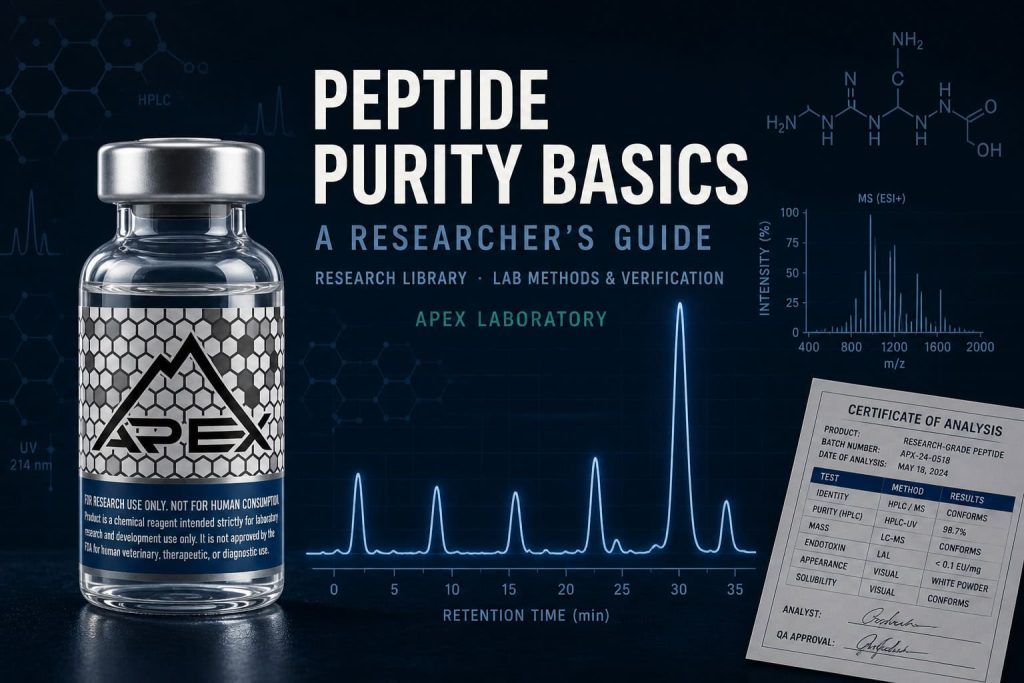
Peptide purity at or above 99% is the modern research-grade threshold because the trailing impurity fraction below that level contains truncated sequences, oxidized variants, and synthesis byproducts that produce reproducibility-breaking off-target effects in research models. The threshold emerged as reversed-phase HPLC matured into the standard analytical method for peptide quality control during the 1980s-90s. Below 99%, experimental data interpretation becomes unreliable.
In 1963, R.B. Merrifield introduced solid-phase peptide synthesis at Rockefeller University — a methodology so transformative it earned the 1984 Nobel Prize in Chemistry. Crude SPPS products of that era contained substantial truncation peptides, deletion sequences, and protecting-group adducts; “purity” was a qualitative claim because the analytical methods to quantify it precisely did not yet exist. By the early 1980s, William Hancock’s reverse-phase HPLC work in J Chromatogr (1981) made percent-purity quantification routine for peptides and proteins. Today, ≥99% HPLC purity verified by orthogonal mass spectrometry is the contemporary standard for research-grade peptides — and Apex Laboratory’s flagship purity standard. Understanding why that 99% threshold matters requires understanding what the alternatives mean and what trace impurities actually do in research-context use.
This article walks the chemistry behind the number. The reader who finishes will recognize ≥99% as appropriate for serious research because the synthesis chemistry, the analytical methodology, and the empirical literature on trace-impurity bioactivity together support it — not because any vendor (including Apex) asserts the standard. The criteria are vendor-agnostic; the conclusion is chemistry-anchored.
Peptide Purity Standards at a Glance
- Peptide purity standards have a measurable historical evolution: qualitative purity claims of the 1960s SPPS era, then quantitative percent-purity routine after Hancock’s 1981 RP-HPLC work, then today’s ≥99% HPLC + orthogonal MS standard
- “Research-grade” without a percentage specified is a red flag — typically 90–95% if measured at all; serious research-context use requires the percentage and the analytical instrument both stated
- The five-tier purity landscape spans “research-grade” unspecified through ≥95%, ≥98%, ≥99% (Apex’s flagship), and ≥99.5% specialty — each tier corresponds to a meaningfully different impurity load and reproducibility envelope
- Trace impurities are not abstract: they are specific chemical species — truncation peptides, deletion sequences, oxidized methionines, deamidated asparagines (Asn→Asp/iso-Asp), racemized residues, aggregates, and counterion variation — each with a defined synthesis-mechanism origin
- The case for ≥99% rests on five reproducibility arguments: trace contaminants can be biologically active, lot-to-lot reproducibility breaks with impurity-profile variation, mechanism studies are confounded by trace-mechanism contributions, receptor selectivity studies are invalid with related-sequence contaminants, and PK studies are biased by truncation-product clearance
- HPLC tells you what fraction of peak area is the main peak; mass spectrometry tells you what molecule the main peak is — both verifications are required, and ≥99% standards reference HPLC + orthogonal MS as the canonical pairing
The 1963 Inflection Point: Merrifield SPPS and the Birth of Synthetic Peptide Impurities
R.B. Merrifield’s 1963 introduction of solid-phase peptide synthesis (SPPS) is the foundational event of synthetic peptide chemistry. The methodology — anchoring a peptide chain to an insoluble polymeric resin and adding amino acids one at a time through repeated cycles of coupling, deprotection, and washing — enabled peptides at scales and complexity levels that solution-phase synthesis could not match. The Robinson and Robinson 2008 Biopolymers historical retrospective documents the lineage of Merrifield’s SPPS introduction and its application to subsequent investigations of peptide chemistry, including deamidation studies that depend on synthesis access to defined sequences.7
The mechanistic structure of SPPS is also the mechanistic structure of synthetic peptide impurities. Each synthesis cycle has a coupling step (the next amino acid is activated and joined to the growing chain) and a deprotection step (the temporary protecting group on the alpha-amine is removed so the next coupling can proceed). Both steps are imperfect at the molecular scale: a coupling cycle that fails to fully install residue n generates a truncated peptide ending at residue n-1; a failed coupling that capping fails to terminate produces a deletion sequence missing one residue internally; incomplete deprotection at the cleavage step leaves protecting groups (Pbf, Trt, OtBu, Boc) on side chains. The Coin, Beyermann, and Bienert 2007 Nature Protocols article on SPPS documents these failure modes alongside the canonical methodology adjustments required for difficult sequences.1
The historical point is that synthetic peptides have always had impurity backgrounds. The change since 1963 has been in the field’s ability to measure them — and that measurement capability is the second half of the purity-standards story.
From Qualitative to Quantitative: Hancock’s 1981 RP-HPLC and the Emergence of Percent-Purity
Through the late 1960s and 1970s, “peptide purity” was largely a qualitative claim. Thin-layer chromatography and amino acid analysis could detect gross contamination but could not resolve trace impurities at the percent-of-peak-area level. The instrument that changed this was reverse-phase high-performance liquid chromatography (RP-HPLC), and the canonical paper documenting its application to peptide and protein mixture analysis is Hancock, Capra, Bradley, and Sparrow’s 1981 J Chromatogr report on reversed-phase HPLC with radial compression for peptide and protein mixture analysis.6
The Hancock RP-HPLC methodology made two things possible: (1) baseline-resolved separation of the intended peptide from synthesis impurities under standardized chromatographic conditions, and (2) integration of the peak-area distribution to compute a percent-purity number — main peak area divided by total peak area. Subsequent analytical-philosophy work in the late 1980s and 1990s, codified in the Anicetti and Hancock 1994 Bioprocess Technology review of analytical considerations in protein purification, established the framing that has persisted into the present: a purity number is a statement about an analytical method, not an absolute property of the material, and the impurity-profile that the method resolves is part of the claim.10
This is why a contemporary ≥99% claim is meaningful only when paired with the analytical instrument that generated it. “≥99% by reverse-phase HPLC” is a verifiable claim. “≥99% pure” with no method named is a marketing assertion. The 1981 Hancock work made the difference between those two formulations real — without RP-HPLC, the percent number cannot be computed.
The Purity Standards Landscape: What “Research-Grade” Actually Means
Once the analytical method exists, purity standards stratify into a recognizable landscape. Across the contemporary research-peptide market, five tiers appear with meaningful frequency. Each tier corresponds to a different impurity load, a different research-context fit, and — for the upper end — a different regulatory framework.3
The five tiers, ordered from least to most stringent:
- “Research-grade” unspecified — no percentage stated on the product page or COA. This formulation typically corresponds to 90–95% if the material is measured at all; the absence of a number is itself the signal. Serious research procurement should treat this as a red-flag tier.
- ≥95% — older HPLC standard; some lower-tier reagent suppliers still operate at this level. Approximately 5% impurity load; meaningful biological-activity risk from related sequences.
- ≥98% — current minimum acceptable for serious research-context use. Approximately 2% impurity load; acceptable for many research contexts but limits reproducibility precision in mechanism / selectivity / PK work.
- ≥99% — Apex Laboratory’s flagship purity standard; matches the pharmaceutical-grade lower bound for many APIs. Up to 1% impurity load; supports mechanism, receptor-selectivity, and PK study reproducibility at the level the empirical literature on impurity bioactivity requires.
- ≥99.5% specialty — achieved with extra purification rounds; appears in pharmaceutical-grade APIs under different regulatory framework (cGMP manufacturing + per-jurisdiction marketing authorization) and in specialty research applications. Up to 0.5% impurity load; the research-context value relative to ≥99% is small for most applications, the pharmaceutical-context value is large.
The honest comparative framing matters: ≥99% is the upper-end of research-grade, not the absolute purity ceiling. Pharmaceutical-grade APIs operating at ≥99.5% sit in a different regulatory category — a category that cannot be collapsed with research-grade reagent supply. The same-batch sister article Research-Grade vs Pharmaceutical-Grade Peptides covers that category distinction in depth.
The Five Research-Peptide Purity Tiers
| Standard | HPLC Spec | Typical Use Context | Impurity Implications |
|---|---|---|---|
| “Research-grade” unspecified | No percentage stated | Red flag — typically 90–95% if measured at all; serious research procurement should treat absence of percentage as a verification-failure signal | 5–10% impurity load; substantial truncation, deletion, and oxidation content; lot-to-lot variation likely |
| ≥95% | ≥95% main peak by HPLC peak area | Older HPLC standard; some lower-tier reagent suppliers still operate at this level | Up to 5% impurity load; meaningful biological-activity risk from related-sequence species |
| ≥98% | ≥98% main peak by HPLC peak area | Current minimum acceptable for serious research-context use; many academic and contract-research workflows operate here | Up to 2% impurity load; acceptable for many contexts, limits reproducibility precision in mechanism / selectivity / PK work |
| ≥99% (Apex flagship) | ≥99% main peak by HPLC peak area + orthogonal MS verification | Apex Laboratory’s flagship purity standard; matches pharmaceutical-grade lower bound for many APIs | Up to 1% impurity load; supports mechanism, receptor-selectivity, and PK study reproducibility |
| ≥99.5% specialty | ≥99.5% main peak; multiple purification rounds | Pharmaceutical-grade APIs under cGMP + per-jurisdiction marketing authorization; specialty research applications | Up to 0.5% impurity load; achieved with extra purification cost; specialty-context value |
What’s Actually in the Other 1–5%: The Impurity Inventory
A purity number is meaningful only against a specific impurity inventory. The “other 1–5%” of a research peptide is not a single substance — it is a mixture of defined chemical species, each with a synthesis-mechanism origin and each with potentially distinct biological activity. Eight species recur across the empirical literature. The Manning, Patel, and Borchardt 1989 Pharm Res foundational review and the Manning, Chou, Murphy, Payne, and Katayama 2010 Pharm Res update together bracket 21 years of accumulated stability and degradation research, covering the inventory comprehensively.910
Truncation sequences
Incomplete coupling during SPPS produces peptides missing one or more N-terminal residues. A coupling cycle that fails to fully install residue n generates a truncated peptide ending at residue n-1. These truncated peptides may co-elute with the main peak or appear as separate peaks depending on the truncation length and the chromatographic conditions.1
Deletion sequences
A residue is skipped during a synthesis cycle, producing a peptide of the intended length minus one residue, with the deletion located internally. Mechanism: a failed coupling that capping fails to terminate, with the next cycle’s residue installing in place of the failed residue. Deletion sequences are often the most chromatographically similar to the intended peptide and therefore the impurity class most likely to escape HPLC resolution.
Side-chain protecting group adducts
Incomplete deprotection at the cleavage step leaves protecting groups (Pbf, Trt, OtBu, Boc) on side chains. Mechanism: insufficient TFA exposure or inadequate scavenger optimization during cleavage. The Isidro-Llobet et al. 2019 J Org Chem ACS GCI Pharmaceutical Roundtable review documents the manufacturing-scale chemistry where these adducts arise.5
Oxidized methionines and cysteines
Post-synthesis air oxidation of sulfur-containing residues. Methionine → methionine sulfoxide (single oxygen addition; +16 Da mass shift) or methionine sulfone (double oxygen addition; +32 Da). Cysteine → cystine (intermolecular disulfide bond formation between two cysteine residues). Both are chemically distinct degradation products with distinct mass signatures.
Deamidated asparagines (Asn→Asp/iso-Asp)
Asn deamidation under acid/base conditions, especially during synthesis or storage. The kinetically-favored product is iso-aspartate (iso-Asp), which forms via a cyclic succinimide intermediate that opens preferentially toward the iso-Asp species under most physiological conditions (~3:1 iso-Asp:Asp ratio); the standard Asp species is the minor product. The Robinson and Robinson 2001 PNAS canonical paper on deamidation of human proteins documents the kinetics, and the 2008 Biopolymers retrospective places the chemistry in its Merrifield-SPPS lineage.87 Deamidation produces a +1 Da mass shift; iso-Asp creates an internal beta-amide linkage that changes the peptide’s physical and biological properties.
Racemized residues
D-amino acid contamination from coupling or deprotection chemistry. Mechanism: alpha-carbon inversion (epimerization) during activation, particularly for histidine, cysteine, and serine; produces diastereomers of the intended peptide that may co-elute on RP-HPLC under one set of conditions and resolve under another.
Aggregates
Intermolecular dimers or higher-order assemblies. Mechanism: intermolecular disulfide bond formation between cysteine residues, or hydrophobic association in tryptophan- and phenylalanine-rich sequences. Aggregates are particularly problematic for receptor-binding assays where the apparent affinity may reflect avidity rather than monomeric affinity.
Counterion (TFA) variation
TFA salt content varies by purification protocol; affects effective peptide content per unit mass even at constant chemical purity. Two lots with identical HPLC purity can differ in actual peptide content by several percent if their TFA salt loadings differ — a practical reproducibility concern that travels beyond the percent-purity number.5
Why the Difference Between ≥99% and ≥98% Matters for Research
The substantive case for ≥99% versus ≥98% rests on the fact that peptide impurities are not pharmacologically inert. Trace contaminants — typically related-sequence species generated by the same synthesis chemistry — can be biologically active at concentrations consistent with their trace presence. The De Groot et al. 2023 Drug Discov Today immunogenicity-risk assessment of synthetic peptide drugs and their impurities provides the most contemporary peer-reviewed empirical case: trace impurities (truncation peptides, deletion sequences, deamidation products, racemized residues) carry independent biological activity, including immunogenicity risk that does not track with the bulk-peptide profile.11
Five mechanism-anchored arguments operationalize this empirical finding:
1. Trace contaminants can be biologically active. A 0.5% truncation impurity that retains affinity for a related receptor can contribute meaningfully to an assay readout, especially when the bulk peptide’s affinity for that receptor is low. The smaller the bulk-peptide effect being measured, the more the impurity background matters.
2. Lot-to-lot reproducibility breaks with impurity-profile variation. If Lot A is 99.2% pure with 0.6% truncation + 0.2% deamidation, and Lot B is 99.1% pure with 0.5% truncation + 0.4% deamidation, the studies using each lot have different impurity backgrounds and are not strictly comparable. The Manning 1989 / 2010 stability-and-degradation literature documents this lot-to-lot variation as the canonical mechanism behind reproducibility loss in peptide pharmaceuticals.910
3. Mechanism studies confounded by trace contaminants. If a trace impurity has a different mechanism — for example, a deletion-sequence variant binding a different receptor — mechanistic interpretation of the bulk peptide’s effect is contaminated by the impurity’s contribution. The smaller the percent-purity headroom, the larger the confound.
4. Receptor selectivity studies invalid with related-sequence contaminants. Receptor selectivity is the most impurity-sensitive research context. Related-sequence contaminants are essentially “designed” to engage related receptors, because they share most of the parent peptide’s sequence by construction. A 1% related-sequence impurity can render a selectivity claim unsupportable.
5. PK studies confounded by truncation-product clearance. Truncation products typically have different pharmacokinetics from the intended peptide — usually faster clearance from reduced size. Their presence in a PK measurement biases the inferred half-life downward; the magnitude of the bias scales with the truncation-product percentage.3
The differential between ≥99% and ≥98% — nominally one percentage point — is therefore a doubling of the impurity-background load (1% versus 2%). For research contexts where the bulk-peptide effect is small or where related-receptor selectivity matters, that doubling is the difference between a defensible result and a contaminated one.
HPLC Purity Quantification: How the Number Is Generated
Once the standards landscape and impurity inventory are established, the methodological question — how is the percent-purity number actually computed — becomes answerable concretely. The canonical procedure traces directly to Hancock’s 1981 RP-HPLC work and the analytical-philosophy framing of the 1990s-era process-development literature.610
The instrument is reverse-phase HPLC on a C18 column — the canonical stationary phase for peptide purity work. The mobile phase is typically a water/acetonitrile gradient with a TFA modifier (~0.1%) to control peak shape. UV detection runs at 214 nm (the peptide-bond π→π* transition; universal peptide detection) and frequently in parallel at 280 nm (Tyr/Trp/Phe aromatic absorbance; provides an orthogonal absorbance check for aromatic-residue-containing peptides). Peak integration over the chromatogram yields the main-peak area and the total peak area; the ratio is the percent-purity number.
The orthogonal-method recommendation matters for impurity classes that may co-elute with the main peak under one chromatographic condition. Running the same sample on a second column chemistry (e.g., HILIC or a different RP stationary phase) or under a different mobile-phase pH (e.g., pH 2.0 versus pH 6.5) often resolves diastereomers and other near-isomeric impurities that escaped the first separation. The Isidro-Llobet et al. 2019 review covers the manufacturing-scale considerations — including TFA counterion variation across purification protocols — that travel beyond the headline percent number.5
The procedural depth-treatment of HPLC peptide testing — instrument settings, method validation, peak-shape diagnostics, troubleshooting — sits in the live Understanding HPLC Testing for Peptide Purity guide. The COA-reading depth-treatment of how to verify the percent number on a per-batch certificate of analysis sits in How to Read a Peptide Certificate of Analysis. Researchers running their own purity checks should also consult Peptide Storage Guide for the post-purification stability conditions that determine whether a verified ≥99% lot stays at ≥99% through the research timeline.
Mass Spectrometry Orthogonal Verification: Why HPLC Alone Isn’t Enough
HPLC tells you what fraction of peak area is the main peak. It does not tell you what molecule the main peak is. These are different verification questions, and the canonical answer to the second is mass spectrometry. The Aebersold and Mann 2003 Nature review codified mass spectrometry’s role as the dominant peptide-identification methodology of contemporary proteomics, a role that has only deepened since.2
Mass spectrometry confirms identity by measuring molecular mass: the intended peptide has a calculable monoisotopic mass; the mass spectrum either matches that calculated mass within instrument tolerance or it does not. A vendor publishing or supplying on request the mass spectrum trace alongside the calculated-versus-observed mass values is making a verifiable identity claim. A ≥99% HPLC peak whose mass does not match the intended peptide is a high-purity sample of the wrong molecule.
Mass spectrometry also detects mass-shift impurities that HPLC alone may miss:
- Methionine oxidation (+16 Da) may co-elute with the main peak depending on column conditions; MS resolves the +16 signal cleanly
- Diastereomers from racemization are chemically identical in mass but may show subtle HPLC retention shifts; combined HPLC + MS distinguishes the cases where one method alone would fail
- Deamidation (+1 Da) is small enough to be below HPLC resolution under some conditions; MS at high mass accuracy resolves it directly
Common modern MS modalities include ESI-MS (electrospray ionization) for soluble peptides at the analytical scale, MALDI-TOF for higher-mass peptides and proteomics workflows, and high-resolution MS platforms (Orbitrap, Q-TOF) for accurate-mass confirmation. The same-batch sister article Mass Spectrometry for Peptide Verification covers the procedural depth — what the spectrum shows, how to read peak patterns, what fragmentation data adds — beyond the orthogonal-verification framing in this section.
What This Means for Choosing a Research Peptide
The reader who has worked through the historical arc, the impurity inventory, and the analytical-method discussion now has a chemistry-anchored framework for evaluating any research-peptide vendor’s purity claim. The framework is vendor-agnostic. It applies to Apex Laboratory and to every other compliant vendor in the research-grade reagent category equally.
The framework reduces to four questions, in order:
- Is a percentage stated? “Research-grade” without a percentage is not a verification claim. Percentage stated, the verification gate is open; absent, closed.
- Is the analytical instrument named? “≥99% by reverse-phase HPLC, confirmed by mass spectrometry” is a verifiable claim. “≥99% pure” with no method specified is a marketing assertion.
- Is the threshold appropriate for the research context? ≥99% is the upper-end of research-grade and matches the pharmaceutical-grade lower bound for many APIs.3 ≥98% is the current minimum acceptable for serious research; ≥95% is increasingly insufficient for mechanism / selectivity / PK work; “research-grade” unspecified should be treated as a red flag.
- Is the verification per-batch? A single reference-batch COA recycled across all lots does not verify the lot in front of the researcher. Per-batch COAs with HPLC and MS values for the specific lot are the discipline-aligned answer.
The De Groot 2023 immunogenicity-of-impurities literature provides the empirical backstop for the framework: ≥99% is not a marketing threshold, it is an empirically-justified standard for scientific reproducibility in the contemporary peer-reviewed literature.11 Apex Laboratory’s flagship purity standard (≥99% HPLC + orthogonal MS, per-batch COA) sits at the contemporary anchor of the research-grade reagent category; the framework above validates it as appropriate for serious research, but the framework would equally validate any compliant vendor operating to the same standard.
The same-batch sister articles complete the cluster: the How to Evaluate a Peptide Vendor checklist operationalizes the four-question framework into a fuller researcher’s checklist; Research-Grade vs Pharmaceutical-Grade Peptides covers the regulatory-category distinction that bounds the research-grade category at its upper edge; Mass Spectrometry for Peptide Verification covers the MS depth referenced in this article.
Research-Grade Catalog Examples at the ≥99% Standard
BPC-157
Apex Laboratory BPC-157 is supplied at ≥99% purity, verified by HPLC and orthogonal mass spectrometry on every batch with per-lot certificate of analysis. For in-vitro and preclinical research only — not for human consumption.
View Product →Semaglutide
Apex Laboratory research-grade Semaglutide is supplied at ≥99% purity, verified by HPLC and orthogonal mass spectrometry on every batch with per-lot certificate of analysis. Distinct from approved pharmaceutical formulations; the Apex catalog product is for in-vitro and preclinical research only — not for human consumption.
View Product →Retatrutide
Apex Laboratory research-grade Retatrutide is supplied at ≥99% purity, verified by HPLC and orthogonal mass spectrometry on every batch with per-lot certificate of analysis. For in-vitro and preclinical research only — not for human consumption.
View Product →Frequently Asked Questions
What does 99% purity mean for research peptides?
≥99% purity for research peptides means that ≥99% of the HPLC peak integration area corresponds to the intended peptide, with ≤1% representing trace impurities — truncation peptides, deletion sequences, oxidized residues, deamidated asparagines, racemized residues, or aggregates. The standard is verified by orthogonal mass spectrometry confirming the main peak’s molecular identity matches the intended peptide’s calculated mass.
What is the difference between 95% and 99% pure peptides?
The difference is a five-fold reduction in impurity load: ≥95% peptides carry up to 5% trace impurities, while ≥99% peptides carry ≤1%. For mechanism, selectivity, and pharmacokinetic studies, that differential is meaningful — related-sequence contaminants engage related receptors, biasing assays at concentrations consistent with the impurity percentage. ≥99% supports reproducibility envelopes that ≥95% does not.
Why does peptide purity matter for research reproducibility?
Lot-to-lot reproducibility depends on impurity-profile consistency, not just headline percent-purity. Two lots at the same nominal percentage may carry different impurity distributions — different truncation, deamidation, or racemization fractions — yielding different biological backgrounds. ≥99% material with documented impurity profiling minimizes the lot-to-lot variation that breaks reproducibility in mechanism, receptor-selectivity, and pharmacokinetic studies.
What impurities are in synthetic peptides?
Eight species recur: truncation sequences (incomplete coupling), deletion sequences (skipped residue), side-chain protecting-group adducts (incomplete deprotection), oxidized methionines and cysteines (post-synthesis air oxidation), deamidated asparagines (Asn→Asp/iso-Asp under acid/base conditions), racemized residues (D-amino acid contamination via alpha-carbon inversion), aggregates (intermolecular disulfide or hydrophobic dimers), and counterion (TFA) salt variation that affects effective peptide content per unit mass.
How is peptide purity measured?
Reverse-phase HPLC on a C18 column with UV detection at 214 nm (peptide bond) generates the chromatogram. Peak integration computes percent-purity as main-peak area divided by total peak area. Orthogonal runs (different column chemistry or mobile-phase pH) detect impurities co-eluting under one condition. Mass spectrometry confirms the main peak’s molecular identity matches the intended peptide.
Is ≥99% purity the highest grade available?
≥99% is the upper-end of research-grade peptide purity, not the absolute ceiling. Pharmaceutical-grade APIs sometimes achieve ≥99.5% through extra purification rounds, operating under separate cGMP manufacturing standards and per-jurisdiction marketing authorization frameworks. The two categories serve different research contexts; ≥99% research-grade is appropriate for serious laboratory research, while ≥99.5% pharmaceutical-grade applies to specific therapeutic-product regulatory contexts.
Why is mass spectrometry used alongside HPLC for purity verification?
HPLC quantifies what fraction of peak area is the main peak; mass spectrometry confirms what molecule that peak is. They answer different verification questions. MS also detects mass-shift impurities — methionine oxidation (+16 Da), deamidation (+1 Da), diastereomer co-elutions — that HPLC alone may miss. The orthogonal pairing is canonical for ≥99% verification claims.
Continue Your Research
Researchers building broader peptide-purity context across the Apex library may find the following references useful:
- Understanding HPLC Testing for Peptide Purity — procedural depth-treatment of the HPLC verification instrument
- How to Read a Peptide Certificate of Analysis — depth-treatment of the per-batch COA verification document
- Peptide Storage Guide — post-purification stability conditions that preserve verified ≥99% lots through the research timeline
- How to Evaluate a Peptide Vendor — same-batch sister article, depth-treatment of the four-question verification framework
- Research-Grade vs Pharmaceutical-Grade Peptides — same-batch sister article, depth-treatment of the regulatory-category distinction
- Mass Spectrometry for Peptide Verification — same-batch sister article, depth-treatment of the MS orthogonal-verification methodology
- Tissue Repair Research Peptide Pillar — context for the BPC-157 catalog illustration in this article
- GLP-1 / Metabolic Research Peptide Pillar — context for the Semaglutide and Retatrutide catalog illustrations
- Growth Hormone Axis Research Peptide Pillar — lateral pillar covering GH-axis research-peptide family
- CNS Research Peptide Pillar — lateral pillar covering CNS research-peptide family
- Cerebrolysin Research Guide — applied example of per-jurisdiction pharmaceutical-grade regulatory framing
- Apex Laboratory Editorial Standards — the verification-discipline posture underwriting Apex catalog purity claims
- Apex Laboratory Lab-Verified COA Archive — example of how research-grade reagent suppliers structure per-batch verification disclosure
- Apex Laboratory Research Library — full library home
- Retatrutide Research Guide
- BPC-157 Research Guide
Research Use Disclaimer
This article is provided for educational and research reference purposes only. It explains the analytical chemistry of peptide purity standards in the research-reagent context — not therapeutic guidance, dosing protocols, or human-use recommendations. Apex Laboratory operates in the research-grade chemical reagent category; products sold by Apex Laboratory are intended exclusively for in-vitro laboratory research use and are not for human consumption. Pharmaceutical-grade peptide products are a distinct category requiring GMP manufacturing and per-jurisdiction regulatory approval for therapeutic human use; the research-grade and pharmaceutical-grade categories serve different research contexts. Researchers should consult primary peer-reviewed literature, applicable regulations in their jurisdiction, and their institutional procurement guidelines.