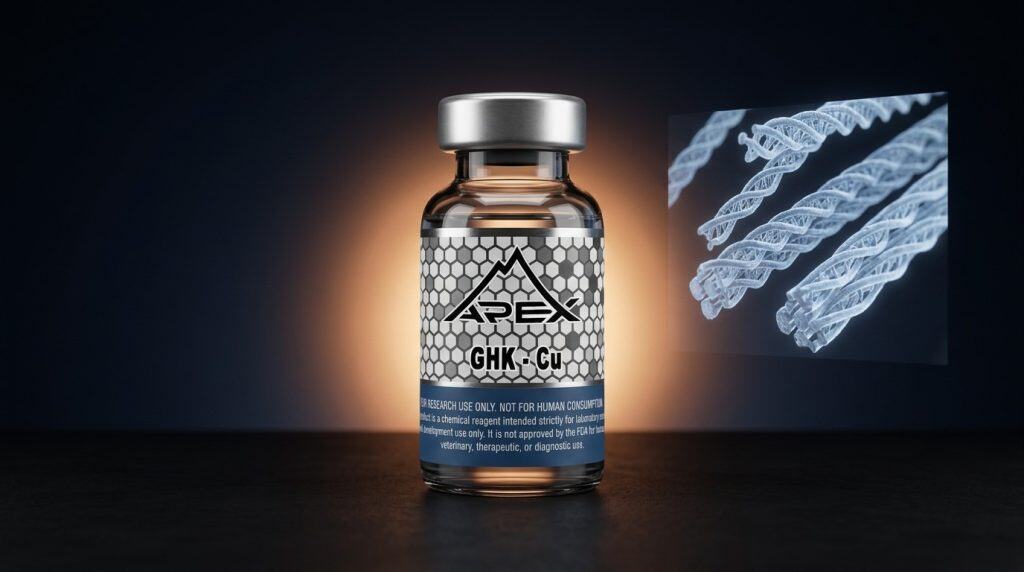
GHK-Cu is a naturally occurring copper-binding tripeptide — glycyl-L-histidyl-L-lysine (Gly-His-Lys) coordinated to a single copper(II) ion — first isolated from human plasma by Loren Pickart and Melvin Thaler in 1973. In dermatological, wound, and connective-tissue research models, the GHK-Cu complex is studied for copper-dependent effects on fibroblast collagen synthesis, glycosaminoglycan production, matrix metalloproteinase regulation, antioxidant signaling, and age-associated gene-expression patterns.
GHK-Cu is one of the most extensively published peptides in the tissue-remodeling research literature. First isolated from human plasma by Loren Pickart in 1973, this small copper-binding tripeptide carries a coordination chemistry that lets it act, in published research models, as a signaling molecule for tissue repair, a regulator of extracellular-matrix composition, a modulator of inflammatory pathways, and an antioxidant — a multi-modal profile that has drawn research interest across dermatology, wound healing, cosmetic science, and regenerative biology.[1][2]
This guide covers GHK-Cu‘s molecular identity and copper-coordination chemistry, the copper-dependent mechanisms behind its biological activities, the published research across skin, wound, and tissue-remodeling models, and how it compares to other tissue-active peptides in the Apex Laboratory catalog. It situates GHK-Cu within the broader tissue-repair research cluster of the Apex Research Library. Every factual claim is referenced to the primary literature, and the compound is supplied strictly as a research-grade chemical reagent for in-vitro and preclinical investigation — not as a drug, cosmetic, dietary product, or therapy for human or veterinary use.
GHK-Cu at a Glance
- GHK-Cu is the copper(II) complex of the tripeptide glycyl-L-histidyl-L-lysine (Gly-His-Lys), bound in a 1:1 stoichiometry; the free peptide carries CAS 49557-75-7 and the copper complex CAS 89030-95-5.
- The copper complex has a molecular weight of approximately 403.93 g/mol (free GHK, 340.38 g/mol) and is catalogued as PubChem CID 71587328 (complex) and CID 73587 (free peptide).
- It was first isolated from human plasma in 1973 by Pickart and Thaler; circulating GHK levels decline with age, an observation that motivated much of the research on exogenous GHK-Cu.
- In fibroblast and wound-research models it stimulates collagen and glycosaminoglycan synthesis and modulates matrix-metalloproteinase expression — a copper-dependent extracellular-matrix remodeling profile.
- Gene-expression analyses reported by Pickart and colleagues describe GHK modulating the expression of more than 4,000 human genes, concentrated in tissue-repair, antioxidant, and anti-inflammatory pathways.
- GHK-Cu has no FDA-approved drug formulation; Apex supplies it strictly as a ≥99%-pure (HPLC + mass-spec verified) research-grade reagent for in-vitro and preclinical use only.
GHK-Cu (Copper Tripeptide-1)
What Is GHK-Cu? Molecular Identity and Copper Coordination
GHK-Cu — glycyl-L-histidyl-L-lysine:copper(II) — is a tripeptide of just three amino acids that occurs naturally in human blood plasma, saliva, and urine. The peptide backbone (Gly-His-Lys) is the same short sequence in every preparation; what defines the copper complex is the chelated copper(II) ion it carries. That distinction matters for both chemistry and nomenclature, and it is the reason two different CAS numbers appear in the literature: the metal-free tripeptide is CAS 49557-75-7, while the copper complex supplied for tissue-research work is CAS 89030-95-5.[2]

GHK-Cu chemical structure. The Gly-His-Lys tripeptide forms a planar coordination complex with a single copper(II) ion. Structure image: PubChem CID 71587328, U.S. National Library of Medicine (public domain).
Copper Coordination Chemistry
GHK forms an unusually stable coordinate complex with copper(II). In the established coordination geometry, the copper ion is held by the imidazole nitrogen of the histidine side chain, the terminal α-amino group of the glycine residue, and the deprotonated amide nitrogen of the glycyl-histidyl peptide bond, with a carboxylate or water completing the coordination sphere. This is not incidental decoration: the copper coordination is the structural foundation of the molecule’s biological activity, and several of its reported functions — from acting as a cofactor donor for copper-dependent enzymes to its superoxide-dismutase-like redox behavior — depend on the bound metal rather than the peptide alone.[2][3]
A Plasma Peptide That Declines With Age
GHK is an endogenous human molecule, not a synthetic novelty. It is present in plasma and has also been detected in cerebrospinal fluid, and the published reviews describe a circulating concentration on the order of 200 ng/mL in young adults that falls to roughly 80 ng/mL by about age 60.[2][4] This age-related decline tracks the well-known reductions in tissue-repair capacity, collagen synthesis, and wound-healing efficiency seen with aging — a correlation that has framed much of the research interest in supplying exogenous GHK-Cu in experimental systems.[5]
GHK Versus GHK-Cu: The Role of the Copper Ion
Researchers encounter the molecule in two forms. The free tripeptide GHK (C14H24N6O4, MW 340.38 g/mol, CAS 49557-75-7) is the metal-free peptide; GHK-Cu (MW ≈403.93 g/mol, CAS 89030-95-5) is the pre-formed 1:1 copper complex. The widely cited 403.93 g/mol figure is the neutral 1:1 peptide–copper value (free GHK plus one copper atom); PubChem lists 402.92 g/mol for the deprotonated cationic form catalogued under CID 71587328, the small difference reflecting protonation state rather than a different molecule. Most of the classical tissue-remodeling activities — collagen and glycosaminoglycan stimulation, matrix-metalloproteinase modulation, redox activity — have been studied with the copper-bound form, where the metal is integral to function.[6] Notably, some skin-research effects, such as recovery of basal keratinocyte stem-cell markers, have also been reported using copper-free GHK, indicating that the peptide and its copper complex are not interchangeable in every assay and that the metal’s contribution is activity-specific.[4]
Discovery and Research History: From Liver Cells to the Genome
The arc of GHK research spans half a century and three distinct eras — an early biochemical-isolation phase, a connective-tissue and wound-remodeling program centered in France, and a modern genomic phase — each adding a layer to how the tripeptide is understood today.
1973: Isolation From Human Plasma
GHK entered the literature in 1973, when Pickart and Thaler reported a tripeptide in human serum that prolonged the survival of cultured normal liver cells and modulated the growth of neoplastic liver tissue.[1] The activity was initially described in growth-factor terms — the peptide was once referred to as a “liver cell growth factor” — before its affinity for copper(II) and its role in connective-tissue biology came into focus. That founding observation, that a small endogenous serum peptide could shift cellular behavior, set the agenda for everything that followed.
The Reims Tissue-Remodeling Program (1980s–1990s)
Through the late 1980s and 1990s, a group at the University of Reims — Maquart, Borel, Gillery, Wegrowski, Siméon, Hornebeck and colleagues, frequently in collaboration with Pickart — built the core experimental case for GHK-Cu as a connective-tissue remodeling agent. They reported that GHK-Cu stimulates collagen synthesis in fibroblast cultures,[6] drives sulfated glycosaminoglycan production,[7] stimulates connective-tissue accumulation in vivo in rat wound models,[8] and modulates the expression and activation of matrix metalloproteinases during wound repair.[9] A telling structural clue emerged from this work: the GHK sequence itself is embedded in the alpha-2(I) chain of type I collagen, suggesting the tripeptide may be liberated by proteases at a wound site and exert remodeling effects in situ.[6]
The Genomic Era (2010s)
The most recent phase reframed GHK as a broad transcriptional modulator. Analyzing public gene-expression datasets — including the Broad Institute Connectivity Map — Pickart and Margolina reported that GHK shifts the expression of a large set of human genes toward a more youthful, reparative pattern, and extended this analysis to genes relevant to nervous-system function and cognition.[5][10][11] This genomic lens did not replace the connective-tissue mechanism so much as enlarge it: the same molecule studied for collagen synthesis in the 1980s was now described as touching thousands of genes across repair, antioxidant, and immune pathways.
Mechanism of Action: Copper-Dependent Signaling
GHK-Cu does not act through a single classical receptor. Its reported activities instead cluster around copper-dependent effects on the extracellular matrix, on redox chemistry, and on gene expression. The summary below maps the best-documented mechanistic threads, each tied to its primary source.
Copper-dependent extracellular-matrix remodeling and redox signaling
In fibroblast and wound-research models, GHK-Cu stimulates synthesis of collagen and glycosaminoglycans while modulating the matrix-metalloproteinase / TIMP balance that governs matrix turnover — favoring constructive remodeling over destructive degradation. Its bound copper underpins redox activity (including superoxide-dismutase-like behavior and inhibition of iron-driven lipid peroxidation) and supplies the cofactor chemistry that downstream enzymes such as lysyl oxidase require to cross-link new matrix. In parallel, gene-expression analyses describe GHK shifting thousands of human genes toward repair-associated pathways. All effects summarized here derive from in-vitro and animal research.
Collagen and Extracellular-Matrix Synthesis
The best-documented activity of GHK-Cu is stimulation of collagen synthesis. In the foundational fibroblast-culture study, Maquart and colleagues reported that GHK-Cu stimulated collagen production with an onset between 10−12 and 10−11 M, a maximum near 10−9 M, and no dependence on a change in cell number — a genuine biosynthetic effect rather than a proliferation artifact.[6] Copper is mechanistically relevant here because lysyl oxidase, the enzyme that cross-links collagen and elastin into mature, mechanically stable fibers, is a copper-dependent amine oxidase; the metal carried by GHK-Cu is the same element that enzyme requires. The later reviews place this collagen stimulation alongside increased decorin and overall matrix accumulation as part of a coordinated remodeling program.[5]
Glycosaminoglycan and Proteoglycan Production
Beyond collagen, GHK-Cu influences the ground substance of connective tissue. Wegrowski and colleagues reported a dose-dependent increase in sulfated glycosaminoglycan synthesis by normal human fibroblasts exposed to GHK-Cu,[7] and Siméon and colleagues documented modulation of glycosaminoglycans and small proteoglycans — including decorin and dermatan sulfate — in wound models.[12] These molecules provide tissue hydration, organize collagen fibrillogenesis, and contribute mechanical resilience, so stimulating their synthesis complements the collagen effect rather than duplicating it.
Matrix Metalloproteinase (MMP) Regulation
Constructive remodeling requires not only building new matrix but clearing damaged matrix in a controlled way, and here GHK-Cu acts on the matrix metalloproteinases. Siméon and colleagues showed that GHK-Cu modulates the expression and activation of MMP-2 (gelatinase A) and MMP-9 (gelatinase B) across the successive phases of rat wound healing, altering their timing rather than simply switching them on or off,[9] and reported that GHK-Cu stimulates MMP-2 expression in fibroblast cultures.[13] The reviews frame this as a balanced remodeling signal — matrix turnover tuned toward repair and away from either runaway degradation or fibrotic scarring.[2]
Antioxidant Activity
The bound copper also gives GHK-Cu redox activity. Miller and colleagues examined GHK:Cu(II) in the context of iron-driven oxidative damage and reported effects on ferritin-dependent lipid peroxidation, linking the peptide’s wound-healing properties to control of iron-catalyzed free-radical chemistry in damaged tissue.[14] The reviews describe the copper center as capable of superoxide-dismutase-like activity — catalyzing the dismutation of superoxide radicals — and situate GHK-Cu’s antioxidant behavior alongside its effects on copper homeostasis in aging tissue.[3][5]
Anti-Inflammatory Cytokine Modulation
Several in-vivo rodent studies report anti-inflammatory effects. In a mouse model of lipopolysaccharide-induced acute lung injury, Park and colleagues reported that the GHK-Cu complex reduced injury and pro-inflammatory signaling,[15] and in bleomycin-induced pulmonary fibrosis, Ma and colleagues described protection mediated through anti-oxidative-stress and anti-inflammation pathways.[16] These models extend GHK-Cu’s anti-inflammatory profile beyond skin and wound tissue, although — like all the findings in this guide — they are animal and cell-culture results, not evidence of any effect in humans.
Gene-Expression Modulation
Perhaps the most striking modern finding is the breadth of GHK’s transcriptional footprint. Pickart and colleagues’ analysis of broad gene-expression data reported that GHK modulates the expression of more than 4,000 human genes — raising the activity of many reparative and antioxidant genes while lowering inflammatory and tissue-destructive ones — with the affected genes concentrated in tissue-repair, antioxidant-defense, immune-regulation, and nervous-system pathways.[5][10] That a three-amino-acid peptide should associate with so wide a transcriptional shift remains an active question, and the authors present it as a correlation drawn from expression-signature analysis rather than a fully resolved mechanism.
Published Research: Key Application Areas
The mechanisms above have been explored across several research domains. The deepest literature is dermatological, but wound, hair-follicle, and nervous-system models each contribute distinct findings.
Dermatological and Skin Research
Skin biology is GHK-Cu’s most extensively published application. Reviews catalogue increased fibroblast collagen and glycosaminoglycan synthesis, improved dermal matrix organization, and antioxidant protection as a coherent skin-regeneration program.[17] At the cellular level, Kang and colleagues reported that copper-GHK increases integrin expression and p63 positivity in keratinocytes — markers associated with the proliferative, regenerative compartment of the epidermis[18] — while a related study reported that copper-free GHK recovered basal keratinocyte stem-cell markers, underscoring that the peptide influences epidermal as well as dermal compartments.[4] This body of work is also the reason GHK-Cu became one of the most widely used active ingredients in cosmeceutical research and commercial “copper peptide” skincare formulations, a context distinct from controlled research-grade use.
Wound-Healing Research
GHK-Cu’s connective-tissue effects converge in wound models. Maquart and colleagues demonstrated that GHK-Cu stimulates connective-tissue accumulation in vivo in rat experimental wounds,[8] and the matrix-metalloproteinase work showed how it tunes matrix turnover through the phases of healing.[9] More recent bioengineering studies have built GHK into delivery systems: a copper-GHK peptide nanofiber hydrogel improved angiogenesis through vascular-endothelial-growth-factor (VEGF) activation and accelerated collagen remodeling in a mouse wound model, with the copper-complexed form outperforming the non-lipidated peptide.[19] These wound-healing mechanisms are complementary to — but distinct from — those of BPC-157 and TB-500; see the BPC-157 research guide and TB-500 research guide for those pathways.
Hair-Follicle Research
An adjacent strand of research examines GHK-Cu in hair-follicle biology. Pyo and colleagues reported effects of the tripeptide-copper complex on human hair growth in vitro, working with the dermal papilla cells that govern the follicular growth cycle.[20] The copper-dependent mechanism is plausibly relevant here because follicle cycling involves extensive matrix remodeling governed by the same MMP/glycosaminoglycan systems GHK-Cu modulates elsewhere — though the in-vitro nature of these findings means they describe follicle-cell behavior in culture, not a demonstrated effect on hair in any organism.
Neuroprotective and Nervous-System Research
The genomic analyses opened a nervous-system line of inquiry. Pickart and Margolina examined GHK’s association with genes relevant to nervous-system function and cognitive decline,[11] and the aging-focused review connected GHK-Cu’s antioxidant and copper-homeostasis activity to neuroinflammation and oxidative stress.[3] The reviews also note GHK’s reported support of nerve outgrowth in experimental systems.[5] These observations are preliminary and hypothesis-generating; they link GHK-Cu’s tissue-remodeling and antioxidant mechanisms to neural contexts without establishing any clinical relevance.
GHK-Cu vs Other Tissue-Active Research Peptides
GHK-Cu is frequently studied alongside other tissue-repair reagents that reach overlapping endpoints through entirely different mechanisms. For broader context see the tissue-repair research peptides hub and the focused BPC-157 vs GHK-Cu comparison.
GHK-Cu vs BPC-157 vs TB-500 vs KPV: Tissue-Active Research Peptides
| Attribute | GHK-Cu | BPC-157 | TB-500 | KPV |
|---|---|---|---|---|
| Size | Tripeptide + Cu(II) | 15-aa pentadecapeptide | 7-aa fragment (Tβ4 43–49) | Tripeptide (Lys-Pro-Val) |
| Primary reported mechanism | Copper-dependent ECM synthesis & MMP modulation | NO-system / VEGF & growth-factor signaling | Actin regulation & cell migration | NF-κB-directed anti-inflammatory signaling |
| Key research focus | Collagen, GAGs, antioxidant, gene expression | Cytoprotection, gut & tendon repair models | Cell recruitment to injury sites | Intestinal/epithelial inflammation models |
| Metal dependence | Yes — integral copper(II) | No | No | No |
| Regulatory status | Research-only; no approved drug | Research-only; no approved drug | Research-only; no approved drug | Research-only; no approved drug |
GHK-Cu vs BPC-157
BPC-157 is a 15-amino-acid gastric pentadecapeptide studied for cytoprotection through nitric-oxide-system modulation and VEGF / growth-factor signaling. GHK-Cu, by contrast, is a three-residue copper complex that acts through copper-dependent collagen stimulation and matrix-metalloproteinase regulation. The mechanisms are distinct and the tissue effects complementary, which is why some research protocols study them in parallel; the dedicated BPC-157 vs GHK-Cu comparison treats the contrast in depth.
GHK-Cu vs TB-500
TB-500, a synthetic fragment corresponding to the actin-binding region of thymosin beta-4, is studied for actin-cytoskeleton regulation and the promotion of cell migration toward injury sites. GHK-Cu operates on the extracellular environment those migrating cells arrive in — supplying matrix-synthesis and copper-dependent remodeling signals rather than driving cell movement. In a simplified division of labor, TB-500 research emphasizes recruiting cells to a site while GHK-Cu research emphasizes building and remodeling the matrix there; the TB-500 research guide details its actin mechanism.
GHK-Cu vs KPV
Like GHK-Cu, KPV (Lys-Pro-Val) is a tripeptide studied in tissue and inflammation models, which makes the pairing instructive. KPV is the C-terminal fragment of alpha-melanocyte-stimulating hormone and is characterized as a largely receptor-independent anti-inflammatory signal acting on the NF-κB pathway, with no metal requirement. GHK-Cu’s distinguishing feature is exactly the opposite: its bound copper is integral, and its primary research narrative is extracellular-matrix construction rather than cytokine suppression — two short peptides reaching adjacent anti-inflammatory and repair endpoints through entirely different chemistry.
Stability, Handling, and Reconstitution (Research Use)
The guidance below concerns laboratory handling of GHK-Cu as a research reagent. Nothing in this section is a human dosing, administration, or usage instruction; GHK-Cu is for in-vitro and preclinical research only.
Lyophilized Storage
Store lyophilized GHK-Cu at −20°C, protected from light and moisture. The copper complex is comparatively robust: the metal coordination locks the peptide into a stable conformation, and well-stored lyophilized material is expected to remain stable over extended periods. The characteristic blue-to-blue-violet color of the powder is normal and arises from d–d electronic transitions of the coordinated Cu2+ ion — a useful visual indicator that the copper is intact.[2] For general principles see the Apex peptide storage guide.
Reconstitution
GHK-Cu dissolves readily in bacteriostatic water, producing a solution with a faint blue tint that is normal for copper-peptide preparations. Researchers planning concentrations for in-vitro work can use the Apex reconstitution calculator and the step-by-step how to reconstitute peptides protocol. These tools support laboratory preparation and contain no human-use directions.
After Reconstitution
Hold reconstituted solution refrigerated at 2–8°C and minimize freeze-thaw cycling; for longer-term storage, aliquot and freeze at −20°C so that individual working volumes are thawed only once. The copper complex confers good solution stability relative to many small peptides, but, as with any reconstituted reagent, freshly prepared solutions give the most reproducible experimental results.
Identity and Purity Verification (COA, HPLC, MS)
Reproducible research depends on knowing exactly what is in the vial. Reversed-phase HPLC quantifies purity by separating the intended complex from synthesis byproducts and degradation species, while mass spectrometry confirms identity against the expected mass. Apex supplies GHK-Cu at ≥99% purity with per-lot documentation available through the lab-verified COA archive; background on interpreting that documentation is provided in the primers on how to read a certificate of analysis and HPLC testing for peptide purity. These specifications describe research-material quality and do not imply any therapeutic standard.
Sourcing Research-Grade GHK-Cu
For tissue-remodeling, dermatology, and wound-research applications, GHK-Cu should be sourced as documented research-grade material accompanied by analytical verification rather than label claims alone. Apex supplies GHK-Cu as a ≥99%-pure lyophilized copper complex, HPLC- and mass-spec-verified, for in-vitro and preclinical use only.
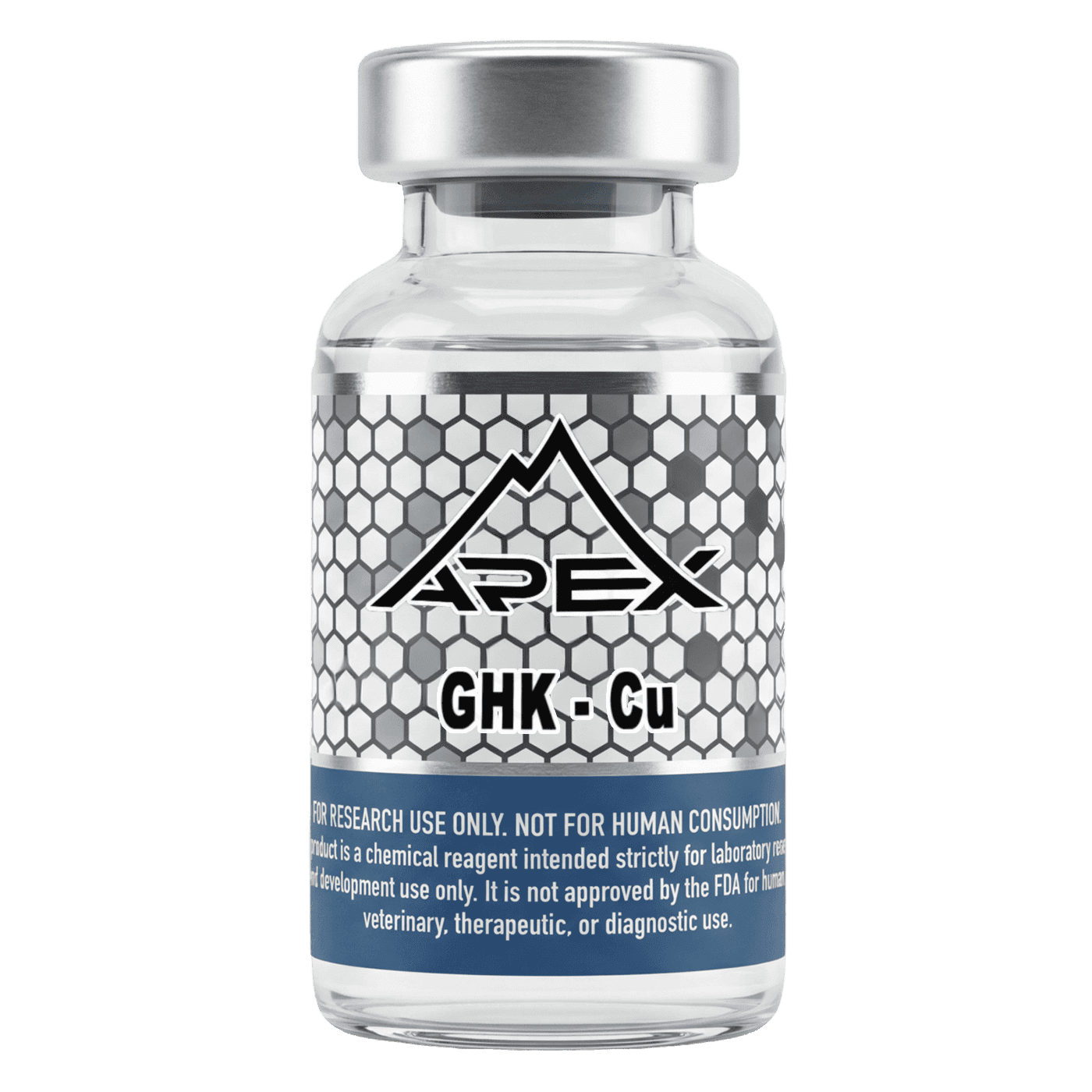
GHK-Cu (Copper Tripeptide-1)
Research-grade glycyl-L-histidyl-L-lysine:copper(II) — a blue-violet lyophilized powder verified to ≥99% purity by HPLC and mass spectrometry, with a per-lot certificate of analysis. Supplied strictly for in-vitro and preclinical research.
View GHK-Cu →Frequently Asked Questions
What is GHK-Cu?
GHK-Cu is the copper(II) complex of the naturally occurring tripeptide glycyl-L-histidyl-L-lysine (Gly-His-Lys). The copper complex has a molecular weight of about 403.93 g/mol and CAS number 89030-95-5, while the metal-free peptide is 340.38 g/mol and CAS 49557-75-7. First isolated from human plasma in 1973, it is studied in dermatology, wound, and connective-tissue research for copper-dependent effects on collagen synthesis and matrix remodeling. Apex Laboratory supplies GHK-Cu as a research-grade chemical reagent for in-vitro and preclinical research only.
What is the molecular structure of GHK-Cu?
GHK-Cu consists of the three-amino-acid sequence glycine-histidine-lysine (Gly-His-Lys) coordinating a single copper(II) ion. The copper is held in a roughly planar complex by the histidine imidazole nitrogen, the terminal amino group, and a deprotonated backbone amide nitrogen. The molecular formula of the complex is commonly written C14H24N6O4 with bound copper (PubChem CID 71587328); the free GHK peptide is C14H24N6O4 (CID 73587). This 1:1 copper coordination is the structural basis of the molecule's reported activity.
How does GHK-Cu work?
In research models GHK-Cu acts through copper-dependent effects rather than a single classical receptor. Published studies report that it stimulates fibroblast collagen synthesis, with maximal effect near nanomolar concentrations (Maquart 1988), increases sulfated glycosaminoglycan production (Wegrowski 1992), and modulates matrix-metalloproteinase expression during wound remodeling (Simeon 1999). Its bound copper supports antioxidant redox activity, and gene-expression analyses describe broad transcriptional effects (Pickart 2014). All of these are in-vitro and animal findings, not demonstrated effects in humans.
Why is GHK-Cu blue or purple in color?
The blue to blue-violet color is characteristic of copper(II) peptide complexes and results from d-d electronic transitions of the coordinated copper ion. The color is normal and expected, and it indicates that the copper is intact within the complex. A colorless GHK preparation would suggest the copper had been lost, which for most studied activities would change the molecule being tested, since many GHK-Cu effects depend on the bound metal.
What is the difference between GHK and GHK-Cu?
GHK is the metal-free tripeptide glycyl-L-histidyl-L-lysine (molecular weight 340.38 g/mol, CAS 49557-75-7). GHK-Cu is the pre-formed 1:1 complex of that peptide with copper(II) (molecular weight about 403.93 g/mol, CAS 89030-95-5). Most classical tissue-remodeling activities have been studied with the copper-bound form, in which the metal is integral to function, although some skin effects have also been reported with copper-free GHK (Choi 2012). The two forms are not interchangeable in every assay.
Is GHK-Cu the same as the "copper peptide" in skincare products?
GHK-Cu is the specific compound most often called "copper peptide" or "copper tripeptide-1" in cosmetic literature. However, commercial skincare formulations contain different concentrations, stabilizers, and delivery vehicles than research-grade material, and they are finished consumer products rather than characterized reagents. Research-grade GHK-Cu from Apex Laboratory is a greater-than-or-equal-to 99 percent pure lyophilized powder supplied for controlled in-vitro experimental use only, not for topical or personal application.
Does GHK-Cu need additional copper to work?
No. GHK-Cu is supplied as the pre-formed copper complex, with the copper(II) ion already coordinated to the GHK peptide in a 1:1 ratio. No additional copper supplementation is needed in experimental systems. The copper is an integral structural and functional component of the molecule rather than a separate additive, which is also why the powder carries its characteristic blue-violet color.
What genes or pathways does GHK-Cu affect?
Gene-expression analyses reported by Pickart and colleagues describe GHK modulating the expression of more than 4,000 human genes, generally raising reparative and antioxidant genes while lowering inflammatory and tissue-destructive ones (Pickart 2014; Pickart 2018). The affected genes are concentrated in tissue-repair, antioxidant-defense, immune-regulation, and nervous-system pathways. This is presented in the literature as a correlation drawn from expression-signature analysis rather than a fully resolved molecular mechanism, and it derives from cell and dataset analyses, not human studies.
How is GHK-Cu stored and reconstituted for research?
Lyophilized GHK-Cu is stored at minus 20 degrees Celsius, protected from light and moisture, where the copper coordination confers good stability. For laboratory use it dissolves readily in bacteriostatic water, giving a faintly blue solution; reconstituted material is held at 2 to 8 degrees Celsius with freeze-thaw cycling minimized, and longer-term aliquots are frozen at minus 20 degrees Celsius. These are laboratory-handling conventions only and are not a human dosing or administration instruction.
Is GHK-Cu approved for human or therapeutic use?
No. GHK-Cu is not approved by the FDA, EMA, or any other regulatory authority as a drug, and it has no approved therapeutic indication, although the molecule is used as an ingredient in cosmetic products under separate regulatory frameworks. The research-grade GHK-Cu supplied by Apex Laboratory is intended strictly for in-vitro and preclinical laboratory research and is not for human or veterinary consumption, diagnosis, treatment, or any clinical use.
How is research-grade GHK-Cu purity verified?
Research-grade GHK-Cu is characterized by reversed-phase HPLC, which separates the intended copper complex from synthesis byproducts and degradation species to quantify purity, and by mass spectrometry, which confirms identity against the expected mass. Apex supplies GHK-Cu at greater-than-or-equal-to 99 percent purity with a per-lot certificate of analysis available through its lab-verified archive. Confirming both purity and identity is what allows experiments using the reagent to be reproducible across batches and laboratories.
Continue Your Research
Related Tissue-Repair Research Guides
Tissue-Repair Research Peptides
The cluster hub situating GHK-Cu among connective-tissue and anti-inflammatory research reagents.
Open HubBPC-157 Research Guide
The gastric pentadecapeptide studied for cytoprotection and gut/tendon repair via NO and VEGF signaling.
Read GuideTB-500 Research Guide
The thymosin beta-4 fragment studied for actin regulation and cell migration to injury sites.
Read GuideKPV Research Guide
The alpha-MSH-derived tripeptide studied for NF-κB-directed anti-inflammatory signaling.
Read GuideReferences
All citations were verified against the published record via the NCBI E-utilities API for existence, correct attribution, and support of the associated claim. Each links to its PubMed record.
- Pickart L, Thaler MM Tripeptide in human serum which prolongs survival of normal liver cells and stimulates growth in neoplastic liver. Nat New Biol. 1973;243(124):85-7. PMID: 4349963
- Pickart L The human tri-peptide GHK and tissue remodeling. J Biomater Sci Polym Ed. 2008;19(8):969-88. PMID: 18644225
- Pickart L, Vasquez-Soltero JM, Margolina A The human tripeptide GHK-Cu in prevention of oxidative stress and degenerative conditions of aging: implications for cognitive health. Oxid Med Cell Longev. 2012;2012:324832. PMID: 22666519
- Choi HR, Kang YA, Ryoo SJ, Shin JW, Na JI, Huh CH, et al. Stem cell recovering effect of copper-free GHK in skin. J Pept Sci. 2012;18(11):685-90. PMID: 23019153
- Pickart L, Vasquez-Soltero JM, Margolina A GHK and DNA: resetting the human genome to health. Biomed Res Int. 2014;2014:151479. PMID: 25302294
- Maquart FX, Pickart L, Laurent M, Gillery P, Monboisse JC, Borel JP Stimulation of collagen synthesis in fibroblast cultures by the tripeptide-copper complex glycyl-L-histidyl-L-lysine-Cu2+. FEBS Lett. 1988;238(2):343-6. PMID: 3169264
- Wegrowski Y, Maquart FX, Borel JP Stimulation of sulfated glycosaminoglycan synthesis by the tripeptide-copper complex glycyl-L-histidyl-L-lysine-Cu2+. Life Sci. 1992;51(13):1049-56. PMID: 1522753
- Maquart FX, Bellon G, Chaqour B, Wegrowski J, Patt LM, Trachy RE, et al. In vivo stimulation of connective tissue accumulation by the tripeptide-copper complex glycyl-L-histidyl-L-lysine-Cu2+ in rat experimental wounds. J Clin Invest. 1993;92(5):2368-76. PMID: 8227353
- Siméon A, Monier F, Emonard H, Gillery P, Birembaut P, Hornebeck W, et al. Expression and activation of matrix metalloproteinases in wounds: modulation by the tripeptide-copper complex glycyl-L-histidyl-L-lysine-Cu2+. J Invest Dermatol. 1999;112(6):957-64. PMID: 10383745
- Pickart L, Margolina A Regenerative and Protective Actions of the GHK-Cu Peptide in the Light of the New Gene Data. Int J Mol Sci. 2018;19(7). PMID: 29986520
- Pickart L, Vasquez-Soltero JM, Margolina A The Effect of the Human Peptide GHK on Gene Expression Relevant to Nervous System Function and Cognitive Decline. Brain Sci. 2017;7(2). PMID: 28212278
- Siméon A, Wegrowski Y, Bontemps Y, Maquart FX Expression of glycosaminoglycans and small proteoglycans in wounds: modulation by the tripeptide-copper complex glycyl-L-histidyl-L-lysine-Cu(2+). J Invest Dermatol. 2000;115(6):962-8. PMID: 11121126
- Siméon A, Emonard H, Hornebeck W, Maquart FX The tripeptide-copper complex glycyl-L-histidyl-L-lysine-Cu2+ stimulates matrix metalloproteinase-2 expression by fibroblast cultures. Life Sci. 2000;67(18):2257-65. PMID: 11045606
- Miller DM, DeSilva D, Pickart L, Aust SD Effects of glycyl-histidyl-lysyl chelated Cu(II) on ferritin dependent lipid peroxidation. Adv Exp Med Biol. 1990;264:79-84. PMID: 2244543
- Park JR, Lee H, Kim SI, Yang SR The tri-peptide GHK-Cu complex ameliorates lipopolysaccharide-induced acute lung injury in mice. Oncotarget. 2016;7(36):58405-58417. PMID: 27517151
- Ma WH, Li M, Ma HF, Li W, Liu L, Yin Y, et al. Protective effects of GHK-Cu in bleomycin-induced pulmonary fibrosis via anti-oxidative stress and anti-inflammation pathways. Life Sci. 2020;241:117139. PMID: 31809714
- Pickart L, Vasquez-Soltero JM, Margolina A GHK Peptide as a Natural Modulator of Multiple Cellular Pathways in Skin Regeneration. Biomed Res Int. 2015;2015:648108. PMID: 26236730
- Kang YA, Choi HR, Na JI, Huh CH, Kim MJ, Youn SW, et al. Copper-GHK increases integrin expression and p63 positivity by keratinocytes. Arch Dermatol Res. 2009;301(4):301-6. PMID: 19319546
- Lee S, Lee SM, Lee SH, Choi WK, Park SJ, Kim DY, et al. In situ photo-crosslinkable hyaluronic acid-based hydrogel embedded with GHK peptide nanofibers for bioactive wound healing. Acta Biomater. 2023;172:159-174. PMID: 37832839
- Pyo HK, Yoo HG, Won CH, Lee SH, Kang YJ, Eun HC, et al. The effect of tripeptide-copper complex on human hair growth in vitro. Arch Pharm Res. 2007;30(7):834-9. PMID: 17703734
Research Use Disclaimer
All GHK-Cu products and the information in this guide are intended strictly for in-vitro and preclinical laboratory research. GHK-Cu is a research-grade chemical reagent and is not a drug, dietary supplement, cosmetic, or therapeutic product. It is not approved by the FDA, EMA, or any other regulatory authority for therapeutic use and has no approved drug indication. It is not for human or veterinary consumption, topical application, diagnosis, treatment, or any clinical use. The mechanistic, dermatological, wound-healing, and gene-expression findings summarized here derive from cell-culture and animal-model studies and are presented for research context only; they do not constitute therapeutic, efficacy, or safety claims. Researchers are responsible for compliance with all applicable institutional, local, and national regulations governing the acquisition, handling, and use of research chemicals.