
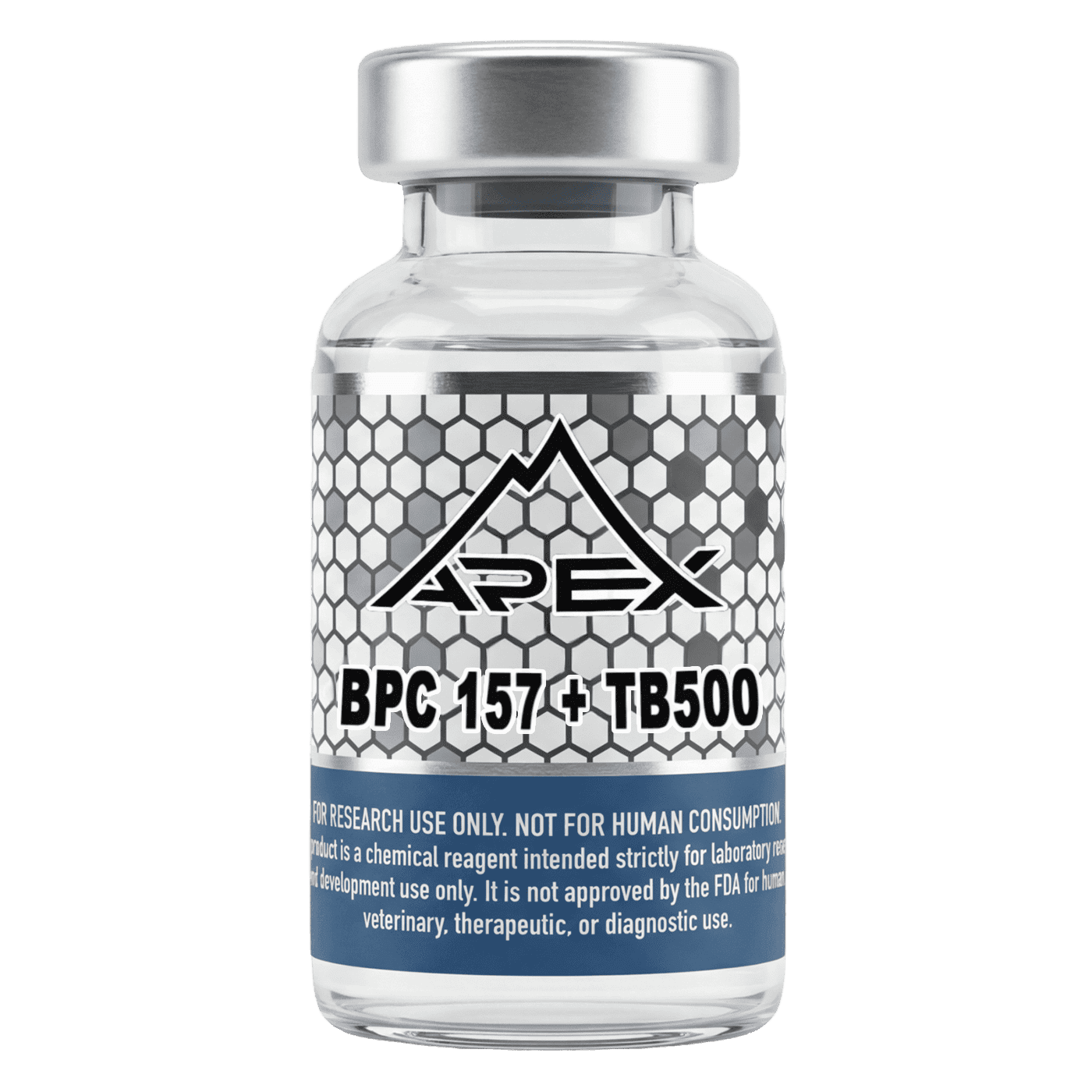
Certificate of Analysis — BPC-157 + TB-500 Blend 10mg
Two-component research blend · BPC-157 + TB-500
Verified by Apex Laboratory in-house HPLC (purity by 220 nm peak area) and ESI mass spectrometry (mass identity confirmation). Data on this page describes the current shipping lot.
- Purity (HPLC, area %): 99.66%
- Batch ID: APX-2026-0406-B
- Test date: April 6, 2026
- Analyst: K. Norwood
- Components: BPC-157 (5mg), 99.68% pure; TB-500 (5mg), 99.70% pure
View BPC-157 + TB-500 Blend 10mg on the Lab Verified COA archive · Read the BPC-157 + TB-500 Blend Research Guide
BPC-157 + TB-500 Blend — Paired Tissue-Research Reagent
This blend co-formulates the two peptides most often studied together in tissue-research literature — BPC-157 and TB-500 — at a matched 1:1 mass ratio in a single lyophilized vial. It is offered in two sizes: a 10 mg blend (5 mg + 5 mg) and a 20 mg blend (10 mg + 10 mg), both supplied for in-vitro and preclinical research use only. Pairing the two compounds in one vial removes the need to reconstitute two separate lots and match their concentrations by hand, and it consolidates verification into a single Certificate of Analysis — a practical format for laboratories that study the two compounds side by side.
Component Research Context
BPC-157 (Pentadecapeptide, MW 1419.53)
BPC-157 is a synthetic 15-amino-acid peptide whose sequence corresponds to a partial fragment of a human gastric protein. It is one of the most frequently referenced peptides in preclinical and in-vitro angiogenesis and cytoprotection research, and a common subject in laboratory assay development. In this blend it is supplied at equal mass to TB-500, the peptide it is most often co-studied with.
TB-500 (Thymosin β4 Fragment, MW 4963.50)
TB-500 is a synthetic peptide related to thymosin β4, an actin-binding protein. In the literature it is investigated in vitro for actin sequestration and cell-migration models. Its molecular weight is more than three times that of BPC-157, so the two peptides sit far apart on a chromatogram and are straightforward to resolve and quantify independently.
Why a 1:1 Pairing
BPC-157 and TB-500 appear together throughout the tissue-research literature, so a fixed equal-mass pairing is the configuration most method protocols call for. Holding the ratio at 1:1 keeps the relative concentrations identical across vials and across the two size options, so a researcher can scale from the 10 mg to the 20 mg blend without recalculating the ratio. Because the two peptides differ sharply in molecular weight, each is individually resolvable on HPLC, and the Certificate of Analysis reports purity for both separately.
Identity & Purity Verification
Each lot is analyzed by reverse-phase HPLC for purity and mass spectrometry for identity, with both components resolved as separate peaks. The interactive Certificate of Analysis above shows batch number, test date, per-component purity, and combined purity for the exact lot, cross-referenceable against the third-party records on the Lab Verified hub. It is identity and quality documentation only, with no use, dose, or efficacy representation.
Cost & Convenience vs. Buying Components Separately
| Approach | What you get | Price |
|---|---|---|
| BPC-157 5 mg + TB-500 5 mg (singles) | 2 vials | $88 |
| BPC-157 + TB-500 Blend 10 mg (5+5) | 1 vial | $42 |
| BPC-157 10 mg + TB-500 10 mg (singles) | 2 vials | $147 |
| BPC-157 + TB-500 Blend 20 mg (10+10) | 1 vial | $65 |
At the 5 mg-per-component size, the two singles total $88; the blend is $42 — roughly half. At the 10 mg-per-component size the singles total $147 versus $65 for the blend. Beyond price, the blend ships one lot with one Certificate of Analysis and a pre-matched ratio, which is the procedural reason most paired-study protocols prefer it.
Reconstitution, Storage & Handling
Store the lyophilized vial at -20 °C, protected from light and moisture. Reconstitute with bacteriostatic water and compute concentration with the reconstitution calculator, which includes this blend as a preset. See the reconstitution guide for technique and the storage guide for reconstituted shelf-life. Hold reconstituted solution at 2-8 °C for short-term research use. Handling is the responsibility of the qualified purchaser.
Selecting This Pairing for a Research Program
The BPC-157 + TB-500 blend suits protocols that study the two tissue-research peptides side by side and want them reconstituted from one vial at a known 1:1 ratio. The two size options let a program start at the 10 mg blend and scale to the 20 mg blend without changing the ratio. Researchers who need only one of the two compounds, or a non-equal ratio, are better served by the corresponding single-compound products; the blend is specifically for the common case where both are studied together at equal mass.
Documentation & Batch Records
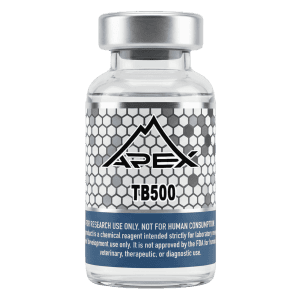
Each lot ships with a batch identifier printed on the vial that matches the batch shown on the Certificate of Analysis, so a research record can be traced to the exact tested material. The certificate records the test date and the analyst, the per-component retention times and purity, and the combined purity for the lot. Apex retains these records and publishes them on the Lab Verified hub so a reviewer, collaborator, or auditor can confirm a batch independently rather than taking a supplier figure on trust. For research groups operating under documented quality procedures, this per-lot traceability is often the deciding factor in selecting a co-formulated reagent: one certificate covers every component in the vial.
Frequently Asked Questions
What are the two size options?
A 10 mg blend (5 mg BPC-157 + 5 mg TB-500) and a 20 mg blend (10 mg + 10 mg). Both hold a 1:1 mass ratio, so the relative concentrations are identical between sizes.
Why are these two peptides blended together?
BPC-157 and TB-500 are studied together throughout tissue-research literature. A fixed 1:1 vial lets researchers reconstitute both at once instead of preparing and matching two separate lots.
Can I confirm both peptides are present and pure?
Yes. Their molecular weights are far apart, so each resolves as a distinct HPLC peak. The Certificate of Analysis reports per-component purity and a combined value for the lot.
How do I calculate concentration for the blend?
Use the reconstitution calculator, which includes this blend as a preset and returns the per-component concentration for your chosen bacteriostatic-water volume.
Is this blend for human use?
No. It is a research reagent for in-vitro and laboratory use only and is not for human or veterinary consumption.
For in-vitro research use only. Not for human or veterinary consumption. BPC-157 + TB-500 Blend is intended exclusively for qualified researchers, accredited laboratories, and educational institutions. Purchasers are responsible for safe handling, storage, and compliance with applicable federal, state, local, and institutional requirements governing chemical research reagents.

Reviews
There are no reviews yet.