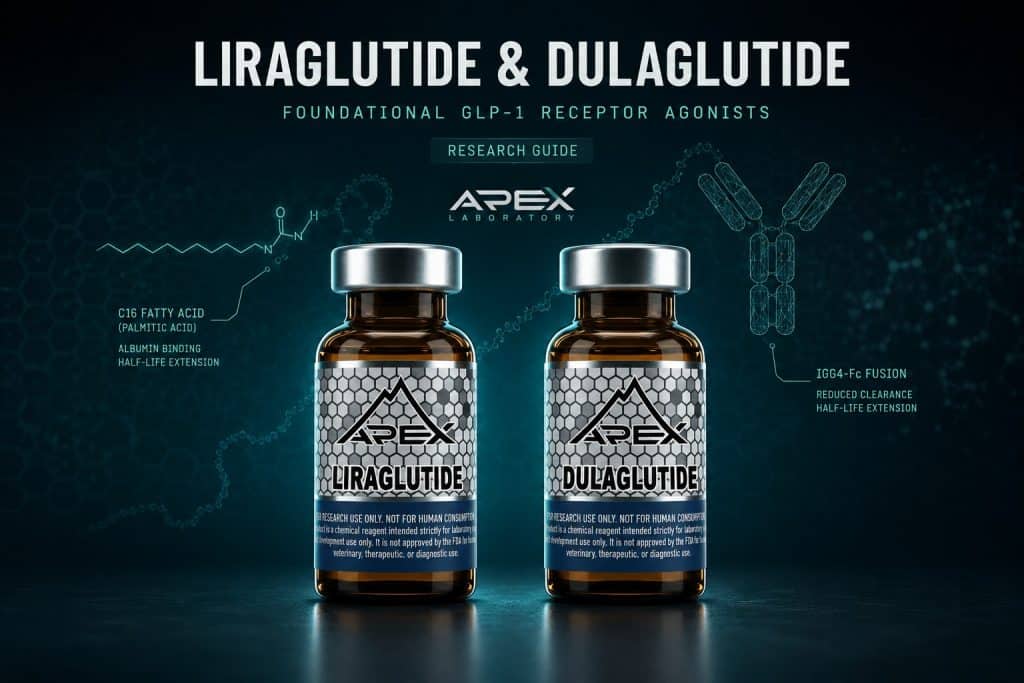
Liraglutide is a fatty-acid (C16) acylated glucagon-like peptide-1 (GLP-1) analog whose acyl chain enables reversible albumin binding for an extended half-life. Dulaglutide is a GLP-1 analog dimer fused to a modified human IgG4 Fc fragment, giving a roughly five-day half-life and once-weekly profile. Both act as agonists at the GLP-1 receptor. Apex Laboratory supplies liraglutide and dulaglutide as research-grade chemical reagents for in-vitro and preclinical research, distinct from the Victoza, Saxenda (liraglutide), and Trulicity (dulaglutide) pharmaceutical formulations.
Liraglutide and dulaglutide are best understood as a matched pair: two foundational glucagon-like peptide-1 (GLP-1) receptor agonists that confronted the same fundamental obstacle and solved it in two completely different ways. Native GLP-1 is one of the shortest-lived hormones in human physiology, cleared within minutes by dipeptidyl peptidase-4 (DPP-4) and renal filtration — a half-life far too brief for any sustained pharmacology. Liraglutide answered that problem by hanging a single C16 fatty-acid chain off the peptide so it could grab onto circulating serum albumin; dulaglutide answered it by fusing the GLP-1 peptide to an antibody fragment, building a molecule large enough to evade rapid clearance on its own.[1][2]
This guide profiles both compounds as research-grade chemical reagents: their shared GLP-1 receptor pharmacology, the contrasting acylation-versus-Fc-fusion chemistry that defines them, the landmark trial programs that dominate their literature, and how they precede and contrast with semaglutide and the next-generation multi-agonist class. Throughout, the framing is research-context only — both molecules are studied here as tools for GLP-1 and metabolic research, not characterized for any therapeutic use, and they are categorically distinct from the Victoza, Saxenda, and Trulicity pharmaceutical formulations that share the same molecules.
Liraglutide and Dulaglutide at a Glance
- Liraglutide and dulaglutide are both agonists at the glucagon-like peptide-1 receptor (GLP-1R), a Class B G-protein-coupled receptor, built on the GLP-1(7-37) peptide backbone.
- They illustrate two distinct half-life-extension strategies applied to the same backbone: liraglutide uses C16 fatty-acid acylation via a γ-glutamyl linker; dulaglutide uses IgG4 Fc-fusion.
- Liraglutide's acyl chain enables reversible serum-albumin binding for a reported half-life of roughly 13 hours, supporting a once-daily profile in the cited literature.
- Dulaglutide (developmental code LY2189265) is a much larger fusion protein with a terminal elimination half-life of about 5 days, supporting once-weekly administration.
- Landmark programs anchor the literature: LEADER for liraglutide and AWARD plus REWIND for dulaglutide, including the AWARD-6 head-to-head comparison of the two compounds.
- Apex supplies both as lyophilized research-grade reagents verified to ≥99% by HPLC and ESI-MS — categorically distinct from the FDA-approved Victoza, Saxenda, and Trulicity formulations.
Liraglutide and Dulaglutide
What Are Liraglutide and Dulaglutide?
Liraglutide and dulaglutide are both glucagon-like peptide-1 receptor (GLP-1R) agonists constructed on the GLP-1(7-37) peptide backbone — the active form of the incretin hormone GLP-1. Where they diverge is in the engineering applied to that shared backbone to make it pharmacologically long-lived.
Liraglutide: a fatty-acid-acylated GLP-1 analog
Liraglutide is a GLP-1(7-37) analog modified with a C16 (palmitoyl) fatty-acid chain attached through a γ-glutamyl spacer. Knudsen and Lau, working at Novo Nordisk, describe how this acylation was engineered so that the fatty-acid chain enables reversible binding to serum albumin, providing systemic protraction while the optimized fatty-acid and linker combination preserves GLP-1 receptor potency.[1] The molecule is catalogued under CAS number 204656-20-2 with the molecular formula C172H265N43O51 and a molecular weight of approximately 3751.20 g/mol; PubChem records the same composition under CID 16134956.
Dulaglutide: a GLP-1–Fc fusion protein
Dulaglutide takes a fundamentally different architectural route. Glaesner and colleagues at Eli Lilly engineered the molecule — identified during development as LY2189265 — as a GLP-1 analog covalently fused to a modified human IgG4 Fc fragment, producing a fusion protein with built-in resistance to DPP-4 and a substantially extended duration of activity in rodent and primate models.[2] As a fusion-protein biologic the molecule is far larger than liraglutide, with a catalog-stated molecular weight of roughly 59,670 g/mol and CAS number 923950-08-7. Because dulaglutide is a large fusion protein rather than a single small molecule, it has no single computed molecular formula; this is normal for an Fc-fusion biologic and is noted here so researchers do not expect a discrete formula on the Certificate of Analysis the way they would for liraglutide.
Foundational GLP-1 Receptor Pharmacology
Both compounds derive their activity from the same target: the glucagon-like peptide-1 receptor (GLP-1R). Understanding that receptor is the foundation for understanding either molecule, because the structural differences between liraglutide and dulaglutide change how long they persist in circulation, not which receptor they engage or how.
GLP-1 as an incretin and the GLP-1 receptor
GLP-1 is an incretin hormone — a gut-derived peptide released in response to nutrient intake that potentiates glucose-stimulated insulin secretion. Müller and colleagues, in a comprehensive review of GLP-1 biology, describe the GLP-1 receptor as a Class B G-protein-coupled receptor expressed across the pancreatic islets, gastrointestinal tract, heart, kidney, lung, and brain, with receptor activation driving glucose-dependent insulinotropic signaling, suppression of glucagon, slowed gastric emptying, and central effects on energy intake.[3]
GLP-1 receptor (Class B GPCR) → Gαs → adenylyl cyclase → cAMP → glucose-dependent insulin secretion + glucagon suppression + slowed gastric emptying
Both liraglutide and dulaglutide are agonists at the glucagon-like peptide-1 receptor (GLP-1R), a Class B G-protein-coupled receptor expressed across pancreatic islets, the gastrointestinal tract, heart, kidney, lung, and brain. Receptor occupancy couples through the stimulatory G protein Gαs to adenylyl cyclase, raising intracellular cyclic AMP and driving glucose-dependent insulinotropic signaling, glucagon suppression, slowed gastric emptying, and central effects on energy intake, as reviewed by Müller and colleagues.[3] The structural differences between the two compounds change how long each persists in circulation, not which receptor they engage or how.
Glucose-dependence and the broader tissue footprint
A defining pharmacologic feature highlighted in the GLP-1 literature is glucose-dependence: the insulinotropic signaling is amplified in the presence of elevated glucose, a property that shapes how the receptor is studied in metabolic models.[3] Sfairopoulos and colleagues, reviewing the clinical pharmacology of the GLP-1 receptor agonist class, situate liraglutide as a long-acting once-daily agonist and dulaglutide as a long-acting once-weekly agonist within that broader receptor framework.[4] The wide tissue distribution of GLP-1R is the reason these agonists are studied across so many research models — from islet biology to cardiovascular and renal endpoints — as catalogued across the GLP-1 and metabolic research cluster.
Two Half-Life-Extension Strategies: Acylation vs Fc-Fusion
The single most instructive reason to study liraglutide and dulaglutide together is that they are textbook illustrations of the two dominant strategies for extending peptide half-life. The same GLP-1 backbone, two different solutions to the clearance problem.
Strategy one: fatty-acid acylation and albumin binding (liraglutide)
Liraglutide's approach is to make the peptide piggyback on a protein the body already keeps in long circulation. By attaching a C16 fatty-acid chain via a γ-glutamyl linker, the molecule binds reversibly to serum albumin; because albumin itself has a long circulating life, the bound fraction of liraglutide is shielded from rapid degradation and renal clearance, while the small free fraction remains available to engage the receptor. Knudsen and Lau detail how the fatty-acid and linker chemistry was optimized to maximize albumin binding while maintaining GLP-1 receptor potency.[1] The reported circulating half-life of roughly 13 hours supports a once-daily profile in the cited literature; this figure is label- and catalog-derived and should be treated as approximate.
Strategy two: Fc-fusion and size-based protraction (dulaglutide)
Dulaglutide does not borrow a carrier protein — it becomes one. Fusing the GLP-1 analog to an IgG4 Fc fragment produces a molecule large enough to escape renal filtration and resistant to DPP-4 cleavage, with the Fc domain itself contributing the long persistence characteristic of antibody-derived molecules.[2] Geiser and colleagues, analyzing clinical pharmacokinetic data, reported a terminal elimination half-life of 5 days for dulaglutide, fitting a two-compartment model and supporting once-weekly dosing largely independent of patient covariates such as age, weight, sex, and race.[5]
Liraglutide vs Dulaglutide vs Semaglutide
| Property | Liraglutide | Dulaglutide | Semaglutide |
|---|---|---|---|
| Molecular format | GLP-1(7-37) analog, small peptide | GLP-1–IgG4 Fc-fusion protein | GLP-1(7-37) analog, small peptide |
| Half-life-extension strategy | C16 fatty-acid acylation → albumin binding | IgG4 Fc-fusion (size-based) | C18 diacid acylation → albumin binding (optimized) |
| Approx. molecular weight | ~3751 g/mol | ~59,670 g/mol | ~4114 g/mol |
| Reported half-life | ~13 h (catalog/label-derived) | ~5 days | ~7 days |
| Dosing cadence (in cited trials) | Once daily | Once weekly | Once weekly |
| Receptor / signaling | GLP-1R agonist (Gαs/cAMP) | GLP-1R agonist (Gαs/cAMP) | GLP-1R agonist (Gαs/cAMP) |
| Apex availability | Research-grade ≥99% lyophilized | Research-grade ≥99% lyophilized | Research-grade ≥99% lyophilized |
Why the contrast matters for research
For laboratory work, these two strategies represent different experimental handles on the same pharmacology. A study comparing protraction mechanisms, plasma stability, or receptor-residence behavior can use liraglutide and dulaglutide as defined reference points for acylation-based versus fusion-based half-life extension — a comparison that becomes even more informative when set against the further-optimized acylation chemistry of semaglutide.
Liraglutide: Structure, Acylation Chemistry, and Pharmacology
Liraglutide repays a closer structural reading because its design is deceptively minimal: a near-native GLP-1 backbone with one carefully engineered modification doing all the pharmacokinetic work.
The acylation that defines the molecule
The defining feature is the C16 (palmitoyl) fatty-acid chain attached to the peptide through a γ-glutamic-acid spacer. Knudsen and Lau describe this as the product of a deliberate design campaign at Novo Nordisk to find fatty-acid and linker combinations that maximize reversible albumin binding without sacrificing GLP-1 receptor potency — the balance that makes the protraction strategy viable.[1] The same lineage of albumin-binding design later carried forward into semaglutide, making liraglutide the structural ancestor of an entire design philosophy.
Preclinical pharmacology: gastric emptying and body weight
Jelsing and colleagues, in a rat-model study co-authored by Knudsen, dissected liraglutide's effects on gastric emptying versus body weight, reporting that its effect on gastric emptying is comparatively short-lived while its effect on body weight is long-lasting, and contrasting its pharmacokinetic profile with that of exenatide.[6] This kind of acute-versus-chronic dissection is exactly the sort of preclinical characterization that makes liraglutide a useful reference reagent: it allows researchers to separate the transient gastrointestinal pharmacology from the sustained metabolic pharmacology within a single well-characterized molecule. These are preclinical observations in animal models and are presented strictly as research findings.
Dulaglutide: GLP-1 Fc-Fusion Architecture and Pharmacokinetics
Dulaglutide's engineering story is the mirror image of liraglutide's: where liraglutide is a small peptide with a single acyl modification, dulaglutide is a large, multi-domain fusion protein in which the half-life extension is built into the molecular scaffold itself.
The LY2189265 fusion-protein design
Glaesner and colleagues at Eli Lilly engineered dulaglutide — then designated LY2189265 — by covalently fusing a GLP-1 analog to a modified human IgG4 Fc fragment. They reported that this architecture confers resistance to DPP-4 cleavage and substantially extends the molecule's half-life and duration of activity in rodent and primate models, while retaining full GLP-1 receptor activity.[2] The IgG4 framework was chosen in part for its relatively low effector-function profile among the IgG subclasses, and the GLP-1 portion was modified to resist enzymatic degradation — the combination producing a once-weekly pharmacokinetic profile.
Pharmacokinetics and early human pharmacology
The clinical pharmacokinetics bear out the design intent. Geiser and colleagues reported a 5-day terminal elimination half-life consistent with once-weekly administration and largely covariate-independent.[5] The earliest human pharmacology came from Barrington and colleagues, whose first-in-human study of LY2189265 reported a dose-dependent effect on glucose-dependent insulin secretion in healthy subjects, establishing that the fusion-protein format retained the expected insulinotropic activity of GLP-1.[7] Together these reports define dulaglutide's pharmacokinetic and pharmacodynamic signature: a long-lived fusion protein that engages the GLP-1 receptor with the characteristic glucose-dependent insulin response.
How These Older-Generation Agonists Precede and Contrast Semaglutide and Multi-Agonists
Liraglutide and dulaglutide are foundational compounds in the GLP-1 receptor agonist story, and their value as research reagents is amplified by their position in the lineage — they are the agonists that came before the current benchmark and the next-generation classes.
From liraglutide to semaglutide
The clearest lineage runs from liraglutide to semaglutide. Knudsen and Lau, who reviewed the discovery and development of both molecules, describe semaglutide as built on the same albumin-binding design principle pioneered with liraglutide, with the fatty-acid and linker chemistry further optimized to extend the half-life from a once-daily to a once-weekly profile.[1] In other words, liraglutide is not merely an earlier drug — it is the structural proof-of-concept that the entire acylation strategy was built on. Researchers tracing that evolution can move directly from this guide to the semaglutide research guide.
Contrast with the next-generation multi-agonist class
Where liraglutide, dulaglutide, and semaglutide are pure GLP-1 receptor agonists, the next-generation class engages multiple incretin receptors at once. Sfairopoulos and colleagues frame the GLP-1 receptor agonist class as a foundation against which newer entrants are compared.[4] The dual GIP/GLP-1 agonists and triple agonists explored in the next-generation GLP-1 research peptides overview, and the comparative framing in semaglutide vs tirzepatide and the retatrutide research guide, all build on the single-agonist pharmacology that liraglutide and dulaglutide established. Studying the foundational pair first is the logical entry point to that larger comparative landscape.
Landmark Trial Programs: LEADER (Liraglutide)
Liraglutide's clinical research base is anchored by the LEADER program, one of the cardiovascular-outcomes trials that defined how the GLP-1 receptor agonist class is studied. These trials are summarized strictly as research observations in their original study populations.
LEADER cardiovascular outcomes
Marso and colleagues reported the primary cardiovascular outcomes of the LEADER trial, a large randomized study evaluating liraglutide versus placebo on major adverse cardiovascular events in type 2 diabetes, published in the New England Journal of Medicine.[8] The trial is one of the most-cited references in the entire GLP-1 literature and established the framework for evaluating cardiovascular endpoints across the class.
LEADER renal analysis
Mann and colleagues subsequently reported the renal outcomes from the same LEADER population, examining liraglutide's association with renal endpoints in type 2 diabetes, again in the New England Journal of Medicine.[9] The pairing of cardiovascular and renal analyses from a single large trial program is part of what makes liraglutide such a thoroughly characterized reference compound. These are clinical-trial findings in defined patient populations and are referenced here for research context only; the compound Apex supplies is a research-grade reagent, not the pharmaceutical formulation used in those trials.
Landmark Trial Programs: AWARD and REWIND (Dulaglutide)
Dulaglutide's clinical research base spans two major programs — the AWARD program and the REWIND cardiovascular-outcomes trial — which together make it one of the most extensively studied molecules in this class.
The AWARD program
The AWARD program comprised a series of phase 3 trials evaluating dulaglutide across different comparators and patient populations. Its single most relevant study for this guide is AWARD-6, the head-to-head comparison with liraglutide discussed in detail in the next section.[10] The program's breadth is illustrated by analyses such as AWARD-CHN1: Li and colleagues reported a post hoc analysis of dulaglutide monotherapy compared with glimepiride in medication-naïve Chinese patients with type 2 diabetes, extending the program across distinct populations.[11]
The REWIND cardiovascular and renal outcomes
Gerstein and colleagues reported the primary cardiovascular outcomes of REWIND, a double-blind, randomized, placebo-controlled trial of dulaglutide in type 2 diabetes, in The Lancet.[12] A companion paper from the same group reported an exploratory analysis of renal outcomes from the REWIND trial.[13] As with the liraglutide trials, these are clinical-trial observations in their original study populations and are cited here only to characterize the research literature surrounding the molecule, not to make any therapeutic claim about the research-grade reagent.
Comparative Pharmacology: Liraglutide vs Dulaglutide Head-to-Head
The reason a combined guide is more than an editorial convenience is that the two compounds were actually compared directly in a single trial — a rarity in this class — which makes them a genuinely matched pair for comparative research.
AWARD-6: the direct comparison
Dungan and colleagues reported AWARD-6, an open-label, randomized phase 3 non-inferiority trial that directly compared once-weekly dulaglutide against once-daily liraglutide in metformin-treated patients with type 2 diabetes.[10] Reported in The Lancet, the trial found once-weekly dulaglutide non-inferior to once-daily liraglutide on its primary glycemic endpoint — a result that is informative precisely because it holds the receptor pharmacology constant while varying the half-life-extension strategy and dosing cadence. For comparative research, AWARD-6 is the anchor that justifies treating these two molecules as a single study system.
What the comparison does and does not show
The structural differences driving the comparison are clear: liraglutide's acylation-plus-albumin-binding versus dulaglutide's Fc-fusion, and a roughly 13-hour versus roughly 5-day half-life translating into once-daily versus once-weekly cadence. Sfairopoulos and colleagues place both within the same class-pharmacology framework, underscoring that the comparison is one of pharmacokinetics and molecular format rather than receptor mechanism.[4] Comparative statements here should be read as research observations about pharmacology and pharmacokinetics, not as equivalence or superiority claims; each compound's behavior is defined by its own cited literature.
Research Applications
As research-grade reagents, liraglutide and dulaglutide serve a set of well-defined experimental roles grounded in their established pharmacology. They are framed here as laboratory tools, not as products for any in-vivo human use.
GLP-1 receptor agonism and comparative protraction studies
The most direct application is as defined GLP-1 receptor agonists in in-vitro receptor and signaling assays, where their well-characterized potency makes them useful reference ligands. Because the two molecules embody distinct half-life-extension strategies, they are also natural reference points for comparative protraction and plasma-stability studies — the kind of acute-versus-chronic dissection Jelsing and colleagues demonstrated for liraglutide's gastric-emptying and body-weight pharmacology.[6]
Reference compounds in metabolic and structural research
Glaesner and colleagues' structural characterization of the Fc-fusion format makes dulaglutide a reference architecture for studying peptide-Fc fusion engineering more broadly, while Barrington and colleagues' first-in-human insulinotropic data anchor its pharmacodynamic profile.[2][7] For laboratory work, both compounds ship as lyophilized powder; reconstitution and handling follow standard peptide practice described in the Apex peptide reconstitution guide and peptide storage guide, with the caveat that the large Fc-fusion format of dulaglutide warrants particular care to avoid freeze-thaw-induced aggregation.
Research-Grade vs Pharmaceutical-Grade: Victoza/Saxenda and Trulicity
Liraglutide and dulaglutide are clear examples of molecules that exist simultaneously as FDA-approved pharmaceutical products and as research-grade chemical reagents. Same molecules; categorically distinct regulatory frameworks. Understanding that distinction is essential for accurate research-context framing.
Liraglutide: Victoza and Saxenda
The liraglutide molecule is the active ingredient in two FDA-approved Novo Nordisk pharmaceutical formulations. Victoza holds NDA 022341 and was approved on January 25, 2010, with Novo Nordisk Inc. as sponsor, for glycemic control in type 2 diabetes as a subcutaneous injection. Saxenda holds NDA 206321 and was approved on December 23, 2014, also from Novo Nordisk, for chronic weight management at a higher (3.0 mg) dose. Both are the same liraglutide molecule in different approved formulations and indications.
Dulaglutide: Trulicity
The dulaglutide molecule is the active ingredient in Trulicity, which holds BLA 125469 and was approved on September 18, 2014, with Eli Lilly and Company as sponsor, for glycemic control in type 2 diabetes as a once-weekly subcutaneous injection. Trulicity is a biologic license application (BLA) rather than a new drug application (NDA), which is the correct regulatory pathway because dulaglutide is an Fc-fusion biologic rather than a small molecule.
Why a research-grade reagent is not a pharmaceutical
A research-grade reagent shares the chemical identity of these approved products but is a lyophilized chemical supplied for in-vitro and preclinical research only. It is not a pharmaceutical, not for human consumption, and not therapeutically equivalent to Victoza, Saxenda, or Trulicity. This is the same regulatory logic Apex applies across same-molecule compounds, set out in the research-grade versus pharmaceutical-grade peptides reference. The existence of an approved drug product does not convert a research reagent into a therapeutic, and nothing in this guide should be read as promoting research-grade liraglutide or dulaglutide as equivalent to any approved formulation.
Safety, Tolerability, and Adverse-Event Observations (Research Context)
This section summarizes tolerability and adverse-event data reported in the published clinical-trial literature for liraglutide and dulaglutide, framed strictly as research findings in the original study populations. It does not describe expected effects of the research-grade reagent and is not health advice; the reagent Apex supplies is for in-vitro and preclinical research only.
Gastrointestinal adverse events across the GLP-1 receptor agonist class
In the published clinical pharmacology of the GLP-1 receptor agonist class, gastrointestinal adverse events — predominantly nausea, vomiting, and diarrhea — are the most frequently reported tolerability signal, a class characteristic that Sfairopoulos and colleagues describe as common, generally dose-related, and most pronounced early in administration before attenuating over time.[4] In the head-to-head AWARD-6 trial, Dungan and colleagues reported gastrointestinal events as the most common adverse events for both once-weekly dulaglutide and once-daily liraglutide, consistent with the shared GLP-1 receptor pharmacology described elsewhere in this guide.[10]
Safety signals documented in the landmark outcomes trials
The large cardiovascular-outcomes programs are the principal sources of long-term safety data in this literature. Marso and colleagues reported the liraglutide LEADER safety experience, in which the documented adverse-event profile in the trial population was dominated by gastrointestinal events.[8] Gerstein and colleagues reported the dulaglutide REWIND safety experience over a median follow-up of more than five years, again with gastrointestinal events the most commonly reported category.[12] Companion renal analyses from the same LEADER and REWIND populations reported renal endpoints as part of these programs' broader safety and outcomes characterization.[9][13]
These are clinical-trial observations in defined patient populations and are reported here only to characterize the research literature surrounding the two molecules. They are not safety claims about, nor expectations for, the research-grade chemical reagent, which is not a pharmaceutical and not for human or veterinary use. Researchers can place these findings within the broader class in the GLP-1 and metabolic research cluster.
Research-Dosing Context: Dose Ranges Studied in the Published Literature
The dose levels below are stated strictly as facts about what published studies administered to their human or animal subjects. They are presented to characterize the research literature, not as a recommended dose, a research protocol, or any guidance on how a reagent should be used. Apex supplies liraglutide and dulaglutide as research-grade reagents for in-vitro and preclinical research only, and these reagents are not for human or veterinary administration.
Doses administered in the liraglutide trials
In the LEADER cardiovascular-outcomes trial, Marso and colleagues administered subcutaneous liraglutide titrated to a maximum of 1.8 mg once daily in the trial population.[8] The same once-daily regimen, titrated to 1.8 mg, was the liraglutide comparator arm in the head-to-head AWARD-6 trial reported by Dungan and colleagues.[10] The once-daily cadence reflects liraglutide's roughly 13-hour reported half-life discussed earlier in this guide.
Doses administered in the dulaglutide trials
Dulaglutide was studied on a once-weekly subcutaneous schedule. In the REWIND trial, Gerstein and colleagues administered dulaglutide 1.5 mg once weekly.[12] The AWARD-6 head-to-head trial also used dulaglutide 1.5 mg once weekly as its dulaglutide arm,[10] and the AWARD-CHN1 analysis reported by Li and colleagues evaluated dulaglutide monotherapy in a distinct population.[11] The earliest first-in-human work by Barrington and colleagues administered ascending single doses of LY2189265 to characterize a dose-dependent insulinotropic response,[7] and the once-weekly schedule reflects the roughly five-day terminal half-life reported by Geiser and colleagues.[5] These study facts describe the cited trials only and carry no implication for use of the research-grade reagent.
Reconstitution and Handling Notes for Research Use
Both compounds ship as lyophilized powder for laboratory handling. The notes below summarize standard peptide and protein research practice for in-vitro and preclinical work and are not instructions for any in-vivo human or veterinary use.
General reconstitution practice
For laboratory reconstitution, liraglutide and dulaglutide follow the standard workflow described in the Apex peptide reconstitution guide: introduce the chosen research-grade diluent slowly down the vial wall rather than directly onto the lyophilized cake, allow the powder to dissolve without vigorous agitation, and avoid vortexing, which can shear or denature peptide and protein material. Stock concentration and diluent selection are determined by the requirements of the specific assay.
Handling the small peptide versus the large fusion protein
The two molecules differ enough in size to warrant different handling care. Liraglutide is a small acylated peptide of roughly 3,751 Da, whereas dulaglutide is a much larger IgG4 Fc-fusion protein of approximately 59,670 Da. As with other large fusion-protein biologics, the dulaglutide format is more susceptible to freeze-thaw-induced aggregation, so single-use aliquots and minimized freeze-thaw cycling are prudent. Storage of both lyophilized powder and reconstituted solution follows the cold-chain and light-protection practice set out in the Apex peptide storage guide. None of these handling notes implies any use beyond in-vitro and preclinical research; the reagents are not pharmaceuticals and are not for human consumption.
Sourcing Research-Grade Liraglutide and Dulaglutide
Apex Laboratory supplies liraglutide and dulaglutide as lyophilized, research-grade chemical reagents for in-vitro and preclinical research only. Each lot is verified to a target of ≥99% purity by reversed-phase high-performance liquid chromatography (HPLC), with identity confirmed by electrospray-ionization mass spectrometry (ESI-MS), and ships with a per-batch Certificate of Analysis available through the lab-verified COA archive. For liraglutide, ESI-MS confirms the expected mass of roughly 3751 Da and the presence of the C16 acyl modification; for the much larger dulaglutide fusion protein, analytical characterization follows the appropriate methods for a biologic of its size. Researchers can review the methodology behind these checks in the Apex references on HPLC purity testing and how to read a peptide COA.
The editorial and sourcing standards behind every product are documented in the Apex editorial standards, and adjacent GLP-1 reagents — including the benchmark semaglutide and the next-generation compounds in the research library — allow researchers to assemble a comparison panel across the class. None of these reagents is a pharmaceutical or intended for human consumption.
Foundational and Next-Generation GLP-1 Reagents
Liraglutide
Fatty-acid-acylated GLP-1 analog research reagent; supplied at ≥99% purity verified by HPLC and mass spectrometry.
View ProductDulaglutide
GLP-1–Fc fusion-protein research reagent; extended-half-life GLP-1 receptor agonist.
View ProductSemaglutide
Benchmark GLP-1 receptor agonist; the successor compound this guide contrasts against.
View ProductFrequently Asked Questions
What are liraglutide and dulaglutide?
Liraglutide and dulaglutide are glucagon-like peptide-1 receptor (GLP-1R) agonists built on the GLP-1(7-37) peptide backbone. Liraglutide is a fatty-acid (C16 palmitoyl) acylated GLP-1 analog, while dulaglutide is a GLP-1 analog dimer fused to a modified human IgG4 Fc fragment. In published research they are studied as agonists at the GLP-1 receptor, a class B G-protein-coupled receptor. Apex Laboratory supplies both only as research-grade chemical reagents for in-vitro and preclinical research.
What is the half-life of liraglutide compared with dulaglutide?
The two compounds illustrate distinct half-life-extension strategies on the same GLP-1 backbone. Liraglutide attaches a C16 fatty-acid chain via a γ-glutamyl linker, which the literature describes as enabling reversible serum-albumin binding and a circulating half-life reported at roughly 13 hours, supporting a once-daily cadence in the cited trials. Dulaglutide fuses GLP-1 analog chains to an IgG4 Fc fragment, a much larger architecture associated in clinical pharmacokinetic analyses with a terminal half-life of about 5 days and once-weekly administration.
How does liraglutide compare to dulaglutide and to semaglutide?
Published reviews position liraglutide and dulaglutide as earlier-generation GLP-1 receptor agonists that differ mainly in half-life-extension format rather than receptor mechanism. The AWARD-6 trial directly compared once-daily liraglutide with once-weekly dulaglutide. Discovery literature describes semaglutide as built on the same albumin-binding principle pioneered with liraglutide, with chemistry optimized for a longer half-life. This guide reports these distinctions as published, making no therapeutic or comparative-efficacy claims.
What side effects were documented in liraglutide and dulaglutide research?
In the published clinical-trial literature, gastrointestinal events such as nausea, vomiting, and diarrhea were the most frequently reported adverse events for both compounds and are described across the GLP-1 receptor agonist class as generally dose-related and most pronounced early. These signals were documented in the AWARD-6, LEADER, and REWIND trial populations. They are reported here strictly as research findings in those populations, not as expectations for the research-grade reagent, which is not a pharmaceutical and not for human use.
What doses of liraglutide and dulaglutide were used in the published trials?
Stated as study facts only: in the LEADER and AWARD-6 trials, liraglutide was administered subcutaneously and titrated to a maximum of 1.8 mg once daily. Dulaglutide was administered at 1.5 mg once weekly in the REWIND and AWARD-6 trials. The once-daily versus once-weekly cadences reflect the roughly 13-hour and 5-day reported half-lives. These figures describe what the cited studies administered and are not a recommended dose or any guidance for using the research-grade reagent.
How are research-grade liraglutide and dulaglutide reconstituted and handled?
For laboratory use, both ship as lyophilized powder and follow standard peptide and protein practice: add the chosen research-grade diluent slowly down the vial wall, let the powder dissolve without vortexing, and store per cold-chain and light-protection guidance. Because dulaglutide is a large IgG4 Fc-fusion protein of about 59,670 daltons, single-use aliquots and minimized freeze-thaw cycling help limit aggregation. These notes apply only to in-vitro and preclinical research handling, not to any in-vivo human use.
Are research-grade liraglutide and dulaglutide the same as Victoza, Saxenda, and Trulicity?
They share the same molecules but exist in categorically distinct regulatory frameworks. Liraglutide is the active molecule in the FDA-approved Victoza and Saxenda formulations (Novo Nordisk), and dulaglutide is the active molecule in FDA-approved Trulicity (Eli Lilly). Apex Laboratory supplies liraglutide and dulaglutide strictly as research-grade chemical reagents, lyophilized powder verified by HPLC and mass spectrometry, for in-vitro and preclinical research only. They are not pharmaceutical products and are not for human consumption.
Why combine liraglutide and dulaglutide in one guide?
Both are GLP-1 receptor agonists from the older generation of this class, and they are most informative when studied together because each represents a different half-life-extension strategy: fatty-acid acylation with albumin binding versus Fc-fusion. A combined guide lets researchers compare these two engineering approaches against a shared receptor pharmacology, including the direct head-to-head data reported in AWARD-6.
Continue Your Research
Researchers building broader context across the Apex Research Library may find the following references useful:
- GLP-1 / Metabolic Research Peptides — The cluster hub situating liraglutide and dulaglutide among GLP-1 and metabolic research reagents.
- Semaglutide Research Guide — The benchmark GLP-1 agonist that extended the liraglutide albumin-binding design.
- Next-Generation GLP-1 Research Peptides — The multi-agonist class that builds on the single-agonist pharmacology established here.
- Semaglutide vs Tirzepatide — Comparative framing of a pure GLP-1 agonist against a dual GIP/GLP-1 agonist.
- Retatrutide Research Guide — A triple-agonist research compound at the leading edge of the incretin class.
- Research-Grade vs Pharmaceutical-Grade Peptides — The same-molecule, distinct-framework logic behind these reagents and Victoza, Saxenda, and Trulicity.
- How to Read a Peptide COA — Interpreting HPLC purity and ESI-MS identity data on a Certificate of Analysis.
- Peptide Storage Guide — Handling lyophilized and reconstituted peptides, including large Fc-fusion proteins, to preserve integrity.
Research Use Disclaimer
This guide is provided for research and educational purposes only. Liraglutide and dulaglutide supplied by Apex Laboratory are research-grade chemical reagents intended exclusively for in-vitro and preclinical laboratory research. They are not drugs, not dietary supplements, and not for human or veterinary consumption, diagnosis, treatment, or any clinical use. Although these molecules share their chemical identity with the FDA-approved pharmaceutical formulations marketed as Victoza and Saxenda (liraglutide, Novo Nordisk) and Trulicity (dulaglutide, Eli Lilly), the research-grade reagents occupy a categorically distinct regulatory framework and are not therapeutically equivalent to, nor a substitute for, those approved formulations — see research-grade versus pharmaceutical-grade peptides. All clinical-trial findings referenced here are summarized as research observations in their original study populations and do not constitute therapeutic or efficacy claims. Researchers are responsible for compliance with all applicable laws, institutional policies, and safe-handling requirements.