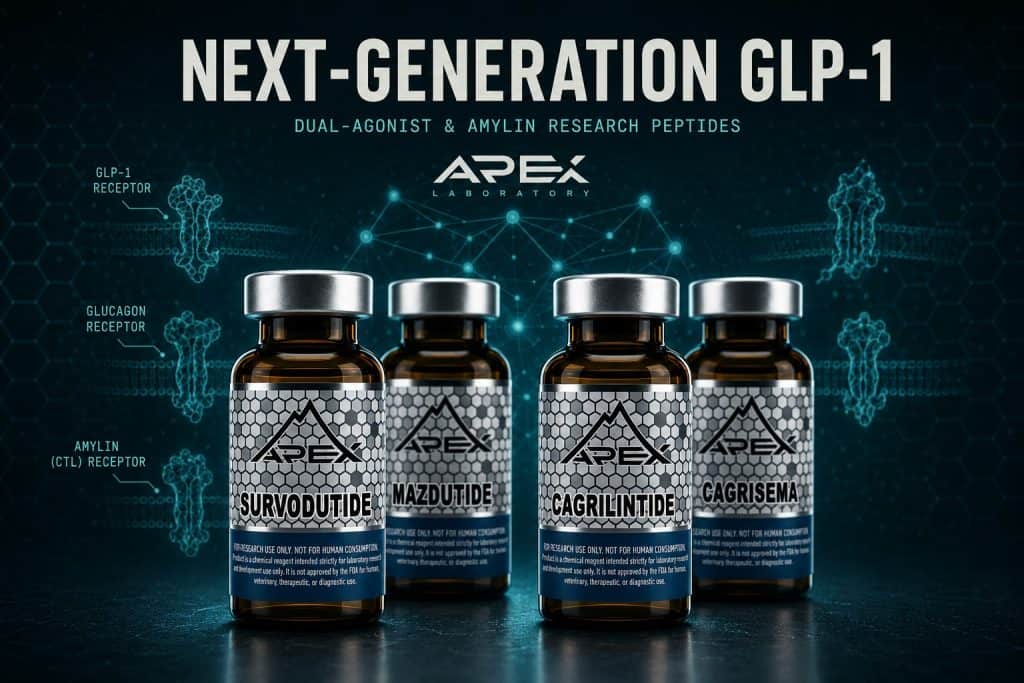
Next-generation GLP-1 peptides are research compounds that extend beyond single GLP-1 receptor activation. Dual glucagon/GLP-1 receptor agonists such as survodutide (BI 456906) and mazdutide (LY3305677) add glucagon receptor activity linked to energy expenditure and hepatic lipid handling, while the amylin receptor agonist cagrilintide (AM833) and the cagrilintide-plus-semaglutide co-formulation CagriSema engage parallel satiety pathways. These molecules are studied as research-grade reagents in the in-vitro and preclinical literature.
Few drug classes have moved as quickly — or sit in as fragmented a regulatory map — as the peptides that followed the first GLP-1 receptor agonists. A single molecule can be an approved medicine in one jurisdiction, an investigational candidate under review in another, and nothing more than a preclinical research reagent everywhere else. Mazdutide illustrates the point sharply: as of this writing it carries marketing approval from China’s National Medical Products Administration (NMPA) yet has no United States or European Union approval at all, while structurally related compounds such as survodutide and the cagrilintide-plus-semaglutide co-formulation CagriSema remain in late-stage development. For researchers, that patchwork matters, because regulatory status — not pharmacology — determines what a compound legally is in a given setting.[1]
This guide maps that landscape and the science underneath it. Next-generation GLP-1 peptides are best understood as a design philosophy rather than a single chemotype: instead of engaging one receptor, they recruit two or more metabolic receptors to broaden the signaling profile. The class extends the through-line that runs from mono GLP-1 agonism (semaglutide) to dual GIP/GLP-1 co-agonism (tirzepatide)[2] and on to triple GIP/GLP-1/glucagon agonism (retatrutide). Below, we cover the dual GLP-1/glucagon agonists survodutide and mazdutide, the amylin receptor agonist cagrilintide, and the CagriSema co-formulation, with research-grade-reagent framing throughout. For the broader cluster, see the GLP-1 and metabolic research peptides hub.
The Next-Generation GLP-1 Class at a Glance
- Next-generation GLP-1 peptides extend beyond mono GLP-1 (semaglutide) and GIP/GLP-1 (tirzepatide) by recruiting additional metabolic receptors — the glucagon receptor or the amylin receptor.
- Survodutide (BI 456906) and mazdutide (LY3305677 / IBI362) are dual glucagon/GLP-1 receptor agonists; mazdutide is built on an oxyntomodulin-analog backbone, while survodutide derives from a Boehringer Ingelheim / Zealand Pharma program.
- Cagrilintide (AM833) is a long-acting, lipidated, disulfide-bridged amylin receptor agonist; CagriSema is a fixed co-formulation pairing cagrilintide with semaglutide, not a single new molecule.
- Regulatory status is mixed and largely pre-approval: as of this writing none of the four is FDA-approved, and mazdutide holds China NMPA approvals granted in 2025.
- The published primary literature on these very-new analogs remains thin, so mechanistic claims anchor on the parent GLP-1, glucagon, amylin, and oxyntomodulin pathways rather than long-term human outcome data.
- Apex Laboratory supplies these compounds strictly as research-grade chemical reagents (≥99% HPLC + ESI-MS verified) for in-vitro and preclinical research, not for human consumption.
Next-Generation GLP-1 Research Reagents
What Are Next-Generation GLP-1 Research Peptides?
In the published literature, “next-generation GLP-1” is a loose umbrella for peptides that engage the GLP-1 receptor as one node within a multi-receptor strategy. The defining move is co-agonism: a single molecule (or, in the case of CagriSema, a fixed pairing of two molecules) is engineered to activate additional receptors whose downstream effects are thought to be complementary to GLP-1 signaling. The two complementary axes most relevant to this guide are the glucagon receptor (GCGR) and the amylin receptor.
Why researchers stack receptor targets
The rationale, articulated in mechanistic reviews of GLP-1/glucagon co-agonism, is that different receptors govern distinct but overlapping arms of energy balance. GLP-1 receptor activation is associated in the literature with enhanced glucose-dependent insulin secretion and reduced food intake; glucagon receptor activation has been linked to effects on energy expenditure and hepatic lipid handling; and amylin receptor activation is described as a satiety signal acting through pathways largely separate from the incretin system. Hope and colleagues frame the central engineering challenge as tuning the relative GLP-1-to-glucagon activity ratio so that the beneficial metabolic actions are recruited without the counter-regulatory glucose effects that unopposed glucagon would otherwise produce.[1] This is mechanistic context drawn from preclinical and clinical research, not a statement of comparative efficacy or therapeutic benefit.
Throughout this article, every compound is treated as a chemical reagent for in-vitro and preclinical study. None of the descriptions below should be read as a therapeutic recommendation. For the distinction that underpins all Apex content, see research-grade vs pharmaceutical-grade peptides.
From Semaglutide to Multi-Receptor Agonism: How the Class Extends
The clearest way to situate these compounds is along a spectrum of receptor breadth. At one end sits mono GLP-1 agonism, exemplified by semaglutide, which activates the GLP-1 receptor alone; the dedicated semaglutide research guide covers that pharmacology in depth. The next step on the spectrum is dual incretin agonism. Tirzepatide engages both the glucose-dependent insulinotropic polypeptide (GIP) receptor and the GLP-1 receptor; Nauck and colleagues characterize it as the first approved GIP/GLP-1 co-agonist and review the SURPASS clinical program that established that profile.[2] Further along still is triple agonism, where retatrutide adds glucagon receptor activity on top of GIP and GLP-1; the retatrutide research guide and the retatrutide vs tirzepatide comparison expand on that triple-receptor design.
Where dual GLP-1/glucagon and amylin co-agonism fit
The compounds in this guide occupy two distinct branches off that main spectrum. Survodutide and mazdutide are dual GLP-1/glucagon agonists — they keep the GLP-1 arm but swap the GIP partner for a glucagon partner, a different way of broadening beyond mono GLP-1 than the GIP-based route tirzepatide took. Cagrilintide takes an entirely separate route: rather than recruiting a second incretin or glucagon signal, it activates the amylin receptor, a satiety pathway outside the incretin family altogether. CagriSema then combines that amylin signal with GLP-1 agonism by co-formulating cagrilintide with semaglutide. The result is a class that is genuinely heterogeneous in mechanism even though it is grouped under a single “next-generation GLP-1” heading.
Next-Generation GLP-1 Peptides: Receptor Targets and Status
| Compound | Receptor Mechanism | Backbone / Research Program | Regulatory Status (as of writing) |
|---|---|---|---|
| Semaglutide | Mono GLP-1 receptor agonist | GLP-1 analog (Novo Nordisk) | FDA/EU-approved (reference baseline) |
| Tirzepatide | Dual GIP + GLP-1 co-agonist | Incretin co-agonist (Eli Lilly) | FDA/EU-approved (reference point) |
| Retatrutide | Triple GIP/GLP-1/glucagon agonist | Triple-agonist (Eli Lilly) | Investigational |
| Survodutide | Dual GLP-1 + glucagon agonist | BI 456906 (Boehringer Ingelheim / Zealand) | Investigational; FDA Breakthrough Therapy (MASH) |
| Mazdutide | Dual GLP-1 + glucagon agonist | LY3305677 / IBI362, oxyntomodulin analog (Innovent / Lilly) | China NMPA-approved (2025); no FDA/EU |
| Cagrilintide | Amylin receptor agonist | AM833, lipidated disulfide-bridged analog (Novo Nordisk) | Investigational |
| CagriSema | Amylin + GLP-1 (co-formulation) | Cagrilintide + semaglutide (Novo Nordisk) | Investigational; FDA NDA under review |
A note on evidence maturity: because these analogs are recent, the body of long-term, independent human literature is still thin relative to the established incretin agonists. Where primary outcome data are limited, the mechanistic discussion below anchors on the better-characterized parent pathways — GLP-1, glucagon, amylin, and oxyntomodulin — and on the specific trial publications that do exist.
Survodutide (BI 456906): Dual GLP-1/Glucagon Receptor Agonism
Survodutide, also designated BI 456906, is a dual glucagon (GCGR) and GLP-1 receptor agonist developed by Boehringer Ingelheim under license from Zealand Pharma. Its design intent is to combine GLP-1-driven insulinotropic and appetite effects with glucagon-receptor engagement, the latter associated in the co-agonism literature with energy expenditure and hepatic lipid metabolism.[1] In a randomized, placebo-controlled, dose-finding phase 2 study in obesity, le Roux and colleagues reported dose-dependent body-weight reductions consistent with the dual-agonist mechanism.[3]
Dual GCGR + GLP-1R co-agonism on class B GPCRs
Dual glucagon/GLP-1 agonists such as survodutide and mazdutide simultaneously engage two class B (secretin-family) G-protein-coupled receptors. GLP-1 receptor activation couples to Gαs, raising intracellular cAMP and potentiating glucose-dependent insulin secretion while reducing food intake; glucagon receptor (GCGR) activation, also Gαs/cAMP-coupled, is associated in the literature with increased energy expenditure and hepatic lipid mobilization. The engineering challenge, reviewed by Hope et al. (2021), is balancing the GLP-1-to-glucagon activity ratio so the GLP-1 arm offsets glucagon’s counter-regulatory glucose effect. Described as a research-context mechanism only.
The glucagon contribution
The glucagon arm is the feature that distinguishes survodutide from a GIP/GLP-1 co-agonist. Because unopposed glucagon receptor activation can raise blood glucose, the engineering objective is a balanced ratio in which the GLP-1 component offsets that effect while the glucagon component contributes to energy expenditure and hepatic lipid mobilization. Blüher and colleagues studied survodutide across a dose range in people with type 2 diabetes, with an open-label semaglutide arm as an active comparator, reporting dose-responsive effects on HbA1c and body weight; this head-to-head design is part of why survodutide is discussed within a “beyond semaglutide” framing in the literature.[4] These are trial observations summarized for research context, not efficacy endorsements. For a direct comparison with the other dual agonist in this class, see survodutide vs mazdutide.
Survodutide Research and Trial Status (Obesity and MASH)
Survodutide has been investigated across two main research programs: obesity and metabolic dysfunction-associated steatohepatitis (MASH). On the obesity side, Wharton and colleagues published the rationale and design for the two phase 3 SYNCHRONIZE trials, establishing the registrational obesity program.[5] On the liver side, Sanyal and colleagues reported a 48-week phase 2 trial in biopsy-confirmed MASH with fibrosis, in which the dual GCGR/GLP-1 rationale — specifically the glucagon arm’s relevance to hepatic lipid — was central to the study’s premise.[6]
Regulatory designations, not approval
In the United States, survodutide has received FDA Fast Track and, in 2024, Breakthrough Therapy designation for non-cirrhotic MASH with moderate-to-advanced fibrosis. It is important to be precise about what those designations mean: they are mechanisms to expedite development and review of an investigational candidate, not marketing approvals. As of this writing, survodutide is not approved by the FDA or the EMA for any indication. All survodutide material referenced by Apex is a research-grade reagent supplied for in-vitro and preclinical use only.
Mazdutide (LY3305677 / IBI362): Oxyntomodulin-Analog Dual Agonist
Mazdutide, designated LY3305677 and IBI362, is a dual glucagon/GLP-1 receptor agonist built on an oxyntomodulin (OXM) analog backbone. Oxyntomodulin is a naturally occurring gut peptide that itself activates both the GLP-1 and glucagon receptors, which makes it a logical structural template for a balanced dual agonist. Mazdutide is developed by Innovent Biologics for the Chinese market under license from Eli Lilly, which holds the ex-China rights.
Early-phase pharmacology
The dual-agonist pharmacology of mazdutide was characterized in early clinical work under its IBI362 / LY3305677 designation. Jiang and colleagues reported a phase 1b randomized controlled trial of the GLP-1/glucagon dual agonist in Chinese patients with type 2 diabetes, establishing the pharmacokinetic and pharmacodynamic profile.[7] Ji and colleagues then examined higher 9 mg and 10 mg doses in a placebo-controlled, multiple-ascending-dose phase 1b trial in Chinese adults with overweight or obesity, supporting the higher-dose safety and activity range.[8] A subsequent phase 2 randomized controlled trial extended the weight-management data in a Chinese obesity population.[9] The named-program attribution — Innovent Biologics and Eli Lilly — and the IBI362 / LY3305677 identity linkage are consistent across these publications.
Mazdutide Trial Status and China NMPA Regulatory Context
Mazdutide is the one compound in this guide that has crossed from investigation into marketing approval — but only in a single jurisdiction. The pivotal evidence on the obesity side comes from the GLORY-1 phase 3 trial: Ji and colleagues reported once-weekly mazdutide in Chinese adults with obesity or overweight, the dataset that underpins its weight-management approval.[10]
NMPA approvals in 2025
China’s National Medical Products Administration (NMPA) approved mazdutide on June 27, 2025, for chronic weight management in adults with overweight or obesity — reported by its developer as the world’s first dual glucagon/GLP-1 receptor agonist approved for weight loss. A separate NMPA approval for glycemic control in adults with type 2 diabetes was announced on September 19, 2025. These are China-specific marketing authorizations; mazdutide has no FDA or EMA approval, and Eli Lilly’s ex-China rights had not, as of this writing, translated into a United States filing. The contrast is the heart of this guide’s regulatory theme: the same molecule can be an approved medicine under one regulator and an unapproved investigational or research material under another. Within the Apex catalog, mazdutide is supplied solely as an NMPA-context research reagent for in-vitro and preclinical study, not as a pharmaceutical product for any market.
Cagrilintide (AM833): Long-Acting Amylin Receptor Agonism
Cagrilintide, designated AM833, represents the second mechanistic branch of this guide: amylin receptor agonism. Amylin is a pancreatic beta-cell hormone co-secreted with insulin that the neuroendocrine literature describes as a satiety signal acting through amylin and calcitonin receptors. Lutz, a long-standing authority on amylin physiology, traces the development of the amylin satiety story and the pharmacology that motivated amylin receptor agonists.[11] Eržen and colleagues review amylin as a neuroendocrine hormone and articulate the rationale for amylin receptor agonists complementing GLP-1-based approaches.[12]
A structurally distinctive peptide
Cagrilintide is a long-acting amylin analog engineered for an extended duration of action. Structurally it is a lipidated peptide carrying a fatty-acid (C20 diacid) modification, with an intramolecular disulfide bridge that cyclizes part of the backbone — design features shared with other long-acting analog chemistries and directly relevant to why identity verification matters for this molecule. Cagrilintide was developed by Novo Nordisk and has been studied both as a monotherapy candidate and, more prominently, in combination with the GLP-1 receptor agonist semaglutide. That combination work is the origin of CagriSema, discussed next.
CagriSema: Amylin Plus GLP-1 Co-Formulation
CagriSema is a fixed co-formulation pairing cagrilintide (an amylin receptor agonist) with semaglutide (a GLP-1 receptor agonist), both developed by Novo Nordisk. A crucial point for accurate characterization: CagriSema is not a single new molecule. It is two distinct peptides delivered together, and in a research context it corresponds to two separate research-grade reagents rather than one compound with a single CAS number or molecular formula.
Why pairing amylin with GLP-1 is mechanistically complementary
The combination rationale rests on the idea that amylin and GLP-1 act through largely distinct appetite-regulatory pathways, so engaging both may recruit parallel satiety signals. The foundational pharmacology came from Enebo and colleagues, who reported a phase 1b trial of concomitant cagrilintide and semaglutide 2.4 mg, establishing the combination’s pharmacokinetics and tolerability and the amylin-plus-GLP-1 complementarity premise.[13] Frias and colleagues subsequently examined co-administered once-weekly cagrilintide 2.4 mg with semaglutide 2.4 mg in a phase 2 trial in type 2 diabetes.[14]
REDEFINE phase 3 program and FDA status
The phase 3 evidence comes from the REDEFINE program. Garvey and colleagues reported REDEFINE 1, evaluating coadministered cagrilintide and semaglutide in adults with overweight or obesity (without a type 2 diabetes requirement).[15] Davies and colleagues reported REDEFINE 2 in adults with overweight or obesity and type 2 diabetes.[16] Novo Nordisk filed a United States FDA New Drug Application for CagriSema for chronic weight management in December 2025; as of this writing the application is under review and CagriSema is not approved. As with every compound here, Apex handles cagrilintide and semaglutide only as research-grade reagents for in-vitro and preclinical use.
How Amylin Co-Agonism Complements GLP-1 Receptor Agonism
It is worth drawing out, mechanistically, why the amylin branch is treated as complementary to — rather than redundant with — GLP-1 agonism. The incretin system (GLP-1, GIP) and the amylin system converge on appetite and energy balance, but they do so through different receptors and, to a substantial degree, different neuronal circuits. Amylin signaling is described in the literature as engaging the area postrema and associated hindbrain satiety pathways via amylin and calcitonin receptors, whereas GLP-1 receptors are distributed across both peripheral tissues and central appetite centers.[11]
Additive versus synergistic signals
Because the two systems are partly non-overlapping, research reviews frame combining an amylin receptor agonist with a GLP-1 receptor agonist as a way to recruit parallel satiety mechanisms rather than simply intensifying one.[12] Whether the combined signal is strictly additive or genuinely synergistic is a question the primary literature is still resolving, and the early combination pharmacology from Enebo and colleagues was designed precisely to interrogate that interaction.[13] For Apex’s purposes this is a mechanistic hypothesis under active investigation in preclinical and clinical research, not a claim of clinical benefit. The same logic of separate-receptor recruitment also underlies the dual GLP-1/glucagon strategy discussed earlier, where the glucagon arm rather than the amylin arm provides the second signal.[1]
Reading the Regulatory Landscape (Pre-Approval, Mixed Global Status)
If there is one organizing principle for this class, it is that pharmacology and regulatory status have come apart. Two compounds can share nearly identical mechanisms and yet hold completely different legal standing depending on the jurisdiction and the stage of development. Reading that landscape accurately is essential before any of these reagents is described in research documentation.
None FDA-approved as of writing
As of May 2026, none of the four compounds in this guide — survodutide, mazdutide, cagrilintide, or CagriSema — is approved by the United States FDA or by the European Medicines Agency. Survodutide carries FDA Fast Track and Breakthrough Therapy designations for MASH, but designations expedite review; they are not approvals. CagriSema is under FDA review following a December 2025 NDA filing, which again is a pending application rather than an authorization.
Mazdutide NMPA China; survodutide and CagriSema in US development
The single exception to the pre-approval picture is mazdutide, which holds China NMPA marketing approval for chronic weight management (granted June 27, 2025) and for glycemic control in type 2 diabetes (announced September 19, 2025). Crucially, an approval in China does not confer any status elsewhere, and it does not make a research-grade reagent a pharmaceutical product. The principle this class makes vivid — the same molecule occupying categorically distinct regulatory frameworks across jurisdictions and supply contexts — is exactly the principle laid out in research-grade vs pharmaceutical-grade peptides. Apex supplies all of these compounds strictly as research-grade chemical reagents for in-vitro and preclinical research, never as a US, EU, or any-market pharmaceutical formulation, and never for human consumption.
Research-Grade Quality: COA, HPLC and ESI-MS Verification
The structural complexity of next-generation incretin and amylin peptides makes identity and purity verification more consequential, not less. These are not simple short peptides: they carry fatty-acid lipidation (cagrilintide), intramolecular disulfide bridges (cagrilintide), oxyntomodulin-derived backbones (mazdutide), and long sequences that can harbor deletion, truncation, or oxidation impurities. For reproducible in-vitro work, a research lab needs documented confirmation that the reagent in the vial matches the intended molecule.
What a compliant COA documents
Every Apex research-grade reagent ships with a per-batch Certificate of Analysis (COA). Purity is determined by reversed-phase high-performance liquid chromatography (HPLC) to a stated threshold of ≥99%, and molecular identity is confirmed by electrospray-ionization mass spectrometry (ESI-MS) against the expected mass. For a co-formulation context such as CagriSema, each component reagent (cagrilintide and semaglutide) is verified on its own COA rather than as a single mixed entity. Researchers can review the methodology behind these documents through the lab-verified COA archive, the guide to reading a peptide COA, and the explanation of HPLC testing for peptide purity. Apex’s editorial standards describe how the research claims in this guide are sourced and reviewed. None of this purity verification implies any therapeutic property; it documents reagent integrity for experimental reproducibility only.
Safety, Tolerability & Adverse-Event Observations (Research Context)
Across the published clinical research on next-generation incretin and amylin agonists, the dominant tolerability signal is gastrointestinal — the same on-target profile reported for the established GLP-1 and GIP/GLP-1 agonists. The findings below are summarized strictly as documented trial observations in the cited study populations; they are not patient guidance, not a description of what any individual should expect, and not a safety claim for any research-grade reagent.
Survodutide: gastrointestinal-predominant adverse events in dose-finding research
In the randomized, placebo-controlled phase 2 dose-finding obesity trial reported by le Roux and colleagues, adverse events occurred in 91% of survodutide recipients versus 75% of placebo recipients, and these were primarily gastrointestinal — documented in roughly three-quarters of survodutide recipients compared with about 42% on placebo — with all tested doses described by the investigators as tolerated.[17] The 48-week phase 2 trial of survodutide in biopsy-confirmed MASH with fibrosis reported by Sanyal and colleagues likewise documented gastrointestinal adverse events as the most common class, consistent with the GLP-1/glucagon mechanism.[18]
Mazdutide and CagriSema: the same on-target tolerability pattern
In the placebo-controlled multiple-ascending-dose phase 1b mazdutide study reported by Ji and colleagues, no serious adverse events were recorded and all treatment-emergent adverse events were mild or moderate, with the most frequently reported events including diarrhoea, decreased appetite, nausea, abdominal distension, and vomiting — a gastrointestinal-weighted profile.[19] For the cagrilintide-plus-semaglutide combination, Enebo and colleagues reported that of 566 adverse events recorded in the phase 1b trial, 207 (37%) were gastrointestinal disorders, most mild to moderate in severity, with a similar proportion of participants reporting at least one event across treatment groups.[20] Because the long-term, independent human literature on these analogs is still thin, no durable adverse-event profile should be inferred beyond what each cited study population and follow-up window actually measured.
Research-Dosing Context: Dose Ranges Studied in the Published Trials
The figures below report the doses administered in the named published studies, stated purely as study facts to give researchers context for the literature. They are not a recommended dose, a protocol, or any form of administration guidance, and they apply to the clinical-trial settings described — not to research-grade reagent handling.
Dual GLP-1/glucagon agonists: survodutide and mazdutide
In the survodutide phase 2 obesity trial, le Roux and colleagues administered once-weekly subcutaneous survodutide at 0.6, 2.4, 3.6, or 4.8 mg following a 20-week dose-escalation period, over 46 weeks total.[17] For mazdutide, Ji and colleagues studied once-weekly subcutaneous administration titrated to 9 mg and 10 mg cohorts, with stepwise escalation schedules (for example, 3→6→9 mg in the 9 mg cohort) intended to manage the gastrointestinal tolerability described above.[19]
Amylin co-agonism: cagrilintide with semaglutide
In the foundational combination trial, Enebo and colleagues co-escalated once-weekly subcutaneous cagrilintide across cohorts spanning 0.16 to 4.5 mg together with semaglutide 2.4 mg, escalated in four-week intervals over a 16-week period.[20] Subsequent phase 2 work by Frias and colleagues examined the higher fixed pairing of cagrilintide 2.4 mg with semaglutide 2.4 mg once weekly.[21] A recurring theme across all of these programs is gradual dose escalation; the stepwise titration is itself a documented study-design feature rather than a finding about any reagent. All compounds share long-acting, once-weekly pharmacology, which is why the trial designs schedule dosing weekly rather than daily.
Reconstitution, Storage & Research Handling Notes
Next-generation incretin and amylin reagents ship as lyophilized powder and must be reconstituted before any in-vitro work. Because these are structurally complex molecules — lipidated and disulfide-bridged in the case of cagrilintide, and built on long incretin or oxyntomodulin-derived backbones — careful handling preserves the molecular integrity that the certificate of analysis documents. The notes here describe general laboratory reagent practice, not a preparation method for any human or animal use.
General handling for lyophilized peptide reagents
Store the lyophilized powder at -20°C, protected from light and moisture, and bring vials to room temperature before opening to limit condensation. Reconstitute per the receiving laboratory’s standard operating procedure, typically with an appropriate sterile diluent added gently down the vial wall rather than directly onto the powder, and avoid vigorous agitation that could shear or denature the peptide. For step-by-step technique, the peptide reconstitution guide and the peptide storage guide cover diluent selection, aliquoting, and freeze-thaw minimization. For a co-formulation context such as CagriSema, remember that the two components — cagrilintide and semaglutide — are handled as two separate research-grade reagents, each against its own lot-specific COA. Confirm reagent identity against the lot-specific certificate of analysis before use, and consult the broader GLP-1 and metabolic research hub for related handling context. These steps support experimental reproducibility only and imply no therapeutic property.
Sourcing Research-Grade Next-Generation GLP-1 Peptides
Researchers working across the next-generation incretin and amylin space typically need more than one compound to map structure-activity relationships, and the four reagents below cover the principal mechanistic branches discussed in this guide. Each is supplied as a lyophilized chemical reagent verified to ≥99% purity by HPLC with identity confirmation by electrospray-ionization mass spectrometry (ESI-MS), with a per-batch COA available through the lab-verified archive.
The dual GLP-1/glucagon branch is represented by survodutide (BI 456906) and mazdutide (LY3305677 / IBI362); the amylin branch by cagrilintide (AM833); and the amylin-plus-GLP-1 co-formulation by CagriSema. Before reconstituting any of these peptides, consult the peptide reconstitution guide, and confirm reagent identity against the lot-specific COA. For wider context, the GLP-1 and metabolic research hub and the full research library connect these compounds to the rest of the corpus.
Next-Generation GLP-1 Research Reagents
Survodutide
Dual GLP-1/glucagon receptor agonist (BI 456906); supplied at ≥99% purity verified by HPLC and mass spectrometry.
View ProductMazdutide
Dual GLP-1/glucagon oxyntomodulin analog (LY3305677 / IBI362); NMPA-China-approved metabolic research reagent.
View ProductCagrilintide
Long-acting amylin receptor agonist (AM833); satiety-pathway co-agonism research reagent.
View ProductCagriSema
Co-formulation of cagrilintide + semaglutide (amylin + GLP-1); combination metabolic research reagent.
View ProductAll products are sold for in-vitro and preclinical research only. They are not pharmaceutical products, are not approved for human use in any context, and are not for human or animal consumption.
Frequently Asked Questions
What are the next-generation GLP-1 research peptides?
In the published literature, next-generation GLP-1 compounds are peptides that extend beyond single GLP-1 receptor activation by engaging additional metabolic receptors. This class includes dual GLP-1/glucagon receptor agonists such as survodutide (BI 456906) and mazdutide (LY3305677), the long-acting amylin receptor agonist cagrilintide (AM833), and the co-formulation CagriSema. They are studied as research reagents for in-vitro and preclinical work, not as approved therapies in most markets.
What is the difference between survodutide and mazdutide?
Both are dual glucagon/GLP-1 receptor agonists, but they originate from different research programs and backbones. Survodutide (BI 456906) is developed by Boehringer Ingelheim with Zealand Pharma. Mazdutide (LY3305677 / IBI362) is built on an oxyntomodulin-analog backbone and is developed by Innovent Biologics under license from Eli Lilly, with reported study activity concentrated in Chinese populations. Their regulatory paths also differ, as discussed in the regulatory section.
What adverse events are reported in the research on these compounds?
In the published clinical research, the dominant adverse-event signal is gastrointestinal, consistent with the on-target incretin and amylin mechanism. The survodutide phase 2 obesity trial documented adverse events that were primarily gastrointestinal, and the cagrilintide-plus-semaglutide phase 1b trial recorded that 37% of all events were gastrointestinal disorders, most mild to moderate. Mazdutide studies similarly reported mild-to-moderate events such as nausea, diarrhoea, and decreased appetite. These are documented trial observations, not patient guidance or a reagent safety claim.
What doses were used in the studies of these next-generation peptides?
Stated only as study facts: the survodutide phase 2 obesity trial administered once-weekly subcutaneous doses of 0.6 to 4.8 mg after a 20-week escalation, mazdutide phase 1b work titrated to 9 mg and 10 mg cohorts, and the foundational cagrilintide-plus-semaglutide trial co-escalated cagrilintide from 0.16 to 4.5 mg with semaglutide 2.4 mg. All used gradual dose escalation. These are doses administered in published trials, not a recommended dose or administration protocol.
What is the half-life of these next-generation GLP-1 peptides?
All four are engineered for long-acting, once-weekly subcutaneous pharmacology, which is why the published trials schedule dosing weekly rather than daily. The cagrilintide-plus-semaglutide phase 1b trial reported by Enebo and colleagues assessed half-life as an exploratory pharmacokinetic endpoint for both components. Exact half-life values vary by compound, assay, and study, so any figure should be drawn from the specific publication being cited rather than generalized across the class.
How are these research peptides reconstituted and stored?
They are supplied as lyophilized powder and reconstituted before in-vitro use following the receiving lab’s standard operating procedure. General practice is to store the lyophilized powder at -20 degrees C protected from light and moisture, bring vials to room temperature before opening, add sterile diluent gently down the vial wall, and avoid vigorous agitation. For a co-formulation such as CagriSema, cagrilintide and semaglutide are handled as two separate reagents, each verified against its own certificate of analysis.
What is the research and approval status of these next-gen compounds?
Regulatory status is mixed and mostly pre-approval. As of writing, none of these compounds is FDA-approved. Mazdutide received China NMPA approval in 2025 for chronic weight management and, separately, for glycemic control in type 2 diabetes. Survodutide and CagriSema are in late-stage development, with CagriSema under FDA review following a December 2025 filing. Apex supplies these strictly as research-grade reagents for in-vitro and preclinical use.
Are next-generation GLP-1 peptides the same as the FDA-approved obesity drugs?
No. Apex Laboratory supplies these compounds as research-grade chemical reagents for in-vitro and preclinical research only. They are not pharmaceutical products, are not for human consumption, and most are not approved by any regulator. Even where a related molecule has approval in a specific market (for example mazdutide in China), the research-grade reagent and any pharmaceutical formulation occupy categorically distinct regulatory frameworks.
Continue Your Research
Researchers building broader context across the Apex Research Library may find the following references useful:
- GLP-1 and Metabolic Research Peptides — the cluster hub situating next-generation agonists within the wider metabolic-peptide corpus
- Survodutide vs Mazdutide — a direct comparison of the two dual GLP-1/glucagon agonists covered here
- Retatrutide vs Tirzepatide — how triple agonism extends the dual-incretin design one receptor further
- Semaglutide vs Tirzepatide — the mono-GLP-1 versus dual GIP/GLP-1 baseline this class builds on
- Retatrutide Research Guide — the triple GIP/GLP-1/glucagon agonist and its receptor pharmacology
- Semaglutide Research Guide — the mono-GLP-1 reference compound and one half of the CagriSema co-formulation
- Research-Grade vs Pharmaceutical-Grade Peptides — the framework explaining why a research reagent is categorically distinct from an approved drug
- How to Read a Peptide COA — interpreting the HPLC and ESI-MS data that verify reagent identity and purity
Research Use Disclaimer
All compounds described in this article — survodutide, mazdutide, cagrilintide, and the CagriSema co-formulation — are supplied by Apex Laboratory exclusively as research-grade chemical reagents for in-vitro and preclinical laboratory research. They are not pharmaceutical products, are not approved for human use by the FDA, EMA, or (except where explicitly noted for mazdutide in China) any other regulator, and are not for human or animal consumption, diagnosis, treatment, or prevention of any disease. Where a structurally related molecule holds marketing approval in a specific jurisdiction (for example mazdutide under China’s NMPA), that pharmaceutical formulation and a research-grade reagent occupy categorically distinct regulatory frameworks; see research-grade vs pharmaceutical-grade peptides. All trial findings referenced here are summarized strictly for research context and do not constitute efficacy, safety, or therapeutic claims.