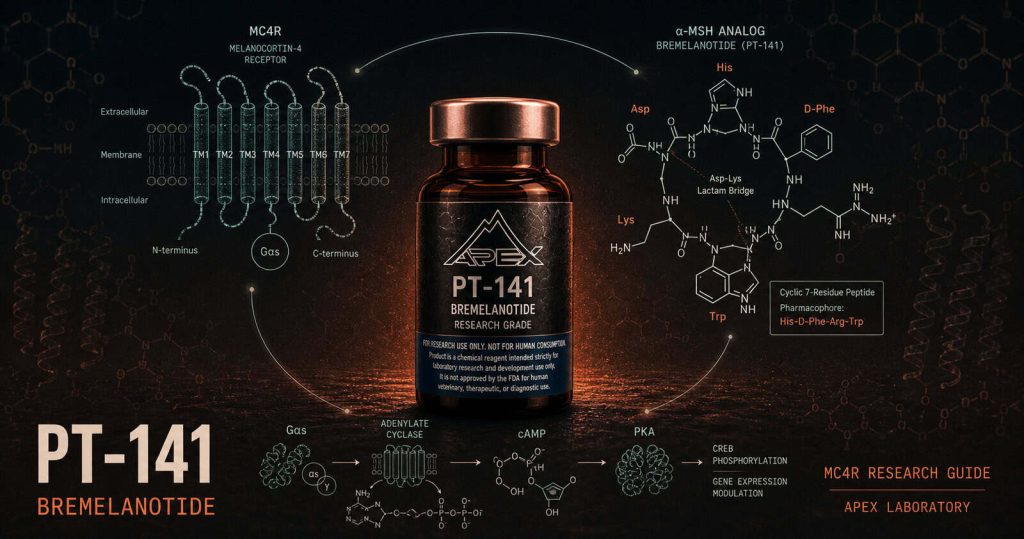
PT-141 (Bremelanotide) is a synthetic 7-residue cyclic α-MSH analog studied for its effects on central nervous system melanocortin signaling, with selective activity at MC4R and MC3R. Its mechanism centers on hypothalamic melanocortin pathways rather than peripheral vascular targets — a CNS-anchored pharmacology distinguishing it from earlier sexual-function research compounds. The molecule was FDA-approved as the prescription drug Vyleesi in 2019; Apex’s PT-141 is for research use only.
Search any non-specialist write-up of PT-141 and a single phrase dominates: “the libido peptide.” That framing collapses the molecule. PT-141 — Bremelanotide — is a synthetic 7-residue cyclic α-MSH analog that descends from the Hadley and Dorr melanocortin pharmacology program at the University of Arizona, was developed by Palatin Technologies, and is studied across the research literature as a selective agonist of the melanocortin-4 receptor (MC4R). The central nervous system pharmacology that ultimately underwrote the Vyleesi 2019 FDA approval for premenopausal hypoactive sexual desire disorder is a downstream consequence of MC4R signaling, not the compound’s defining identity. This guide treats Bremelanotide as the research literature treats it: an MC4R-selective melanocortin pharmacology research tool whose receptor selectivity is the organizing logic.
This guide reads PT-141 in that frame: molecular identity, the Hadley/Dorr Arizona lineage, MC4R receptor pharmacology, selectivity across the melanocortin family, central nervous system research, the clinical-research lineage, the Vyleesi regulatory landscape, and the research-grade catalog distinction.
PT-141 (Bremelanotide) at a Glance
- PT-141 (Bremelanotide) is a synthetic 7-residue cyclic α-MSH analog — Ac-Nle-cyclo[Asp-His-D-Phe-Arg-Trp-Lys]-NH₂ — with selective MC4R agonism per Wessells 2003 published canonical sequence
- The molecule descends from the Hadley and Dorr melanocortin program at the University of Arizona; Palatin Technologies licensed and developed the Bremelanotide pharmaceutical lineage
- MC4R is a Gαs-coupled GPCR distributed across central nervous system regions including paraventricular nucleus, amygdala, and brain stem; cryo-EM structural biology has resolved its ligand-recognition geometry
- Vyleesi — the Bremelanotide pharmaceutical formulation — was FDA-approved June 21, 2019 by Palatin Technologies / AMAG Pharmaceuticals for hypoactive sexual desire disorder in premenopausal women under NDA 210557
- Apex Laboratory’s PT-141 10mg is a research-grade chemical reagent verified to ≥99% purity by HPLC and mass spectrometry — categorically distinct from the Vyleesi pharmaceutical formulation per the 0069 Lab Methods framework
- The “libido peptide” framing collapses what is actually MC4R-selective melanocortin pharmacology research; the clinical indication is a downstream consequence of MC4R signaling, not the compound’s defining identity
What PT-141 (Bremelanotide) actually is — molecular identity
PT-141 is Bremelanotide — a synthetic seven-residue cyclic α-MSH analog with the canonical sequence Ac-Nle-cyclo[Asp-His-D-Phe-Arg-Trp-Lys]-NH₂ (CAS 189691-06-3; molecular weight 1025.18 g/mol). The C-terminal amide (-NH₂) form is the published Bremelanotide structure documented by Wessells, Hruby, Hackett, and Han in Neuroscience in 20031 — the paper that explicitly published the sequence and characterized brain and spinal melanocortin receptor mechanisms in the same report.
Structurally, the molecule is the cyclic-disulfide reduction of the broader Hadley / Hruby / Dorr Arizona α-MSH analog program: the seven-residue core preserves the His-D-Phe-Arg-Trp pharmacophore that governs melanocortin-receptor binding, with the Asp-Lys backbone-cyclization providing conformational rigidity and the N-terminal Nle (norleucine) substitution providing oxidative stability beyond what the native Met of α-MSH offers. The -NH₂ amide terminus distinguishes the published Bremelanotide structure from the carboxylic-acid (-OH) terminus that occasionally appears in non-canonical references. The Apex Laboratory catalog ships PT-141 as a 10 mg lyophilized powder verified to ≥99% purity by HPLC and mass spectrometry, intended exclusively for in-vitro and preclinical research.
The Hadley / Dorr Arizona melanocortin program — lineage
PT-141 does not stand alone. It descends from a multi-decade structure-activity-relationship program at the University of Arizona College of Medicine that produced Melanotan I (afamelanotide), Melanotan II, and PT-141 as three distinct points along the same pharmacological lineage. Mac E. Hadley (Department of Cell Biology and Anatomy) and Robert T. Dorr (Arizona Cancer Center) anchored the program; Victor J. Hruby’s chemistry department supplied the synthetic backbone. The foundational paper is Sawyer, Hruby, Darman, and Hadley’s 1982 PNAS report of the cyclic [half-Cys⁴, half-Cys¹⁰]-α-MSH superagonist — the first demonstration that disulfide cyclization across positions 4 and 10 of α-MSH generated biological activity exceeding that of the native peptide.2
The Arizona program moved from basic structure-activity research into clinical pharmacology with Robert Dorr, Lines, Levine, and Brooks’s 1996 Life Sciences report of the first phase 1 clinical study of Melanotan-II — the first human trial of a cyclic melanotropic peptide.3 Two years later, Hadley, Hruby, Blanchard, and Dorr published the definitive review of the Melanotan-I and Melanotan-II discovery and development arc in Pharmaceutical Biotechnology, synthesizing the structure-activity work, clinical-pharmacology pathway, and downstream development trajectory that Palatin Technologies subsequently licensed and extended into the Bremelanotide pharmaceutical lineage.4 The Hadley & Dorr 2006 Peptides paper “Melanocortin peptide therapeutics: historical milestones, clinical studies and commercialization” remains the most-direct historical-attribution reference for the Arizona-program → Palatin-development arc, covering Melanotan I, Melanotan II, and PT-141 in a single synthesis.5
The lineage attribution matters editorially. PT-141 is not a free-standing Palatin invention; it is the Hadley/Dorr Arizona α-MSH program’s seven-residue MC4R-selective derivative, with Palatin Technologies as the development sponsor that carried the Bremelanotide molecule through the regulatory pathway to the 2019 Vyleesi approval.
MC4R receptor pharmacology — why selectivity matters
The melanocortin receptor family comprises five subtypes — MC1R, MC2R, MC3R, MC4R, MC5R — all of which are Class A G-protein coupled receptors (GPCRs) coupled primarily to Gαs and the adenylate cyclase / cAMP signaling cascade. Hadley, Hruby, Jiang, Sharma, and Fink’s 1996 Pigment Cell Research review established the MC1R-MC5R subtype identification and characterization framework with melanotropic peptide agonists and antagonists.6 The five subtypes carry distinct tissue distributions and distinct physiological roles: MC1R in skin melanocytes (pigmentation); MC2R in adrenal cortex (cortisol regulation; ACTH receptor); MC3R and MC4R in central nervous system (energy homeostasis and neuroendocrine signaling); MC5R in exocrine tissues.
MC4R is the receptor PT-141 is studied against. Roger D. Cone’s 2005 Nature Neuroscience single-author review of the central melanocortin system anatomy and regulation remains the canonical reference for MC4R distribution: the receptor concentrates in the paraventricular nucleus of the hypothalamus (PVN), with additional populations in the amygdala, brain stem, and spinal cord.7 Hadley and Haskell-Luevano’s 1999 review of the proopiomelanocortin (POMC) system in Annals of the New York Academy of Sciences anchors the endogenous-pharmacology context — the upstream biology that generates α-MSH, ACTH, and the other endogenous melanocortins MC4R was characterized against.8
The canonical MC4R-specific pharmacology synthesis is Ya-Xiong Tao’s 2010 Endocrine Reviews comprehensive paper “The melanocortin-4 receptor: physiology, pharmacology, and pathophysiology” — the most-cited MC4R review in the field and the load-bearing reference for any researcher reading PT-141 literature against MC4R structure-function depth.9 The Tao review covers MC4R pharmacology, ligand binding, signaling, and disease relevance with the receptor-pharmacology granularity that contextualizes everything PT-141 is studied for. Modern structural biology has resolved the MC4R receptor architecture itself: Zhang, Chen, Yang, Mao, and colleagues’ 2021 Cell Research cryo-EM paper “Structural insights into ligand recognition and activation of the melanocortin-4 receptor” provides the contemporary structural-pharmacology depth — how MC4R-selective ligands (including Bremelanotide) bind the receptor.10
Receptor selectivity profile across the melanocortin family
The PT-141 selectivity story is what distinguishes it from the rest of the Hadley/Dorr Arizona α-MSH lineage. Bremelanotide engages MC4R as its primary receptor, with secondary affinity for MC3R and minimal activity at MC1R, MC2R, and MC5R. This is categorically different from the broader pan-melanocortin profile of Melanotan II (engages all five subtypes MC1R-MC5R) and from the MC1R-selective profile of Melanotan I / afamelanotide (the Scenesse pharmaceutical formulation FDA-approved for erythropoietic protoporphyria in October 2019).
Schiöth, Haitina, Ling, Ringholm, and Fredriksson’s 2005 Peptides review of melanocortin-receptor structural, pharmacological, and genomic conservation across vertebrates anchors the receptor-subtype framing in modern post-2000 literature.11 Yuan and Tao’s 2022 Biomolecules review “Ligands for Melanocortin Receptors: Beyond Melanocyte-Stimulating Hormones and Adrenocorticotropin” provides the contemporary synthetic-agonist synthesis covering Bremelanotide (PT-141), afamelanotide (Melanotan I), Melanotan II, and the small-molecule MC4R agonists that have entered the modern receptor-ligand literature.12 Together with the 1996 Hadley review6, the Schiöth and Yuan/Tao references provide the receptor-subtype literature that contextualizes PT-141’s MC4R-selective profile against the broader melanocortin pharmacology.
The selectivity comparison is easier to read in side-by-side form than as paragraph prose. The comparison table below summarizes the four melanocortin agonists most relevant to the Apex catalog — PT-141, Melanotan I, Melanotan II, and the endogenous α-MSH reference — across primary receptor, selectivity profile, and Apex catalog status. The side-by-side format anchors the central editorial point: PT-141 is one selectivity choice within a broader family of melanocortin agonists, not a stand-alone “libido peptide.”
Melanocortin Agonist Receptor Selectivity
| Compound | Primary Receptor | Selectivity Profile | Apex Catalog Status |
|---|---|---|---|
| PT-141 (Bremelanotide) | MC4R | MC4R primary; MC3R secondary; minimal MC1R/MC2R/MC5R | Apex PT-141 10mg research-grade ≥99% (Vyleesi pharmaceutical FDA June 21, 2019 — categorically distinct) |
| Melanotan I (afamelanotide) | MC1R | MC1R-selective | Apex Melanotan I 10mg research-grade ≥99% (Scenesse pharmaceutical FDA October 2019 — categorically distinct) |
| Melanotan II | MC1-5R (pan) | Pan-melanocortin agonist across all five subtypes | Apex Melanotan II 10mg research-grade ≥99% (research-only globally) |
| α-MSH (endogenous reference) | MC1-5R (native) | Endogenous pan-agonist | Endogenous reference; not a catalog SKU |
For deeper context on the pan-melanocortin Melanotan II profile, see the Apex Melanotan II research guide — the primary internal reference for the Melanotan II family member. The planned Melanotan I vs Melanotan II comparison guide (forward-held: /melanotan-i-vs-melanotan-ii/) will provide the head-to-head receptor-selectivity comparison once published.
Central nervous system pharmacology research
PT-141’s research literature concentrates on central nervous system pharmacology because that is where MC4R lives. The Wessells 2003 Neuroscience paper that published the Bremelanotide sequence also demonstrated the central-and-spinal mechanism: PT-141 induces penile erection in animal models via brain and spinal melanocortin receptors, with central activation mapping onto MC4R-expressing neurons in the PVN and brain stem.1 The Cone 2005 anatomy and regulation review provides the central-melanocortin-system framework against which the Wessells 2003 mechanism reads coherently.7
The female preclinical pharmacology arc is anchored by James G. Pfaus and colleagues at Concordia University Montréal. Pfaus, Shadiack, Van Soest, and Tse’s 2004 PNAS paper “Selective facilitation of sexual solicitation in the female rat by a melanocortin receptor agonist” remains a top-tier preclinical CNS citation for PT-141’s central pharmacology — the foundational female-rat behavioral paper demonstrating that melanocortin-receptor agonism facilitates specific solicitation behaviors via central pathways.13 Pfaus, Giuliano, and Gelez’s 2007 Journal of Sexual Medicine preclinical CNS overview synthesized the preclinical evidence base before the pivotal clinical-trial program reached its phase 3 readouts.14 Both Pfaus papers frame the central pharmacology in MC4R-pathway terms, not in reductionist behavioral-outcome terms — the preclinical literature treats the central pathway as the pharmacological object of study, with behavioral outputs as the readouts.
Clinical-research lineage — early-phase studies
The PT-141 clinical-research arc traces from the Hadley-coauthored J Urol paper of 1998 through phase 2 evidence in 2006 to the registrational phase 3 RECONNECT trials of 2019. Hunter Wessells, Fuciarelli, Hansen, and Mac E. Hadley’s 1998 Journal of Urology paper reported the first human clinical-research demonstration that a synthetic melanotropic peptide (the Melanotan-II precursor in the Bremelanotide-lineage research) initiates erections in men with psychogenic erectile dysfunction in a double-blind, placebo-controlled crossover study.15 The Hadley co-authorship preserves the Arizona-lineage attribution into the human-clinical phase of the program.
Leonard E. Diamond, Daniel C. Earle, Julia R. Heiman, Raymond C. Rosen, and Michael A. Perelman’s 2006 Journal of Sexual Medicine paper “An effect on the subjective sexual response in premenopausal women with sexual arousal disorder by bremelanotide (PT-141), a melanocortin receptor agonist” established the early-phase clinical evidence base in premenopausal women — the population that the subsequent phase 3 RECONNECT trials would target as the regulatory study cohort.16 The pivotal phase 3 evidence came from Sheryl A. Kingsberg, Anita H. Clayton, David Portman, Lisa A. Williams, and Julie Krop’s 2019 Obstetrics & Gynecology report of the two RECONNECT randomized phase 3 trials of bremelanotide for hypoactive sexual desire disorder17 — the registrational evidence base supporting the FDA approval discussed in the next section.
The Vyleesi FDA approval — Cerebrolysin-precedent regulatory framing
Vyleesi is the pharmaceutical formulation of bremelanotide. The U.S. Food and Drug Administration approved Vyleesi on June 21, 2019 by Palatin Technologies / AMAG Pharmaceuticals under New Drug Application NDA 210557 for the treatment of acquired, generalized hypoactive sexual desire disorder (HSDD) in premenopausal women, formulated as a subcutaneous auto-injector (1.75 mg in 0.3 mL). The Kingsberg 2019 RECONNECT phase 3 paper anchored the registrational evidence; the Hadley & Dorr 2006 Peptides historical-milestones synthesis provides the commercialization-context backdrop covering the Arizona-program → Palatin-development arc that culminated in the Vyleesi approval.5
The Cerebrolysin-precedent regulatory framing matters editorially. Vyleesi is the FDA-approved Bremelanotide pharmaceutical formulation for a specific clinical indication — a documented regulatory fact that the research literature describes in regulatory-fact terms. Apex Laboratory’s PT-141 10mg is a research-grade chemical reagent, lyophilized powder, ≥99% purity by HPLC and mass spectrometry, intended exclusively for in-vitro and preclinical research. Same molecule (Bremelanotide); categorically distinct regulatory frameworks. Apex’s research-grade material is not a pharmaceutical product, is not therapeutically equivalent to Vyleesi, and is not framed in this guide as a substitute for or alternative to the FDA-approved pharmaceutical formulation. The Vyleesi indication is named factually because the regulatory record is what it is; it is not promoted as a use case for the research-grade catalog product.
The same regulatory-precedent template is used elsewhere in the Apex corpus for compounds where a research-grade chemical reagent and an approved pharmaceutical formulation share the same molecule but live in categorically distinct regulatory contexts — see the Cerebrolysin Research Guide for the parallel per-jurisdiction framing template applied to the Cerebrolysin Austrian / European / Russian / Asia approvals against the Apex research-grade material.
Research-grade vs pharmaceutical-grade — the Apex catalog distinction
The framework anchor for the Vyleesi-vs-Apex catalog distinction is the LIVE Lab Methods cluster article on research-grade vs pharmaceutical-grade peptides, which establishes the categorical distinction across the Apex corpus. The framework applies cleanly to PT-141 / Bremelanotide:
Vyleesi pharmaceutical formulation — manufactured under Good Manufacturing Practice (GMP) for clinical use; supplied through the prescription pharmaceutical distribution channel; carries an FDA-approved indication (HSDD in premenopausal women) and an FDA-approved label specifying dosing, contraindications, and adverse-event profile; sponsor Palatin Technologies / AMAG Pharmaceuticals (NDA 210557).
Apex catalog PT-141 10mg — research-grade chemical reagent, lyophilized powder, ≥99% purity verified per batch by HPLC and mass spectrometry per the ≥99% purity standard and mass-spectrometry verification protocol documented in the lab-verified COA archive; supplied through the research-reagent vendor channel for in-vitro and preclinical research applications. NOT a pharmaceutical product; NOT for human consumption.
Same molecule (Bremelanotide); categorically distinct regulatory frameworks. Researchers building broader vendor and grade-discrimination context may also find the vendor evaluation checklist and the Editorial Standards page useful for the analytical-chain documentation that distinguishes Apex’s research-grade material from less-rigorous reagent suppliers.
Reading PT-141 research papers — what receptor selectivity changes
For researchers reading PT-141 literature for the first time, the single most useful interpretive frame is receptor selectivity. The MC4R-selective profile changes what conclusions the literature can support. Studies using PT-141 are characterizing MC4R-selective pharmacology — central nervous system pathway activation, MC4R-receptor occupancy, downstream Gαs / cAMP signaling consequences. Studies using Melanotan II (pan-melanocortin MC1R-MC5R) are characterizing pan-melanocortin pharmacology — pigmentation effects (MC1R), CNS effects (MC4R), and other receptor-subtype contributions blended together. Studies using Melanotan I / afamelanotide (MC1R-selective) are characterizing pigmentation-pathway pharmacology specifically.
This receptor-selectivity discipline matters when reading older literature in particular. Pre-MC4R-cloning literature (much of it from before the receptor-subtype identification work synthesized in the Hadley 1996 review6) sometimes treats “melanocortin agonism” as a single pharmacological category, blurring receptor-subtype contributions that the modern literature parses out explicitly. The Tao 2010 Endocr Rev MC4R-specific review9 and the Yuan and Tao 2022 modern-ligand review12 are useful for re-reading older PT-141 literature against modern receptor-subtype framing. The companion Apex Melanotan II research guide provides the parallel pan-melanocortin reading frame for the broader Melanotan II literature.
Sourcing PT-141 for in-vitro and preclinical research
Apex Laboratory supplies PT-141 (Bremelanotide) as a research-grade chemical reagent at ≥99% purity, verified by HPLC and mass spectrometry on every batch and documented through the lab-verified COA archive per the editorial standards — the Apex PT-141 10mg catalog product is a 10 mg lyophilized powder for in-vitro and preclinical research applications, distinct from any pharmaceutical formulation of bremelanotide. Procedural references on peptide reconstitution, cold-chain storage, Certificate of Analysis verification, research-context dosing calculation, and HPLC purity verification document the analytical chain.
Researchers building broader melanocortin-family research context may find the related Apex catalog products useful: PT-141 (MC4R-selective), Melanotan II (pan-MC1-5R), and Melanotan I / afamelanotide (MC1R-selective). The forward-held Specialty Research Peptides pillar (publishing simultaneously: /specialty-research-peptides/) provides the cluster-level context for the eleven Specialty research peptides in the Apex catalog. Cross-cluster lateral context: the Tissue Repair pillar, GLP-1 / Metabolic pillar, GH-Axis pillar, and CNS pillar cover the broader Apex research-library architecture.
Melanocortin Agonist Research Reagents
PT-141 10mg
Bremelanotide synthetic 7-residue cyclic α-MSH analog; selective MC4R agonist research reagent supplied at ≥99% purity verified by HPLC and mass spectrometry.
View ProductMelanotan II 10mg
Pan-melanocortin agonist active across all five MC1R-MC5R receptor subtypes; cyclic α-MSH analog research reagent for melanocortin receptor pharmacology studies.
View ProductMelanotan I 10mg
Afamelanotide MC1R-selective α-MSH analog research reagent; the [Nle⁴, D-Phe⁷]-α-MSH 13-residue analog from the Hadley/Dorr Arizona program.
View ProductFrequently Asked Questions
What is PT-141 (Bremelanotide)?
PT-141, also known as Bremelanotide, is a synthetic seven-residue cyclic α-MSH analog with the canonical sequence Ac-Nle-cyclo[Asp-His-D-Phe-Arg-Trp-Lys]-NH₂ (CAS 189691-06-3; MW 1025.18 g/mol). It is a selective agonist of the melanocortin-4 receptor (MC4R) descending from the Hadley and Dorr Arizona α-MSH analog program, supplied by Apex Laboratory as a research-grade chemical reagent.
How does PT-141 work mechanistically?
PT-141 acts as a selective agonist of the MC4R receptor — a Gαs-coupled GPCR distributed across central nervous system regions including the paraventricular nucleus, amygdala, brain stem, and spinal cord. Wessells 2003 demonstrated that PT-141 induces effects via brain and spinal melanocortin receptors. Pfaus 2004 PNAS extended the central-pathway pharmacology in female preclinical models.
What is the MC4R receptor?
The melanocortin-4 receptor is a Class A G-protein coupled receptor coupled primarily to Gαs and the adenylate cyclase / cAMP signaling cascade. Its central nervous system distribution concentrates in the paraventricular nucleus and amygdala. Tao 2010 in Endocrine Reviews and Cone 2005 in Nature Neuroscience are the canonical pharmacology and anatomy references for MC4R.
What is Vyleesi and how is it different from research-grade PT-141?
Vyleesi is the pharmaceutical formulation of bremelanotide, FDA-approved June 21, 2019 by Palatin Technologies / AMAG Pharmaceuticals under NDA 210557 for hypoactive sexual desire disorder in premenopausal women. Apex Laboratory’s PT-141 10mg is a research-grade chemical reagent for in-vitro and preclinical research — same molecule, categorically distinct regulatory frameworks per the 0069 Lab Methods framework.
How is PT-141 different from Melanotan II?
PT-141 is MC4R-selective with secondary MC3R activity and minimal MC1R, MC2R, and MC5R engagement. Melanotan II is a pan-melanocortin agonist active across all five receptor subtypes MC1R through MC5R. The selectivity difference matters for what conclusions the literature can support: PT-141 studies characterize MC4R-selective pharmacology; Melanotan II studies characterize pan-melanocortin pharmacology blending receptor-subtype contributions together.
What is the Hadley and Dorr melanocortin program?
Mac E. Hadley and Robert T. Dorr at the University of Arizona College of Medicine led the α-MSH analog development program through the 1980s and 1990s, anchored by Sawyer, Hruby, and Hadley’s 1982 PNAS cyclic α-MSH superagonist paper. The program produced Melanotan I, Melanotan II, and PT-141 along a single pharmacological lineage developed by Palatin Technologies.
Is PT-141 the same as the “libido peptide”?
That framing collapses the molecule. PT-141 is an MC4R-selective melanocortin receptor agonist studied across the research literature for central nervous system pharmacology, MC4R receptor selectivity, and downstream Gαs / cAMP signaling. The Vyleesi clinical indication (HSDD in premenopausal women) is a downstream consequence of MC4R signaling — not the molecule’s defining identity in the research literature.
Continue Your Research
Researchers building broader MC4R, melanocortin, and specialty research-peptide context across the Apex library may find the following references useful:
- Melanotan II Research Guide — pan-melanocortin Melanotan II compound guide; primary internal context for the melanocortin family
- Cerebrolysin Research Guide — sister Tier 2 guide; parallel Cerebrolysin-precedent regulatory framing template
- Research-Grade vs Pharmaceutical-Grade Peptides — Lab Methods cluster framework anchor for the Vyleesi-vs-Apex distinction
- Vendor Evaluation Checklist — Lab Methods vendor-discrimination reference
- ≥99% Purity Standard and Mass Spectrometry Verification — analytical-chain documentation
- Tissue Repair Research Peptides Pillar, GLP-1 / Metabolic Research Peptides Pillar, Growth-Hormone-Axis Research Peptides Pillar, CNS Research Peptides Pillar — lateral cluster pillars
- Procedural references: reconstitution, storage, dosing calculation, COA verification, HPLC purity verification
- Forward-held same-batch references (live once batch 5 publishes simultaneously): the Specialty Research Peptides Pillar at /specialty-research-peptides/ and the planned Melanotan I vs Melanotan II comparison at /melanotan-i-vs-melanotan-ii/
Research Use Disclaimer
This article is provided for educational and research reference purposes only. PT-141 (Bremelanotide) and all products sold by Apex Laboratory are intended exclusively for in-vitro laboratory and preclinical research use and are not for human consumption. Apex Laboratory’s research-grade PT-141 10mg is a chemical research reagent distinct from the Vyleesi pharmaceutical formulation (FDA-approved June 21, 2019 by Palatin Technologies / AMAG Pharmaceuticals under NDA 210557 for hypoactive sexual desire disorder in premenopausal women); this article describes the research-reagent context only and does not endorse, describe procedures for, or imply therapeutic equivalence between the research-grade chemical reagent and the FDA-approved pharmaceutical formulation. Documented findings in animal models and cellular research assays should not be extrapolated to human-clinical claims for the research-grade catalog product. Researchers should consult the primary peer-reviewed literature cited throughout this article for detailed methodological protocols, experimental designs, and complete data sets.