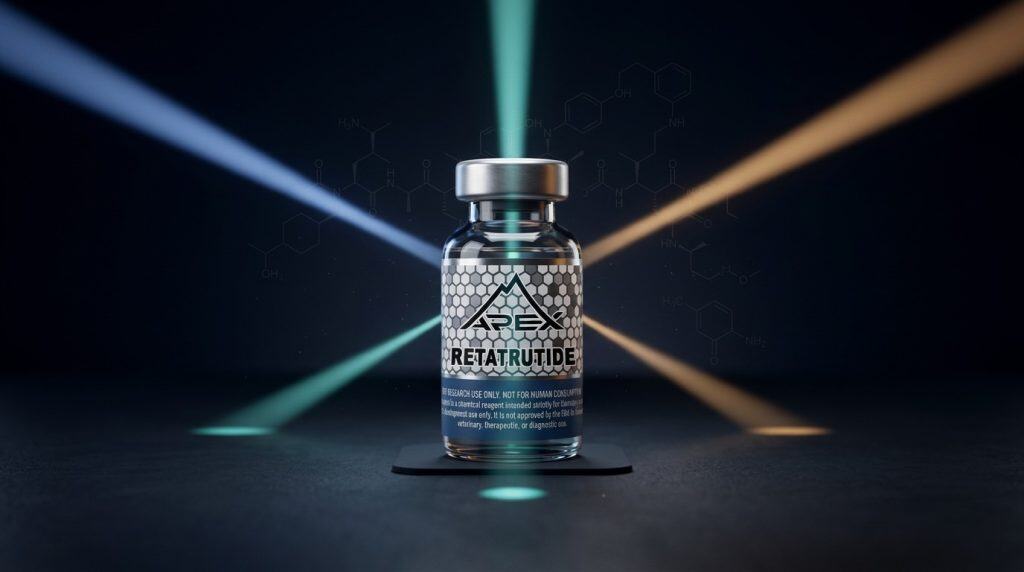
Retatrutide (LY3437943) is an investigational, synthetic multi-agonist peptide that activates three metabolic hormone receptors: GIPR, GLP-1R, and GCGR. That makes it mechanistically distinct from semaglutide, a GLP-1 receptor agonist, and tirzepatide, a dual GIP/GLP-1 receptor agonist. Published phase 2 studies report dose-dependent changes in body weight, glycemic markers, liver fat, and body composition, while also documenting gastrointestinal tolerability patterns typical of incretin-class pharmacology.
Retatrutide sits at the frontier of incretin peptide research because it combines the two-receptor logic of tirzepatide with a third glucagon-receptor pathway. The design question is not simply whether one additional receptor produces a larger number on a weight-change endpoint. The more interesting research question is how three signals – GIP receptor agonism, GLP-1 receptor agonism, and glucagon receptor agonism – are integrated across pancreatic, central appetite, adipose, hepatic, and energy-expenditure biology.
The current peer-reviewed literature is now deeper than the first wave of retatrutide summaries suggested. The original discovery and proof-of-concept paper described LY3437943 as a triple GCGR/GIPR/GLP-1R agonist with balanced GCGR and GLP-1R activity and greater GIPR activity in vitro.1 Human phase 2 data in obesity and type 2 diabetes followed in 2023, and 2024-2025 publications added structural, liver-fat, and body-composition context.2, 3, 4, 5, 6 This guide keeps the existing Retatrutide Research Guide URL intact while bringing the article up to the current Apex editorial standard: mechanism depth, verified citations, research-dose context, reconstitution math, COA and analytical-verification discipline, and FAQ schema for extraction.
What Is Retatrutide?
Retatrutide is the adopted name for LY3437943, a single synthetic peptide designed to agonize the glucose-dependent insulinotropic polypeptide receptor (GIPR), glucagon-like peptide-1 receptor (GLP-1R), and glucagon receptor (GCGR). In the discovery paper, Coskun and colleagues described LY3437943 as a triple agonist peptide that produced body-weight and glycemic effects in preclinical models, then moved into phase 1 clinical proof of concept.1
That receptor triad places retatrutide in the GLP-1 / metabolic research peptides cluster but separates it from older single-pathway and dual-pathway compounds. Semaglutide is a GLP-1R agonist. Tirzepatide is a GIPR/GLP-1R dual agonist. Retatrutide keeps those two incretin-family receptor pathways and adds glucagon-receptor agonism, the pathway most closely associated with hepatic fuel handling, fatty-acid oxidation, and energy-expenditure biology.
Technical identity
- Common name: Retatrutide
- Development code: LY3437943
- CAS Registry Number: 2381089-83-2
- Research classification: Triple GIPR/GLP-1R/GCGR agonist peptide
- Published human-trial route: once-weekly subcutaneous administration in clinical trial settings, not a laboratory-use instruction
- Apex catalog context: research-grade Retatrutide for in-vitro laboratory research only
The most important editorial distinction is that retatrutide is not just “stronger tirzepatide.” It is a different receptor architecture. Tirzepatide tests dual GIP/GLP-1 signaling; retatrutide tests whether GCGR agonism can be added to that foundation while preserving glycemic control through simultaneous incretin signaling. The direct comparison article, Retatrutide vs Tirzepatide, covers that head-to-head question in more detail.
The Triple-Agonist Mechanism: GIPR, GLP-1R, and GCGR
Retatrutide’s mechanism should be read as coordinated receptor pharmacology rather than three separate effects stacked on a label. The published discovery paper reported balanced GCGR and GLP-1R activity with greater GIPR activity in vitro, and the authors framed the weight-loss mechanism as reduced calorie intake from GIPR/GLP-1R biology plus GCGR-mediated energy-expenditure contribution.1 A 2024 structural paper further examined how retatrutide engages GLP-1R, GIPR, and GCGR at the receptor-structure level.4
GIP receptor agonism
GIPR activation belongs to the incretin side of the mechanism. In metabolic physiology, GIP participates in glucose-dependent insulin secretion and adipose-tissue nutrient handling. In multi-agonist pharmacology, the GIP component is especially relevant because tirzepatide’s clinical program already established that GIPR/GLP-1R dual agonism can outperform GLP-1-only comparators in type 2 diabetes and obesity research contexts.7, 8
GLP-1 receptor agonism
GLP-1R agonism is the established anchor of the class. It supports glucose-dependent insulin secretion, reduces glucagon secretion in hyperglycemic states, slows gastric emptying, and engages central appetite-regulation pathways. Semaglutide’s STEP 1 trial provides the canonical single-agonist obesity benchmark, with once-weekly semaglutide 2.4 mg producing a large mean weight reduction compared with placebo in adults with overweight or obesity.9
Glucagon receptor agonism
GCGR agonism is the distinguishing third pathway. Isolated glucagon signaling can raise glucose, which is why glucagon receptor activity cannot simply be added without regard for glycemic balance. Retatrutide is designed to study that pathway in the context of simultaneous GIPR and GLP-1R agonism. The research hypothesis is that incretin signaling can offset glycemic liability while GCGR signaling contributes to hepatic lipid handling, energy expenditure, and fat-mass reduction. Reviews of triple agonism describe this as the rationale for GLP-1/GIP/glucagon receptor triagonists in obesity and cardiometabolic research.10, 11
Published Research Findings
The retatrutide evidence base now includes discovery work, phase 2 obesity data, phase 2 type 2 diabetes data, a liver-fat substudy, and body-composition data. That is still an investigational literature base, not a mature label-level product record, but it is substantial enough that the guide should cite specific endpoints rather than speak in generalities.
Phase 2 obesity trial
The highest-impact publication is the 2023 New England Journal of Medicine phase 2 trial in adults with obesity or overweight plus a weight-related condition. The trial randomized 338 adults to placebo or once-weekly retatrutide dose groups over 48 weeks. At week 24, least-squares mean body-weight change ranged from -7.2% with 1 mg to -17.5% with 12 mg, compared with -1.6% for placebo. At week 48, the least-squares mean changes were -8.7% with 1 mg, -17.1% with 4 mg, -22.8% with 8 mg, and -24.2% with 12 mg, compared with -2.1% for placebo.2
Those numbers are why retatrutide draws so much attention. They are not a dosing recommendation and they should not be detached from study design, inclusion criteria, escalation strategy, and adverse-event monitoring. The same abstract reports that gastrointestinal adverse events were common, dose-related, mostly mild to moderate, and partially mitigated by a lower starting dose. Dose-dependent heart-rate increases peaked at 24 weeks and declined thereafter.2
Phase 2 type 2 diabetes trial
The companion 2023 Lancet phase 2 trial enrolled adults with type 2 diabetes across 42 US research and health-care centers. Retatrutide produced clinically meaningful HbA1c reductions and dose-dependent body-weight reductions. At 24 weeks, HbA1c changes reached approximately -2.02 percentage points in the 12 mg escalation group, compared with -0.01 for placebo and -1.41 for dulaglutide 1.5 mg. At 36 weeks, body-weight changes reached -16.94% in the 12 mg escalation group, compared with -3.00% for placebo and -2.02% for dulaglutide.3
For researchers, the diabetes trial is important because it shows why GCGR activity did not automatically erase glycemic benefits in this setting. The peptide’s combined incretin activity and study design produced improved glycemic markers despite glucagon-receptor agonism. That finding is central to the triple-agonist thesis.
Liver fat and MASLD research
The liver-fat substudy is especially relevant to GCGR biology. In a phase 2a analysis of participants with metabolic dysfunction-associated steatotic liver disease and liver fat of at least 10%, retatrutide produced large mean relative liver-fat reductions at 24 weeks: -42.9% with 1 mg, -57.0% with 4 mg, -81.4% with 8 mg, and -82.4% with 12 mg, compared with +0.3% for placebo. Normal liver fat, defined as less than 5%, was reached by 79% of the 8 mg group and 86% of the 12 mg group at 24 weeks, compared with 0% of placebo participants.5
This does not make retatrutide a marketed MASLD treatment. It does make the hepatic endpoint one of the clearest areas where triple agonism is more than a weight-loss headline. The GCGR pathway gives researchers a mechanistic reason to watch liver fat, lipid handling, insulin sensitivity, and metabolic markers together.
Body composition
A 2025 body-composition substudy in people with type 2 diabetes assessed DXA-measured fat mass. Retatrutide significantly improved total fat-mass reduction versus placebo and dulaglutide, and the authors reported that the proportion of lean-mass loss to weight loss was similar to other obesity treatments despite greater overall weight loss.6 That matters because a high total weight-change number can be misleading without body-composition context.
How to interpret the endpoint pattern
The endpoint pattern across the retatrutide papers is more useful than any single percentage. The obesity trial establishes the dose-response relationship for body-weight change. The type 2 diabetes trial establishes that glycemic improvement can coexist with GCGR agonism when GIPR and GLP-1R agonism are present. The MASLD substudy connects the mechanism to liver fat, an endpoint that is especially relevant to the glucagon-receptor component. The body-composition substudy then asks whether the larger overall weight change comes with a disproportionate lean-mass penalty; the authors reported that the lean-mass proportion was similar to other obesity treatments despite greater total weight loss.2, 3, 5, 6
That sequence matters for research design. A receptor-signaling assay might focus on potency, efficacy, and bias across GLP-1R, GIPR, and GCGR. A cell or tissue model might focus on downstream cAMP, insulin secretion, lipid-handling markers, or hepatocyte-relevant readouts. An animal-model protocol might focus on food intake, body weight, glucose tolerance, lipid handling, and liver-fat endpoints together rather than isolating one number. Retatrutide is most informative when the experiment is built around the full triple-agonist hypothesis instead of treating it as another GLP-1 analog.
Safety and tolerability signals in the published trials
The published trial abstracts also make clear that tolerability is part of the mechanism story. In the obesity phase 2 trial, gastrointestinal adverse events were the most common events in retatrutide groups, were dose-related, and were mostly mild to moderate. The same abstract notes that a lower starting dose partially mitigated those events and that dose-dependent heart-rate increases peaked at 24 weeks and declined thereafter.2 In the type 2 diabetes phase 2 trial, mild-to-moderate gastrointestinal events were also common, and the investigators reported no severe hypoglycemia and no deaths during the study.3
Those findings do not create a use protocol for research-grade material. They do tell researchers which variables should not be ignored when reading the literature: escalation design, starting dose, adverse-event capture, heart-rate monitoring, glycemic context, comparator arm, and study duration. A retatrutide experiment that ignores tolerability-linked variables can overread efficacy endpoints and underread the pharmacology that produced them.
Dose Context from Published Trials
Retatrutide dose language should be handled carefully. Published clinical dose arms describe controlled trial protocols, not instructions for self-administration or human use of research-grade material. For laboratory work, “dose” usually means a mass, concentration, or aliquot calculation inside a non-clinical experimental protocol. These are different categories.
| Study context | Published dose arms | Key endpoint context |
|---|---|---|
| Phase 2 obesity trial | 1 mg, 4 mg, 8 mg, and 12 mg once weekly groups, with different starting-dose strategies | 48-week body-weight change, responder thresholds, GI tolerability, heart-rate monitoring2 |
| Phase 2 type 2 diabetes trial | 0.5 mg, 4 mg, 8 mg, and 12 mg retatrutide groups, plus placebo and dulaglutide comparator | HbA1c and body-weight changes through 24-36 weeks3 |
| MASLD liver-fat substudy | 1 mg, 4 mg, 8 mg, and 12 mg retatrutide groups | Relative liver-fat change and normalization of liver fat below 5% at 24 weeks5 |
Two practical implications follow for readers using the literature. First, lower starting doses and gradual escalation appear throughout the published clinical protocols because tolerability is part of the pharmacology. Second, laboratory reconstitution math should never be confused with clinical dosing. Reconstitution produces a concentration, such as mg/mL or mcg/mL. Experimental dose selection belongs to the approved research protocol, species model, assay system, and institutional oversight.
Retatrutide vs Tirzepatide, Semaglutide, and Other Metabolic Peptides
Retatrutide is easiest to position as a receptor-architecture progression inside the metabolic peptide cluster. Semaglutide established the GLP-1-only benchmark in obesity research.9 Tirzepatide added GIPR agonism to GLP-1R agonism and produced large weight and glycemic effects in published trials.7, 8 Retatrutide adds GCGR agonism to the GIP/GLP-1 foundation.
Retatrutide vs semaglutide
Semaglutide is a GLP-1R agonist. Its strength is depth of clinical literature and class familiarity. Retatrutide is less mature as a literature base but broader as receptor pharmacology. The comparison is therefore not simply “which is stronger”; it is single-receptor maturity versus triple-receptor investigational breadth. Readers who need semaglutide-specific pharmacology should start with the Semaglutide Research Guide; the corresponding semaglutide catalog page is the product-side reference for that GLP-1R-only comparator.
Retatrutide vs tirzepatide
Tirzepatide is the closest comparator because it shares GIPR and GLP-1R agonism but lacks GCGR agonism. Retatrutide’s differentiator is the glucagon receptor. That third pathway is the reason hepatic fat and energy-expenditure questions show up repeatedly in retatrutide interpretation. For the full side-by-side, use Retatrutide vs Tirzepatide; for the dual-incretin class contrast, use Semaglutide vs Tirzepatide. The product-side reference is the tirzepatide catalog page.
Retatrutide vs GLP-1/glucagon dual agonists
Survodutide and mazdutide sit between semaglutide and retatrutide from a receptor-count perspective because they pair GLP-1R with GCGR but do not include GIPR. Retatrutide includes all three. That makes it a useful anchor compound when researchers are mapping the design space around incretin, glucagon, hepatic lipid handling, and body-composition outcomes. Older GLP-1 lineage context sits in the Liraglutide / Dulaglutide Research Guide, with product-side references for liraglutide and dulaglutide. Amylin-adjacent combination work is indexed through cagrilintide and CagriSema. For the class-level map, use GLP-1 Agonists Compared.
Reconstitution and Handling for Research-Grade Retatrutide
Retatrutide supplied as a lyophilized research peptide should be handled as a stability-sensitive peptide reagent. Peptide stability in aqueous solution is affected by hydrolysis, oxidation, aggregation, deamidation, pH, concentration, excipients, container surfaces, and storage environment.12 Protein and peptide stability also differ between dried and aqueous states, which is why reconstitution changes the stability question rather than merely dissolving a powder.13
Before reconstitution
Confirm vial identity, lot information, nominal mass, and COA details before adding solvent. Reconstitution should be the last step after identity and analytical documentation are checked, not the first. If the goal is a defined working concentration, calculate the solvent volume in advance and document it in the lab notebook or LIMS. Apex’s COA-reading guide explains what to check on a certificate of analysis, and the peptide reconstitution calculator can help convert vial mass and solvent volume into concentration.
Solvent and concentration math
For non-clinical research workflows, concentration is the key output of reconstitution. A 5 mg vial reconstituted with 2.5 mL solvent yields 2 mg/mL. A 10 mg vial reconstituted with 2 mL yields 5 mg/mL. The formula is simple: vial mass divided by solvent volume equals concentration. The hard part is not the arithmetic; it is preventing category errors between laboratory concentration, experimental dose, and clinical trial dose arms. Use the peptide reconstitution protocol for step-by-step handling discipline.
Storage after reconstitution
Aqueous peptide solutions generally deserve colder, cleaner, shorter timelines than lyophilized material. The literature on peptide and protein formulation emphasizes that aqueous storage creates different degradation risks than dried storage, while lyophilization and freezing conditions influence product quality attributes.14 Preserved bacteriostatic water contains benzyl alcohol, a preservative used in parenteral product formulations, but preservative presence is not a substitute for aseptic technique or validated stability data.15 Light and temperature sensitivity are common concerns across biotechnology-derived products, supporting cold, light-protected storage habits for peptide materials.16
Why COA, HPLC, and ESI-MS Verification Matter for Retatrutide
Retatrutide is a complex synthetic peptide in a high-demand research category. That combination makes analytical verification more than a procurement checkbox. A product label can state “retatrutide”; only batch-specific analytical documentation can support whether the material’s purity, chromatographic profile, and mass identity match the research requirement.
Three documents or data types matter most. The COA is the batch-level record that should connect lot identity, stated purity, test methods, and acceptance criteria. HPLC gives chromatographic purity information, helping researchers distinguish a principal peak from related impurities or truncated sequences. ESI-MS or comparable mass spectrometry confirms molecular identity by matching observed mass behavior to the expected peptide. The Apex trust pieces on why ≥99% purity matters and mass spectrometry peptide verification explain why purity and identity are separate questions.
For retatrutide specifically, this matters because receptor-pharmacology interpretation depends on the material being what the study says it is. A degraded, impure, or misidentified peptide can distort in-vitro receptor assays, cell-signaling readouts, concentration-response curves, stability studies, and downstream comparisons against tirzepatide or semaglutide. The right workflow is not promotional; it is scientific: verify the batch, record the concentration, minimize avoidable degradation, and keep the research-use boundary intact.
Frequently Asked Questions
What is retatrutide?
Retatrutide, also known as LY3437943, is an investigational synthetic peptide that activates GIP, GLP-1, and glucagon receptors. It is studied as a triple-agonist metabolic peptide, distinct from semaglutide’s GLP-1-only mechanism and tirzepatide’s dual GIP/GLP-1 mechanism.
How is retatrutide different from tirzepatide?
Tirzepatide activates GIP and GLP-1 receptors. Retatrutide activates those two receptors plus the glucagon receptor. The glucagon-receptor component is the key mechanistic difference and is central to retatrutide’s liver-fat and energy-expenditure research questions.
What did the retatrutide phase 2 obesity trial show?
The 2023 phase 2 obesity trial reported dose-dependent body-weight reductions over 48 weeks. The 12 mg group had a least-squares mean body-weight change of -24.2% at week 48, compared with -2.1% for placebo, with gastrointestinal adverse events reported as the most common events.
What retatrutide doses were studied?
Published phase 2 trials studied once-weekly retatrutide dose arms including 0.5 mg, 1 mg, 4 mg, 8 mg, and 12 mg depending on the trial and escalation design. These are controlled clinical-study dose arms, not instructions for use of research-grade material.
How do you reconstitute retatrutide for laboratory research?
Reconstitution is a concentration calculation: vial mass divided by solvent volume equals mg/mL. For example, 5 mg reconstituted with 2.5 mL yields 2 mg/mL. Researchers should confirm COA details before reconstitution, use sterile technique, and follow a written laboratory protocol.
Why does HPLC and ESI-MS testing matter for retatrutide?
HPLC addresses chromatographic purity, while ESI-MS or comparable mass spectrometry addresses molecular identity. Retatrutide research depends on both questions because an impure or misidentified peptide can distort receptor-signaling and concentration-response interpretation.
Is retatrutide for human use?
Apex Laboratory retatrutide is supplied as a research-grade chemical reagent for in-vitro laboratory research only. It is not sold for human consumption, clinical administration, diagnostic use, or therapeutic use.
Continue Your Research
- Retatrutide product page – current research-grade catalog listing
- Retatrutide vs Tirzepatide – dual versus triple agonist comparison
- GLP-1 / Metabolic Research Peptides – category hub for incretin and metabolic peptide research
- How to Reconstitute Peptides – step-by-step laboratory reconstitution protocol
- How to Read a COA – batch-documentation guide
- Why ≥99% Purity Matters – purity-threshold explainer
- Mass Spectrometry Peptide Verification – ESI-MS and identity-confirmation context
- Tirzepatide Research Guide and Semaglutide Research Guide – comparator compound guides
Research Use Disclaimer
This article is provided for educational and research reference purposes only. Retatrutide and all products sold by Apex Laboratory are intended exclusively for in-vitro laboratory research use and are not for human consumption. The clinical studies cited above describe controlled investigational protocols; they do not create instructions for clinical use, self-administration, or dosing of research-grade material. Researchers should consult the primary literature, institutional protocols, and applicable regulations before designing any study.