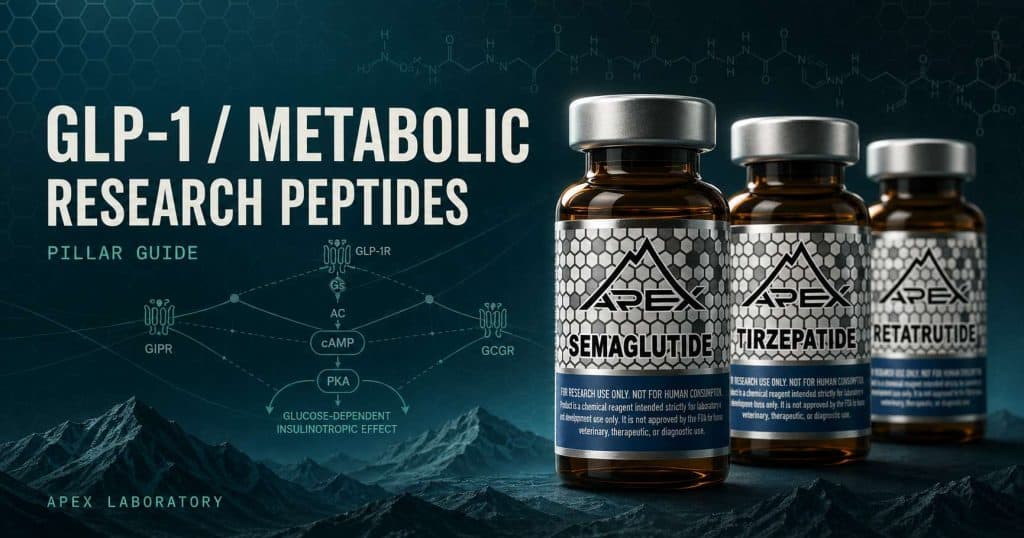
The GLP-1 peptides that anchor the contemporary metabolic-research pipeline trace back along a tightly documented fifty-year discovery arc — a lineage of named investigators at named institutions whose work, decade by decade, built the molecular vocabulary the modern multi-agonist class now exploits. John C. Brown at the University of Saskatchewan, with Viktor Mutt at the Karolinska Institute and Raymond A. Pederson at the University of British Columbia, isolated gastric inhibitory polypeptide between 1969 and 1971; Pederson and Brown then established its glucose-dependent insulinotropic action in 1976, founding the incretin concept. Daniel Drucker, Joel Habener, and Svetlana Mojsov at Massachusetts General Hospital and the University of Toronto cloned the second incretin — glucagon-like peptide-1 — in 1987. Jens Juul Holst at the University of Copenhagen synthesized the emerging clinical incretin biology across the 1990s and into the canonical 2007 Physiological Reviews monograph. Eli Lilly’s exenatide commercialization in 2005, Novo Nordisk’s progression from Liraglutide through Semaglutide, Lilly’s first-in-class dual GIP/GLP-1 agonist Tirzepatide and triple-agonist Retatrutide, Boehringer Ingelheim’s Survodutide, Innovent Biologics’ Mazdutide, and the Cagrilintide / Cagrisema amylin-co-agonist program at Novo Nordisk represent the industrial extension of that academic lineage.
This guide provides a mechanism-family reference to the GLP-1 / metabolic research peptides in the Apex Laboratory catalog — Semaglutide, Liraglutide, Dulaglutide, Tirzepatide, Retatrutide, Survodutide, Mazdutide, Cagrilintide, Cagrisema, AOD9604, 5-Amino-1MQ, and AICAR — organized by receptor-agonism stoichiometry across six families, anchored by a research timeline and a mechanism family map, and closed with a regulatory-landscape section applying per-jurisdiction precision across FDA-approved, NMPA China-approved, pre-NDA, and research-grade cluster members.
GLP-1 / Metabolic Research Peptides at a Glance
- The category sits on a fifty-year discovery arc: Brown and Pederson at Saskatchewan isolated GIP in 1969-1971, Drucker, Habener, and Mojsov at MGH and Toronto cloned GLP-1 in 1987, and Holst at Copenhagen synthesized the canonical incretin physiology across the 1990s
- Six mechanism families organize the catalog by receptor-agonism stoichiometry: single-agonist GLP-1R (Semaglutide, Liraglutide, Dulaglutide); dual GLP-1/GIP (Tirzepatide); triple GLP-1/GIP/glucagon (Retatrutide); dual GLP-1/glucagon (Survodutide, Mazdutide); amylin co-agonists (Cagrilintide, Cagrisema); and adjunct metabolic compounds with heterogeneous mechanisms (AOD9604, 5-Amino-1MQ, AICAR)
- Tirzepatide is the active ingredient in Mounjaro (FDA-approved May 13, 2022 for Type 2 diabetes) and Zepbound (FDA-approved November 8, 2023 for chronic weight management); Apex Laboratory’s research-grade Tirzepatide is a chemical research reagent distinct from these approved pharmaceutical formulations
- Retatrutide is in active Phase 2 / Phase 3 clinical development under Eli Lilly’s TRIUMPH program with no FDA, EMA, or other regulatory approval anywhere — classified as a research compound globally
- Mazdutide is approved by China’s National Medical Products Administration for chronic weight management (June 2025) and Type 2 diabetes glycemic control (September 2025) under the trade name Xinermei®, marketed by Innovent Biologics; it is research-only outside China, and Apex’s research-grade Mazdutide is distinct from the NMPA-approved Xinermei® formulation
- Apex Laboratory supplies all twelve catalog compounds as research-grade chemical reagents intended exclusively for in-vitro laboratory research, distinct from any FDA-approved, EMA-approved, or NMPA-approved pharmaceutical formulations
What “GLP-1 / Metabolic Research Peptides” Means
The phrase GLP-1 peptides, taken at the broadest pillar register, names the contemporary metabolic-research compound family organized around the incretin axis — the gut-derived hormone signaling system that potentiates glucose-dependent insulin secretion, slows gastric emptying, and modulates central satiety. The category extends outward from that incretin core through compounds engaging the GIP and glucagon receptors (the dual and triple agonists), through the parallel amylin satiety pathway (Cagrilintide and Cagrisema), and out to a small set of adjunct metabolic compounds (AOD9604, 5-Amino-1MQ, AICAR) whose mechanisms are heterogeneous but whose research use cases are categorically adjacent. The most-cited contemporary synthesis of the underlying receptor pharmacology is Molecular Metabolism, Müller et al. (2019), the Helmholtz Munich consortium review co-authored by Drucker, Habener, Holst, Nauck, and DiMarchi.
The incretin axis as the organizing biology
Incretin biology rests on a simple observation: oral glucose produces a substantially larger insulin response than equivalent intravenous glucose, and the difference reflects gut-derived hormones — GIP and GLP-1 — that potentiate β-cell insulin secretion in glucose-dependent fashion. Both incretins arise through tissue-specific processing of larger precursors (preproglucagon yields GLP-1 and GLP-2 in intestinal L-cells while yielding glucagon in pancreatic α-cells), both are rapidly degraded by dipeptidyl peptidase-IV (giving endogenous GLP-1 a one-to-two-minute half-life), and both signal through class-B G-protein-coupled receptors that elevate cyclic AMP and amplify glucose-stimulated insulin gene expression. Cell Metabolism, Drucker (2018) covers the mechanism landscape comprehensively, while Physiological Reviews, Holst (2007) remains the canonical clinical-physiology synthesis.
Receptor-agonism stoichiometry as the family axis
Where small-molecule drug classes typically cluster around a single receptor target, the GLP-1 peptide category organizes naturally along a different axis: how many receptors a given compound engages and which receptors those are. Family 1 mono-agonists engage GLP-1R alone. Family 2 (Tirzepatide) adds GIPR. Family 3 (Retatrutide) adds GIPR and the glucagon receptor (GCGR), reaching three. Family 4 (Survodutide, Mazdutide) couples GLP-1R with GCGR while leaving GIPR alone. Family 5 (Cagrilintide, Cagrisema) targets the amylin receptor heteromers — calcitonin receptor with RAMP1, RAMP2, or RAMP3 (AMY₁, AMY₂, AMY₃) — converging on the same satiety axis through distinct receptor pharmacology. Family 6 collects adjunct compounds whose targets sit outside the incretin and amylin systems entirely: the β3-AR-independent lipolytic action of the AOD9604 hGH 176-191 fragment, the nicotinamide N-methyltransferase enzyme target of 5-Amino-1MQ, and the AMP-activated protein kinase activation that AICAR drives through its ZMP intermediate. The full Apex Research Library indexes this pillar alongside lateral pillars on tissue repair and nootropic and CNS research peptides; a forthcoming growth-hormone-axis pillar will sit alongside this one.
Foundational Discovery Programs Anchoring the Field
Three named investigator lineages — running in parallel across the 1960s to the 2000s — explain how the GLP-1 peptide field arrived at its contemporary multi-agonist landscape. Each lineage anchors a citation chain that the modern industrial pipeline still draws on directly, and the timeline block that follows visualizes the eight milestones that connect the academic discovery arc to the present-day regulatory landscape.
Brown and Pederson at Saskatchewan: GIP and the birth of the incretin concept (1969–1976)
John C. Brown at the University of Saskatchewan, working with Viktor Mutt at the Karolinska Institute, isolated gastric inhibitory polypeptide from porcine intestinal extracts and reported its amino acid composition and tryptic peptide map in Canadian Journal of Biochemistry, Brown (1971). The original isolation was prompted by the observation that intestinal extracts could inhibit gastric acid secretion, and the peptide was named for that effect. Five years later, Raymond A. Pederson and Brown reported in Endocrinology, Pederson and Brown (1976) that GIP produced glucose-dependent insulin secretion in the perfused rat pancreas — the foundational experiment that established GIP as the first incretin and prompted the field’s later renaming of the molecule as glucose-dependent insulinotropic polypeptide while preserving the original three-letter abbreviation.
Habener, Drucker, and Mojsov at MGH and Toronto: GLP-1 cloning and the second incretin (1987)
The canonical paper anchoring the modern GLP-1 era is PNAS, Drucker, Philippe, Mojsov, Chick, and Habener (1987). Working at Massachusetts General Hospital and Harvard (with Drucker subsequently moving the program to the University of Toronto and the Lunenfeld-Tanenbaum Research Institute), the group demonstrated that GLP-1 increases cyclic AMP, insulin mRNA, and insulin release in cultured rat insulinoma cells — establishing GLP-1 as a physiologic modulator of insulin gene expression. The 1987 paper is the lineage anchor for nearly every subsequent GLP-1-receptor-agonist development program. Drucker’s recent Journal of Clinical Investigation, Drucker (2024) retrospective traces the through-line from the 1987 cloning to the contemporary multi-agonist landscape with first-author authority.
Holst at Copenhagen: clinical incretin physiology synthesis (1990s–2007)
Jens Juul Holst at the University of Copenhagen built the clinical-physiology synthesis that translated the 1987 cloning into a usable framework for analog design. Holst’s program characterized the rapid DPP-IV degradation that gives endogenous GLP-1 its one-to-two-minute half-life, the postprandial secretion kinetics from intestinal L-cells, the differential effects on insulin and glucagon secretion, and the central satiety and gastric-emptying actions that organize the pharmacology of the entire receptor-agonist class. The capstone synthesis remains Physiological Reviews, Holst (2007) — the single most-cited foundational reference in incretin biology, and the document against which contemporary multi-agonist trial readouts are still calibrated. The Müller consortium’s Molecular Metabolism, Müller et al. (2019) review consolidates the lineage with Drucker, Habener, Holst, Nauck, and DiMarchi as co-authors — the academic spine of the field assembled in a single contemporary paper. Apex’s editorial standards anchor research-context attribution to peer-reviewed primary literature wherever possible, and the named-lineage citation discipline practiced in this pillar reflects that standard directly.
A Half-Century of Incretin Research
The discovery arc above reads along a single vertical timeline: GIP isolation at Saskatchewan, GLP-1 cloning at MGH, the Copenhagen synthesis, the 2005 exenatide commercialization, the cardiovascular and obesity outcomes trials of the 2010s, the first-in-class dual and triple agonists of the early 2020s, and the first NMPA-approved member of the multi-agonist landscape. The eight milestones below anchor the citation chain that organizes the rest of this guide.
-
1969
GIP discovered at Saskatchewan
John C. Brown at the University of Saskatchewan, working with Viktor Mutt at the Karolinska Institute, isolates gastric inhibitory polypeptide from porcine intestinal extracts. The structural characterization is reported in Canadian Journal of Biochemistry, Brown (1971) — the foundational paper for the entire incretin axis.
-
1976
Pederson and Brown establish the incretin concept
Raymond A. Pederson and John C. Brown demonstrate the glucose-dependent insulinotropic action of GIP in the perfused isolated rat pancreas in Endocrinology, Pederson and Brown (1976), founding the incretin pharmacology that organizes the entire downstream therapeutic class.
-
1987
Drucker, Habener, and Mojsov clone GLP-1 at MGH
Daniel Drucker, Jacques Philippe, Svetlana Mojsov, William Chick, and Joel Habener at Massachusetts General Hospital and Harvard demonstrate that GLP-1 stimulates insulin gene expression and elevates cyclic AMP in pancreatic islet cells in PNAS, Drucker et al. (1987) — the canonical lineage paper for modern GLP-1 receptor agonism.
-
2005
Exenatide (Byetta) FDA-approved
The first GLP-1 receptor agonist reaches the United States market on April 28, 2005, commercialized by Eli Lilly and Amylin Pharmaceuticals. Exenatide, a synthetic version of exendin-4 from Heloderma suspectum, opens the industrial era of GLP-1 therapeutics. Drucker (2024) narrates the historical milestone with first-author authority.
-
2010
Liraglutide (Victoza) FDA-approved
Liraglutide reaches the United States market on January 25, 2010 for Type 2 diabetes — Novo Nordisk’s first-generation acylated GLP-1 analog. The cardiovascular outcomes program later anchors at NEJM, Marso et al. (2016) LEADER, with the obesity indication (Saxenda) approved December 23, 2014.
-
2017
Semaglutide (Ozempic) FDA-approved
Semaglutide reaches the United States market on December 5, 2017 for Type 2 diabetes. The cardiovascular outcomes evidence base is published in NEJM, Marso et al. (2016) SUSTAIN-6, and the chronic weight management evidence in NEJM, Wilding et al. (2021) STEP-1, with Wegovy approved June 4, 2021 and oral Rybelsus approved September 20, 2019.
-
2022–2023
Tirzepatide approvals — first-in-class dual GIP/GLP-1
Mounjaro (Tirzepatide) reaches the United States market on May 13, 2022 for Type 2 diabetes, with Zepbound approved November 8, 2023 for chronic weight management. The Phase 3 evidence base anchors at Lancet, Rosenstock et al. (2021) SURPASS-1 and NEJM, Jastreboff et al. (2022) SURMOUNT-1. The Apex catalog Tirzepatide is research-grade material distinct from the approved pharmaceutical formulations.
-
2025
Mazdutide NMPA China approval (Xinermei®)
Mazdutide receives China NMPA approval for chronic weight management in June 2025 and for Type 2 diabetes glycemic control in September 2025, marketed by Innovent Biologics under the trade name Xinermei® with Eli Lilly holding ex-China rights. Drugs, Shirley (2025) “Mazdutide: First Approval” documents the milestone. Mazdutide is research-only in all other jurisdictions; Apex’s research-grade Mazdutide is distinct from the approved Xinermei® formulation.
Read in sequence, the eight milestones describe a single continuous program: academic discovery in the late 1960s and 1970s, molecular cloning in the late 1980s, clinical-physiology synthesis into the canonical 2007 review, industrial commercialization from 2005 onward, the cardiovascular-outcomes era of the 2010s, and the multi-agonist generation defining the early 2020s. Each downstream family below draws its citation backbone from this arc.
The Industrial Development Era
By the mid-2000s the academic-discovery phase had transitioned into a commercialization phase organized around four industrial sponsors whose pipelines define the contemporary cluster. Each sponsor’s program follows a recognizable lineage from the foundational discovery work and occupies a distinct receptor-stoichiometry niche in the family taxonomy below.
Eli Lilly: from Exenatide to Tirzepatide and Retatrutide
Eli Lilly’s metabolic pipeline opens with the 2005 exenatide commercialization (in partnership with Amylin) and moves through the Dulaglutide Fc-fusion long-acting GLP-1 analog (Trulicity, FDA-approved September 18, 2014) into the first-in-class dual GIP/GLP-1 agonist Tirzepatide and the triple GIP/GLP-1/glucagon agonist Retatrutide currently in late-stage clinical development. Tirzepatide’s Phase 3 program produced the SURPASS series (T2D) and SURMOUNT series (obesity); Retatrutide’s TRIUMPH program sits at the Phase 2 to Phase 3 transition with no FDA, EMA, or other regulatory approval. Lilly also holds ex-China rights to Mazdutide via partnership with Innovent Biologics. Drucker (2024) traces the development arc from the inside.
Novo Nordisk, Boehringer Ingelheim, and Innovent Biologics
Novo Nordisk’s pipeline runs from Liraglutide (Victoza 2010, Saxenda 2014) through Semaglutide (Ozempic 2017, Rybelsus 2019, Wegovy 2021) into Cagrilintide (a long-acting amylin analog) and Cagrisema (the co-formulated Cagrilintide + Semaglutide research compound). All Cagrilintide- and Cagrisema-program compounds remain pre-NDA globally. Boehringer Ingelheim’s Survodutide (BI 456906) is a dual GLP-1/glucagon agonist in the SYNCHRONIZE Phase 3 program with no current regulatory approval anywhere. Innovent Biologics, in partnership with Eli Lilly, developed Mazdutide (LY3305677 / IBI362) — a dual GLP-1/glucagon agonist — through Phase 2 and Phase 3 trials in Chinese cohorts and secured NMPA approval in 2025 for chronic weight management (June) and Type 2 diabetes (September) under the trade name Xinermei®, with research-only status in all other jurisdictions. The pre-clinical and early-research compounds in Family 6 — AOD9604, 5-Amino-1MQ, AICAR — sit outside the four-sponsor industrial pipeline entirely. Reconstitution and storage protocols for the catalog are documented in the peptide reconstitution guide.
Family 1 — Single-Agonist GLP-1 Receptor Peptides
For comparison context inside the GLP-1 cluster, continue with GLP-1 agonists compared, Retatrutide vs Tirzepatide, and Tirzepatide research guide.
The first and largest mechanism family comprises the three GLP-1R mono-agonists in the Apex catalog: Semaglutide, Liraglutide, and Dulaglutide. Each engages GLP-1R alone, each carries a Phase 3 cardiovascular and weight-management evidence base, and each is the active ingredient in one or more FDA-approved pharmaceutical formulations whose per-trade-name regulatory precision is consolidated below in the regulatory landscape section. The Apex catalog products are research-grade chemical reagents distinct from those approved formulations.
Semaglutide — once-weekly GLP-1R analog
Semaglutide is a 31-residue GLP-1 analog with a C-18 fatty diacid side chain that confers extended albumin binding and a once-weekly subcutaneous dosing profile in trials. Two NEJM landmark publications anchor the Semaglutide research base: NEJM, Marso et al. (2016) SUSTAIN-6 reported reduced major adverse cardiovascular events in 3,297 high-risk Type 2 diabetes participants over 104 weeks (6.6% vs 8.9% placebo for the composite primary endpoint), and NEJM, Wilding et al. (2021) STEP-1 reported -14.9% body weight reduction at 68 weeks in 1,961 adults with overweight or obesity at the 2.4 mg weekly dose (vs -2.4% placebo), with 86.4% of participants achieving ≥5% body weight reduction. The companion Semaglutide vs Tirzepatide research comparison examines the head-to-head pharmacology in detail. Apex catalog: Semaglutide.
Liraglutide — daily acylated GLP-1 analog
Liraglutide is a fatty-acid-modified GLP-1 analog with a daily subcutaneous half-life of approximately thirteen hours and was Novo Nordisk’s first-generation acylated incretin analog. NEJM, Marso et al. (2016) LEADER reported a 13.0% versus 14.9% reduction in the primary composite cardiovascular endpoint in 9,340 Type 2 diabetes participants at high cardiovascular risk over a median 3.8 years, and NEJM, Pi-Sunyer et al. (2015) SCALE reported 8.4 kg versus 2.8 kg body weight reductions at 56 weeks in 3,731 participants without Type 2 diabetes at the 3.0 mg daily dose. The forthcoming Liraglutide-Dulaglutide research guide will examine the program in greater depth. Apex catalog: Liraglutide.
Dulaglutide — once-weekly Fc-fusion GLP-1 analog
Dulaglutide is a fusion-protein construct combining two GLP-1 analog peptides with a modified human IgG4 Fc fragment, conferring once-weekly subcutaneous dosing. Diabetes Care, Umpierrez et al. (2014) AWARD-3 reported superior HbA1c reduction versus metformin monotherapy at 52 weeks in 807 participants — the foundational evidence base for Trulicity’s 2014 approval — and Lancet, Gerstein et al. (2019) REWIND reported reduced cardiovascular composite events (12.0% vs 13.4% placebo, hazard ratio 0.88) over a median 5.4 years in 9,901 participants across 24 countries. Apex catalog: Dulaglutide.
Family 2 — Dual GLP-1/GIP Agonists (Tirzepatide)
Family 2 is a single-compound family. Tirzepatide is the first-in-class dual GIP/GLP-1 receptor agonist and the molecule that revived GIPR pharmacology as a therapeutic target — a trajectory that traces directly back to Brown’s 1971 GIP isolation and Pederson’s 1976 demonstration of glucose-dependent insulinotropic action. The receptor-stoichiometry rationale for adding GIPR engagement to GLP-1R agonism is that the two incretin receptors converge on glucose-dependent insulin secretion through complementary intracellular pathways while differing in their effects on energy balance, central satiety, and adipose tissue lipid handling — a distinction the Müller consortium Müller et al. (2019) review covers in mechanistic detail.
Tirzepatide trial program — SURPASS and SURMOUNT
The Phase 3 evidence base divides between Type 2 diabetes (SURPASS series) and obesity (SURMOUNT series). Lancet, Rosenstock et al. (2021) SURPASS-1 reported HbA1c reductions of 1.87% to 2.07% across the 5/10/15 mg weekly dose range and body weight reductions of 7.0 to 9.5 kg in 478 drug-naïve T2D participants over 40 weeks. NEJM, Frías et al. (2021) SURPASS-2 reported the head-to-head comparison versus Semaglutide 1 mg in 1,879 participants — Tirzepatide 10 and 15 mg produced HbA1c reductions of -2.24% and -2.30% versus -1.86% for Semaglutide, with 3.6 to 5.5 kg additional body weight reduction. NEJM, Jastreboff et al. (2022) SURMOUNT-1 reported body weight reductions of -15.0%, -19.5%, and -20.9% (5/10/15 mg) versus -3.1% placebo at 72 weeks in 2,539 adults with obesity — the evidence base for the Zepbound chronic-weight-management indication. Tirzepatide is the active ingredient in Mounjaro and Zepbound; full per-trade-name precision sits in the regulatory landscape section below. Apex catalog: Tirzepatide.
Family 3 — Triple GLP-1/GIP/Glucagon Agonists (Retatrutide)
Where Family 2 layered GIPR onto GLP-1R, Family 3 layers a third receptor — the glucagon receptor (GCGR) — onto that dual pairing. Retatrutide (LY3437943) is a 39-residue triple receptor agonist engineered by Eli Lilly to engage all three receptors simultaneously, and the rationale for adding GCGR is that glucagon receptor signaling contributes hepatic glucose production modulation, lipid mobilization, and resting-energy-expenditure effects that the incretin axis alone does not deliver. The compound is in active Phase 2 / Phase 3 clinical development under Eli Lilly’s TRIUMPH program; it has no FDA, EMA, NMPA, or other regulatory approval anywhere and is classified as a research compound globally.
Retatrutide Phase 2 trial program — TRIUMPH
Two parallel Phase 2 trials anchor the published Retatrutide research base. NEJM, Jastreboff et al. (2023) reported body weight reductions of -8.7%, -17.1%, -22.8%, and -24.2% across the 1, 4, 8, and 12 mg weekly dose arms over 48 weeks in 338 adults with obesity (versus -2.1% placebo) — the readout that defined the triple-agonist class as a distinct pharmacological category and produced the most striking weight reductions reported to date in the Phase 2 GLP-1 cluster. Lancet, Rosenstock et al. (2023) reported the parallel Phase 2 Type 2 diabetes readout: 281 participants on placebo, dulaglutide active control, or 0.5/4/8/12 mg Retatrutide weekly, with up to 17% body weight reduction at 36 weeks at the 8 and 12 mg arms without an apparent plateau, and HbA1c <6.5% in up to 82% of participants at the highest dose. Both readouts are explicitly Phase 2 — pre-NDA, pre-licensure, with the Phase 3 program currently in progress under TRIUMPH. The dedicated Retatrutide Research Guide covers the trial program in greater depth, and a planned Retatrutide-versus-Tirzepatide comparison will sit alongside the current Semaglutide-vs-Tirzepatide guide. Apex catalog: Retatrutide.
Family 4 — Dual GLP-1/Glucagon Agonists (Survodutide and Mazdutide)
Family 4 occupies the receptor-stoichiometry slot that pairs GLP-1R with GCGR while leaving GIPR alone — a different two-receptor combination than Family 2’s GLP-1R + GIPR pairing, and a different stoichiometry from Family 3’s three-receptor triple agonism. Two compounds populate the family: Boehringer Ingelheim’s Survodutide and the Innovent Biologics / Eli Lilly partnership compound Mazdutide. The two share a receptor-target pattern but differ in development stage and regulatory status — Survodutide remains pre-NDA globally, while Mazdutide secured NMPA China approval in 2025 under the trade name Xinermei®.
Survodutide (BI 456906) — Boehringer Ingelheim Phase 2
Lancet Diabetes & Endocrinology, le Roux et al. (2024) reported the Phase 2 dose-finding readout for Survodutide in 386 participants with overweight or obesity over 46 weeks. Body weight reductions were -6.2% (0.6 mg), -12.5% (2.4 mg), -13.2% (3.6 mg), and -14.9% (4.8 mg) weekly versus -2.8% placebo. Survodutide is in Boehringer Ingelheim’s SYNCHRONIZE Phase 3 program and has no regulatory approval anywhere. Apex catalog: Survodutide 10mg.
Mazdutide (LY3305677 / IBI362) — Innovent Biologics + Eli Lilly partnership
Nature Communications, Ji et al. (2023) reported the Phase 2 readout in 248 Chinese participants with overweight or obesity at 3, 4.5, or 6 mg weekly Mazdutide versus placebo over 24 weeks, with -6.7% to -11.3% body weight reductions dose-dependently. The Phase 3 Type 2 diabetes program followed in Nature, Zhu et al. (2026), which reported HbA1c reduction of -2.15% versus -0.14% placebo and body weight reduction of -7.81% versus -1.26% placebo at 6 mg weekly over 24 weeks in 320 Chinese T2D participants. The Phase 2 and Phase 3 evidence base supported NMPA China approval as documented in Drugs, Shirley (2025): Mazdutide is approved by China’s National Medical Products Administration for chronic weight management (June 2025) and Type 2 diabetes glycemic control (September 2025) under the trade name Xinermei®, marketed by Innovent Biologics with Eli Lilly holding ex-China rights. It is research-only in all other jurisdictions; the United States FDA, the European EMA, and other regulatory agencies have not approved Mazdutide. Apex Laboratory’s research-grade Mazdutide is a chemical research reagent distinct from the NMPA-approved Xinermei® formulation, intended exclusively for in-vitro research use. The forthcoming Mazdutide research guide will examine the compound in deeper detail. Apex catalog: Mazdutide 10mg.
Family 5 — Amylin Co-Agonists (Cagrilintide and Cagrisema)
Amylin is a 37-residue β-cell hormone co-secreted with insulin that signals through a distinct receptor system: heteromeric complexes of the calcitonin receptor (CT-R) with one of three receptor activity-modifying proteins (RAMP1, RAMP2, RAMP3) yielding the AMY₁, AMY₂, and AMY₃ amylin receptor subtypes. Cagrilintide is a long-acting amylin analog; Cagrisema is the research-context co-formulation of Cagrilintide with Semaglutide. The amylin pathway converges on the same satiety and gastric-emptying axis as GLP-1R agonism but through receptor pharmacology that is independent of the incretin receptor family — a structural feature the Müller consortium Müller et al. (2019) review situates within the broader appetite-regulatory neuropeptide landscape.
Cagrilintide — long-acting amylin analog
Lancet, Lau et al. (2021) reported the Phase 2 dose-finding readout for once-weekly Cagrilintide in 706 participants across 57 sites in 10 countries. Body weight reductions were significant and dose-dependent across the 0.3, 0.6, 1.2, 2.4, and 4.5 mg weekly dose arms, and the compound was well tolerated at the doses tested. Cagrilintide is pre-NDA globally with no FDA, EMA, or NMPA approval. Apex catalog: Cagrilintide.
Cagrisema — research-context Cagrilintide + Semaglutide co-formulation
Lancet, Frías et al. (2023) reported the Phase 2 readout for once-weekly Cagrisema (2.4 mg Cagrilintide co-administered with 2.4 mg Semaglutide) in 92 T2D participants over 32 weeks. Body weight reductions were -15.6% for Cagrisema versus -5.1% for Semaglutide alone and -8.1% for Cagrilintide alone; HbA1c reductions were -2.2, -1.8, and -0.9 percentage points respectively. Cagrisema is best understood as a research-context combination of two separately characterized peptides; it is not an approved combination drug anywhere, and the Apex catalog Cagrisema (2.5mg + 2.5mg) is supplied as a co-formulated research reagent with the regulatory framing this implies. Apex catalog: Cagrisema (2.5mg+2.5mg).
Family 6 — Adjunct Metabolic Peptides (AOD9604, 5-Amino-1MQ, AICAR)
Family 6 is the cluster outlier. Three compounds with heterogeneous mechanisms — none of which engage the incretin or amylin receptor systems — are included in this pillar for cluster completeness rather than for shared receptor signaling: the lipolytic hGH-fragment AOD9604, the small-molecule NNMT inhibitor 5-Amino-1MQ, and the AMP-activated protein kinase activator AICAR. Each occupies its own primary-literature lineage, each has its own canonical mechanism citation, and each is research-only globally with no regulatory therapeutic approval anywhere. Family 6 is presented as separate research literatures rather than as a coordinated mechanism category. The same adjacent metabolic-research bucket is the cleanest place to index Adipotide (FTTP), a prohibitin-targeting research peptide that should be read alongside, not inside, the incretin-family literature.
AOD9604 — hGH 176-191 lipolytic fragment
AOD9604 is a modified 16-residue fragment of the C-terminus of human growth hormone, retaining the lipolytic domain while excluding GH’s somatogenic activity. The Bornstein research group at Monash University laid the foundational hGH-fragment pharmacology in Biochim Biophys Acta, Ma, Macaulay, Maggs, Armstrong, and Bornstein (1982), characterizing the hyperglycaemic action of synthetic peptides corresponding to the C-terminal sequence of human growth hormone. The contemporary AOD9604 mechanism literature continues at the Heffernan / Ng program: AJP-Endocrinology and Metabolism, Heffernan et al. (2000) reported that oral administration of the lipolytic-domain peptide reduced weight gain in obese mice while decreasing lipogenesis and increasing lipolysis in adipose tissue, and Endocrinology, Heffernan et al. (2001) established that AOD9604’s lipolytic action is not mediated directly through the β3-adrenergic receptor. The full AOD9604 Research Guide covers the mechanism in greater depth. Apex catalog: AOD9604.
5-Amino-1MQ — selective NNMT inhibitor
Nicotinamide N-methyltransferase is a cytosolic methyltransferase consuming S-adenosylmethionine and nicotinamide to generate 1-methylnicotinamide and S-adenosylhomocysteine, with downstream effects on methylation flux and NAD+ salvage. Biochemical Pharmacology, Neelakantan et al. (2018), working in the Watowich group at the University of Texas Medical Branch, characterized 5-Amino-1MQ as a selective and membrane-permeable small-molecule NNMT inhibitor — reducing intracellular methylnicotinamide, raising intracellular NAD+, and suppressing lipogenesis in cultured adipocytes; in diet-induced obesity mice it reduced body weight, white adipose mass, and adipocyte size without affecting food intake. Apex catalog: 5-Amino-1MQ.
AICAR — AMPK activator and exercise mimetic
AICAR (5-aminoimidazole-4-carboxamide ribonucleotide) is an adenosine analog that, after intracellular phosphorylation to its ZMP form, activates AMP-activated protein kinase by mimicking the AMP allosteric signal. Cell, Narkar et al. (2008) at the Salk Institute / Evans group established AICAR as the foundational pharmacological probe of AMPK-driven oxidative-muscle adaptation: in sedentary mice, AICAR administration produced roughly 44% improved running endurance through PGC-1α-coupled oxidative-fiber gene expression, and the paper’s “exercise mimetic” framing organized a substantial downstream AMPK-pharmacology literature. AICAR is also listed as a prohibited substance under World Anti-Doping Agency regulation — a descriptive fact about its athletic-competition profile rather than a therapeutic-regulation status. Apex catalog: AICAR.
Mechanism Family Map — Comparison Reference
The six-family taxonomy described across the preceding sections reads at a glance as a single comparison artifact organized along the receptor-agonism stoichiometry axis (one → two → three receptors) with the amylin and adjunct families occupying distinct positions outside the incretin core. The placement of this map after the family deep-dives is deliberate: the table operates as a synthesis of the prose that precedes it, not as the spine that organizes it. Researchers seeking the mechanistic precedent for receptor-stoichiometry classification of incretin compounds can consult Müller et al. (2019), which assembled an analogous (though prose-organized) classification across an overlapping compound set.
Six Mechanism Families Across the GLP-1 / Metabolic Catalog
| Family | Receptor target | Representative compound(s) | Research context | Catalog availability |
|---|---|---|---|---|
| Single-Agonist GLP-1R (mono-agonist) | GLP-1R | Semaglutide; Liraglutide; Dulaglutide | T2D and obesity Phase 3 program (SUSTAIN, STEP, LEADER, SCALE, AWARD, REWIND) | Apex catalog: Semaglutide, Liraglutide, Dulaglutide |
| Dual GLP-1/GIP | GLP-1R + GIPR | Tirzepatide (LY3298176) | T2D and obesity Phase 3 program (SURPASS, SURMOUNT) | Apex catalog: Tirzepatide |
| Triple GLP-1/GIP/Glucagon | GLP-1R + GIPR + GCGR | Retatrutide (LY3437943) | Obesity and T2D Phase 2 (TRIUMPH); pre-NDA globally | Apex catalog: Retatrutide |
| Dual GLP-1/Glucagon | GLP-1R + GCGR | Survodutide (BI 456906); Mazdutide (LY3305677 / IBI362) | Survodutide Phase 2 (pre-NDA); Mazdutide NMPA China-approved 2025 (Xinermei®), research-only outside China | Apex catalog: Survodutide 10mg, Mazdutide 10mg |
| Amylin Co-Agonist | CT-R + RAMP1/2/3 (AMY₁/AMY₂/AMY₃) | Cagrilintide; Cagrisema (Cagrilintide + Semaglutide co-formulation) | Phase 2 obesity and T2D; pre-NDA globally | Apex catalog: Cagrilintide, Cagrisema (2.5mg+2.5mg) |
| Adjunct Metabolic (cross-mechanism) | β3-AR-independent lipolysis (AOD9604); NNMT enzyme inhibition (5-Amino-1MQ); AMPK activation (AICAR) | AOD9604; 5-Amino-1MQ; AICAR | Preclinical mechanism characterization; research-only globally | Apex catalog: AOD9604, 5-Amino-1MQ, AICAR |
The stoichiometry progression in the first three rows — one receptor, two receptors, three receptors — describes the dominant developmental trajectory in the GLP-1 cluster from 2010 to the present. Family 4 represents a different two-receptor pairing (GLP-1R + GCGR rather than Family 2’s GLP-1R + GIPR), Family 5’s amylin co-agonist mechanism sits outside the incretin receptor system but converges on the same satiety axis, and Family 6 collects compounds whose mechanisms do not share a receptor with the rest of the catalog. Per-jurisdiction regulatory status varies substantially; the next section assembles the precision required.
Reading the Regulatory Landscape Across the Cluster
The GLP-1 / metabolic peptide cluster is unusual in the contemporary research-peptide landscape because its members occupy four distinct regulatory states simultaneously: FDA-approved (the Family 1 mono-agonists and Tirzepatide), pre-NDA globally (Retatrutide, Survodutide, Cagrilintide, and Cagrisema), NMPA-China-approved with research-only status outside China (Mazdutide), and research-grade across all jurisdictions (Family 6’s adjunct compounds). Per-jurisdiction precision is required throughout this section. Apex Laboratory supplies the entire catalog as research-grade chemical reagents intended exclusively for in-vitro laboratory research use; where an FDA-approved, EMA-approved, or NMPA-approved pharmaceutical formulation also exists for the same active ingredient, the Apex research-grade compound is distinct from that approved formulation.
FDA-approved Family 1 and Family 2 compounds
Tirzepatide is the active ingredient in Mounjaro (FDA-approved May 13, 2022 for adults with Type 2 diabetes) and Zepbound (FDA-approved November 8, 2023 for chronic weight management). Semaglutide is the active ingredient in Ozempic (FDA-approved December 5, 2017 for T2D), Wegovy (FDA-approved June 4, 2021 for chronic weight management), and Rybelsus (FDA-approved September 20, 2019 for oral T2D). Liraglutide is the active ingredient in Victoza (FDA-approved January 25, 2010 for T2D) and Saxenda (FDA-approved December 23, 2014 for chronic weight management). Dulaglutide is the active ingredient in Trulicity (FDA-approved September 18, 2014 for T2D). In each case, Apex Laboratory’s research-grade compound is a chemical research reagent distinct from the approved pharmaceutical formulations named here.
Pre-NDA globally — research-only
Four compounds in the Apex catalog occupy the pre-NDA / research-only regulatory state with no FDA, EMA, NMPA, or other regulatory approval anywhere. Retatrutide is in active Phase 2 / Phase 3 clinical development under Eli Lilly’s TRIUMPH program; it has no regulatory approval and is classified as a research compound globally — and the article must not describe Retatrutide as approved in any jurisdiction. Survodutide (BI 456906) is in Boehringer Ingelheim’s SYNCHRONIZE Phase 3 program and similarly carries no approval anywhere. Cagrilintide remains pre-NDA globally under Novo Nordisk’s development program. Cagrisema, the co-formulated Cagrilintide + Semaglutide research compound, is also pre-NDA globally; it is best understood as a research-context combination of two separately characterized peptides rather than as an approved combination drug.
NMPA-China-approved — Mazdutide (Xinermei®)
Mazdutide (Innovent Biologics + Eli Lilly partnership compound; trade name Xinermei®) is approved by China’s National Medical Products Administration for chronic weight management (June 2025) and Type 2 diabetes glycemic control (September 2025). It is research-only in all other jurisdictions; the United States FDA, the European EMA, and other regulatory agencies have not approved Mazdutide. Apex Laboratory’s research-grade Mazdutide is a chemical research reagent distinct from the NMPA-approved Xinermei® formulation, intended exclusively for in-vitro research use. The per-jurisdiction precision applied here parallels the framing applied in the Cerebrolysin Research Guide — another compound whose national-level approvals require per-country specificity in editorial framing rather than shorthand.
Research-grade across all jurisdictions — Family 6
The three Family 6 adjunct metabolic compounds are research-only globally with no therapeutic regulatory approval anywhere. AOD9604 has been investigated in food and beverage adjunct contexts within some regulatory frameworks but remains research-only as a peptide therapeutic. 5-Amino-1MQ is at preclinical / early-research stage with no regulatory submission. AICAR is a research compound that is also listed as a prohibited substance under WADA anti-doping regulation in sport contexts — a descriptive fact about its athletic-competition profile rather than a therapeutic-regulation status. Each Apex Laboratory product in this family is supplied as a lab-verified research-grade chemical reagent intended exclusively for in-vitro laboratory research use.
Sourcing Research-Grade GLP-1 Peptides
Apex Laboratory supplies the GLP-1 peptides discussed across this guide as lyophilized chemical research reagents intended exclusively for in-vitro laboratory research use. Each compound is supplied with ≥99% purity verified by HPLC and mass spectrometry, accompanied by a Certificate of Analysis documenting identity, purity, and lot-specific quality control data. Researchers preparing reconstituted working stocks should consult the peptide reconstitution guide, the peptide storage guide, the Certificate of Analysis explainer, and the HPLC purity testing reference; each Apex product is lab-verified against catalog specifications before release. Where a research-grade compound has an FDA-approved, EMA-approved, or NMPA-approved counterpart formulation, the Apex catalog product is a chemical research reagent distinct from that approved formulation.
Flagship trio — research-context catalog presentation
Catalog GLP-1 Research Peptides
Semaglutide
31-residue GLP-1 receptor agonist with C-18 fatty diacid side chain; Family 1 mono-agonist anchor; SUSTAIN and STEP trial-program research lineage; lyophilized; ≥99% purity (HPLC + MS verified).
View ProductTirzepatide
First-in-class dual GIP/GLP-1 receptor agonist; Family 2 anchor; SURPASS and SURMOUNT trial-program research lineage; lyophilized; ≥99% purity (HPLC + MS verified). Research-grade material distinct from Mounjaro and Zepbound formulations.
View ProductRetatrutide
39-residue triple GIP/GLP-1/glucagon receptor agonist; Family 3 anchor; Phase 2 TRIUMPH program research lineage; pre-NDA globally; lyophilized; ≥99% purity (HPLC + MS verified).
View ProductFrequently Asked Questions: GLP-1 Research Peptides
What are GLP-1 research peptides, and what does “incretin” mean?
GLP-1 research peptides are short polypeptide compounds — analogs and multi-receptor agonists — used in preclinical and clinical research on the incretin axis. The incretin effect is the observation that oral glucose produces a substantially larger insulin response than equivalent intravenous glucose, mediated by gut-derived hormones (GIP and GLP-1) that potentiate β-cell insulin secretion in glucose-dependent fashion, as synthesized in Müller et al. (2019).
What is the difference between GLP-1, GIP, and glucagon receptor agonism?
GLP-1R agonism elevates β-cell cyclic AMP, stimulates glucose-dependent insulin secretion, slows gastric emptying, and activates central satiety circuits. GIPR agonism complements GLP-1R action with distinct effects on adipose lipid handling and energy balance. GCGR agonism contributes hepatic glucose production modulation and resting-energy-expenditure effects. Multi-agonists engage two or three receptors simultaneously, layering complementary mechanisms — as covered in Drucker (2018).
Are Tirzepatide and Retatrutide GLP-1 peptides?
Both compounds engage GLP-1R and are part of the broader GLP-1 peptide cluster, but neither is a pure GLP-1R mono-agonist. Tirzepatide is a dual GIP/GLP-1 receptor agonist (Family 2 in the receptor-stoichiometry taxonomy) and Retatrutide is a triple GIP/GLP-1/glucagon receptor agonist (Family 3). The receptor-stoichiometry distinction explains why their preclinical and Phase 2/3 readouts differ from the Family 1 mono-agonists.
Is Tirzepatide FDA-approved? Is Retatrutide FDA-approved? Is Mazdutide approved?
Tirzepatide is the active ingredient in Mounjaro (FDA-approved May 13, 2022 for Type 2 diabetes) and Zepbound (FDA-approved November 8, 2023 for chronic weight management). Retatrutide is in active Phase 2 / Phase 3 clinical development under Eli Lilly’s TRIUMPH program with no FDA, EMA, or other regulatory approval anywhere — research-only globally. Mazdutide is approved by China’s NMPA for chronic weight management (June 2025) and Type 2 diabetes glycemic control (September 2025) under the trade name Xinermei®, marketed by Innovent Biologics; it is research-only outside China and not FDA- or EMA-approved, as documented in Shirley (2025). The dedicated Retatrutide Research Guide covers the TRIUMPH program in greater depth.
What is the difference between Apex’s research-grade Semaglutide and Ozempic, Wegovy, or Rybelsus?
Apex Laboratory’s research-grade Semaglutide is a chemical research reagent supplied as a lyophilized peptide for in-vitro laboratory research use, with HPLC- and MS-verified purity and a Certificate of Analysis. Ozempic, Wegovy, and Rybelsus are FDA-approved pharmaceutical formulations of Semaglutide manufactured by Novo Nordisk under their respective indications, with their own dosage forms, excipients, regulatory supply chains, and labeling. The two are distinct.
What does “Cagrisema” mean — is it an approved combination drug?
Cagrisema is the research-context co-formulation of Cagrilintide (a long-acting amylin analog acting on AMY₁/AMY₂/AMY₃ receptors) and Semaglutide (a GLP-1 receptor agonist). The combination has been studied in the Phase 2 trial reported in Frías et al. (2023). Both Cagrilintide and Cagrisema remain pre-NDA globally; Cagrisema is not approved as a combination drug anywhere.
What’s the relationship between AOD9604, 5-Amino-1MQ, AICAR, and the GLP-1 agonist family?
The three are adjunct metabolic compounds with heterogeneous mechanisms — none of which engage the incretin or amylin receptor systems. AOD9604 is a 16-residue hGH C-terminal lipolytic fragment with β3-AR-independent action; 5-Amino-1MQ is a small-molecule NNMT enzyme inhibitor characterized in Neelakantan et al. (2018); AICAR is an AMPK activator characterized in Narkar et al. (2008). They are included in the Apex GLP-1 / metabolic catalog for cluster completeness as adjacent metabolic-research compounds, not as members of the incretin agonist family. The dedicated AOD9604 Research Guide covers the hGH-fragment lineage in greater depth.
Continue Your Research
- Semaglutide vs Tirzepatide: Mechanism & Research Comparison — head-to-head comparison of the Family 1 Semaglutide and Family 2 Tirzepatide pharmacology, anchored by the SURPASS-2 head-to-head Phase 3 trial readout.
- Retatrutide Research Guide: Phase 2 Triple-Agonist Data — Family 3 anchor; full mechanism deep-dive on the GLP-1R + GIPR + GCGR triple-agonism rationale and the TRIUMPH Phase 2 program.
- AOD9604 Research Guide: hGH-Fragment Lipolytic Mechanism — Family 6 anchor; the 16-residue hGH C-terminal fragment and the Heffernan / Bornstein / Ng research lineage at Monash.
- Tissue Repair Research Peptides: Complete Pillar Guide — lateral sister Tier 1 pillar; mechanism-family map across BPC-157, TB-500, GHK-Cu, KPV, LL-37, Thymosin Alpha-1, ARA-290, and SS-31.
- Nootropic & CNS Research Peptides: Complete Pillar Guide — lateral sister Tier 1 pillar; CNS mechanism-mosaic taxonomy across Semax, Selank, Cerebrolysin, Dihexa, and adjacent compounds.
The GLP-1 peptides cluster sits within a broader Apex Research Library architecture that organizes research peptides by mechanism family at pillar tier and by individual compound at standalone-guide tier — with lateral pillars on tissue repair and nootropic / CNS research peptides applying analogous taxonomies.
Research Use Disclaimer
This article is provided for educational and research reference purposes only. Semaglutide, Liraglutide, Dulaglutide, Tirzepatide, Retatrutide, Survodutide, Mazdutide, Cagrilintide, Cagrisema, AOD9604, 5-Amino-1MQ, AICAR, and all products discussed in this article and sold by Apex Laboratory are intended exclusively for in-vitro laboratory research use and are not for human consumption. Researchers should consult the primary peer-reviewed literature cited throughout this article for detailed methodological protocols, experimental designs, and complete data sets. Tirzepatide is the active ingredient in the FDA-approved formulations Mounjaro and Zepbound; Semaglutide in Ozempic, Wegovy, and Rybelsus; Liraglutide in Victoza and Saxenda; Dulaglutide in Trulicity; and Mazdutide is approved by China’s NMPA as Xinermei® for chronic weight management (June 2025) and Type 2 diabetes (September 2025); Retatrutide, Survodutide, Cagrilintide, and Cagrisema remain pre-NDA globally; AOD9604, 5-Amino-1MQ, and AICAR are research-only across all jurisdictions. The GLP-1 peptides supplied by Apex Laboratory in each case are research-grade chemical reagents intended exclusively for in-vitro laboratory research use, distinct from any approved pharmaceutical formulations.