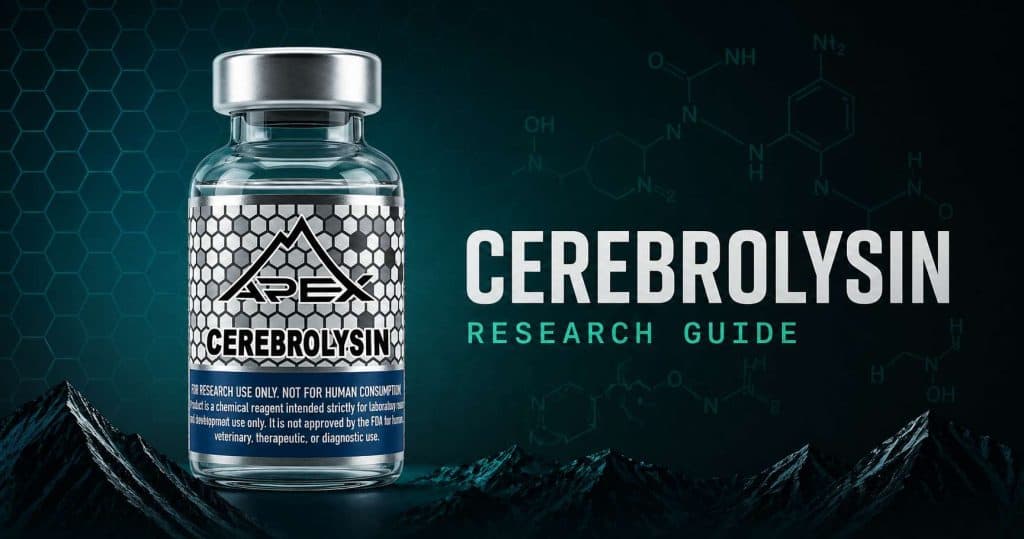
Cerebrolysin is a standardized peptide-and-amino-acid mixture enzymatically derived from purified porcine brain proteins, studied for its effects on neurotrophic-factor signaling, neuronal survival, and cognitive recovery in stroke and dementia research models. Its proposed mechanism is multifactorial neurotrophic-factor-like activity rather than action through a single receptor target. Research evidence spans decades of published clinical and preclinical literature in neurological-recovery and aging-research contexts.
Cerebrolysin occupies a unique position in the research peptide landscape as a standardized peptide-and-amino-acid mixture enzymatically derived from purified porcine brain proteins — a biological hydrolysate whose pharmacology is described in the published literature not as a single receptor mechanism, but as a multi-factor neurotrophic-factor-like activity profile. Every other compound in the Apex Laboratory CNS catalog is a defined synthetic peptide with a CAS number, a single sequence, and a discrete molecular target. Cerebrolysin is none of those things.
This guide covers the cerebrolysin literature for researchers — compositional facts, the proposed neurotrophic-factor-like mechanism, named published clinical research conducted in jurisdictions where Cerebrolysin is an approved pharmaceutical, cluster positioning, and reagent-handling considerations for a lyophilized brain-derived preparation.
- Cerebrolysin is not a single peptide — it is a standardized peptide-and-amino-acid mixture (~25% peptides <10 kDa / ~75% free amino acids by total nitrogen content) and the mixture-vs-single-molecule distinction reframes every mechanism and citation discussion
- The preparation is produced by controlled enzymatic hydrolysis of purified porcine brain proteins by Ever Neuro Pharma (Austria), formerly marketed under the Ebewe Pharma brand
- Mechanism is characterized in the published literature as exhibiting CNTF-, BDNF-, GDNF-, and NGF-like activity in experimental models — pharmacodynamic similarity, not molecular identity
- Cerebrolysin is an approved injectable pharmaceutical in over 40 countries (primarily Austria and parts of Eastern Europe, plus several Asian markets) but is not FDA-approved in the United States, where it is classified as a research chemical
- The Cochrane systematic-review evidence base remains hedged: the vascular dementia review concluded effects “may be too small to be clinically meaningful,” and the 2023 acute ischaemic stroke update reports moderate-certainty evidence of no benefit on all-cause death alongside a potential increase in non-fatal serious adverse events
Why Cerebrolysin Is Not a Single Peptide (and Why That Matters)
Most research peptides — BPC-157, the Khavinson tetrapeptides, Selank, Semax, the GHRH analogs — are defined synthetic molecules with a single CAS number, a single sequence, and a single molecular weight. The mixture is a deliberate departure. As characterized by Hartbauer et al. (2001) at Karl-Franzens University, Graz, the preparation contains “approximately 25% of low molecular weight peptides (<10 kDa)” and “approximately 75% free amino acids” by total nitrogen content — a standardized biological hydrolysate rather than a discrete chemical entity. The published literature does not describe a receptor-binding profile of the kind that defines ipamorelin’s GHSR-1a selectivity or Semax’s BDNF upregulation; it describes a polypharmacological mixture whose bioactivity is distributed across a peptide fraction and a free-amino-acid fraction. The standard Apex Specifications block — CAS / MW / Formula / Sequence — does not apply, and the structure of any honest cerebrolysin summary in the Apex research library reflects that.
Cerebrolysin Composition and Manufacturing Origin
Source Tissue and Enzymatic Hydrolysis Process
Cerebrolysin is manufactured by Ever Neuro Pharma (Austria), formerly marketed under the Ebewe Pharma brand. The starting material is purified porcine brain proteins, processed through a controlled enzymatic hydrolysis that fragments the parent proteins into a defined low-molecular-weight peptide population while liberating the free amino acid pool. Foundational characterization traces to Hutter-Paier et al. (1998) — the earliest of the Windisch-group neuroprotection papers — which documented protection of chick cortical neurons against iron-induced and glutamate-induced neurodegeneration alongside preserved MAP2 expression. Porcine-source biosafety considerations (TSE/prion screening as part of pharmaceutical-grade manufacturing) are addressed in the manufacturer’s regulatory dossier.
Cerebrolysin
Standardized Peptide-and-Amino-Acid Composition
The peptide fraction, not the free amino-acid fraction, is the active component in mechanism studies. Hartbauer et al. (2001) fractionated the preparation and reported that the peptide fraction prevented apoptotic cell death in cortical neurons (TUNEL and DNA-laddering verified) while the amino-acid fraction provided only transient nutritional support without antiapoptotic activity. For the research-grade reagent supplied at ≥99% HPLC + MS verified purity by Apex, this is why a CAS-and-sequence specification cannot describe the material.
Cerebrolysin’s Proposed Mechanism — Neurotrophic-Factor-Like Activity
The Four-Factor Neurotrophic Mimicry Frame (CNTF, BDNF, GDNF, NGF)
The mixture has been characterized in the published literature as exhibiting CNTF-, BDNF-, GDNF-, and NGF-like activity in experimental models — a pharmacodynamic-similarity description, not a molecular-identity claim. The primary literature does not establish that the mixture contains those neurotrophic factors as constituent molecules; it establishes that the biological signature parallels the activity profiles those endogenous factors produce. The NGF-like component has the strongest primary-source anchor: research documented by Ubhi et al. (2013) at UC San Diego’s Masliah lab demonstrated modulation of the proNGF-to-mature-NGF balance in a hAPP transgenic mouse model, with concomitant cholinergic-neuron protection. CNTF, BDNF, and GDNF framings are supported at review level.
Four-Factor Neurotrophic-Factor-Like Activity
Across the published mechanism literature, the preparation’s pharmacodynamic profile has been characterized as exhibiting CNTF-, BDNF-, GDNF-, and NGF-like activity in experimental models. This multi-target framing — synthesized in the Brainin (2018) narrative review — describes pharmacodynamic similarity to four endogenous neurotrophic factors, not molecular identity. The peptide fraction is the active component; the amino-acid fraction provides transient nutritional support without contributing to the neurotrophic signature.
Anti-apoptotic Activity in Cortical Neuron Models
Beyond the four-factor framing, the mixture’s antiapoptotic activity is among the best-characterized findings in the primary literature. The Hutter-Paier in-vitro observation that the preparation protects cortical neurons against iron-induced oxidative damage and glutamate excitotoxicity has been replicated across the Windisch-group catalogue, and the Hartbauer fractionation localized the antiapoptotic signal to the <10 kDa peptide population.
Sonic Hedgehog Pathway and Neurogenesis
The pro-neurogenic component has its strongest primary-source anchor in the Henry Ford Hospital work on rat embolic stroke. Research documented by Zhang et al. (2013) in Stroke established that the mixture upregulates Sonic hedgehog (Shh) and its receptors patched and smoothened in neural progenitor cells — and, critically for causal inference, that pharmacological blockade of smoothened with cyclopamine abolishes the pro-neurogenic effect. In vivo, treatment 24 hours after stroke enhanced neurogenesis, oligodendrogenesis, and axonal remodeling in the peri-infarct area — the cleanest pharmacological-pathway proof in the cerebrolysin mechanism literature.
Pharmacokinetics — Why Effects Outlast Plasma Concentration
Plasma half-life of the preparation is reported in the published pharmaceutical-program literature as approximately 2.5 to 6 hours after parenteral administration, though peer-reviewed primary pharmacokinetic data in human subjects is limited and the figure should be treated as a literature-reported range. The mechanistically interesting feature is the duration paradox: in the CARS trial (Stroke, Muresanu et al., 2016), a 21-day administration course produced measurable day-90 benefit on the Action Research Arm Test — well beyond any plausible plasma residency. The proposed reconciliation is that effects are mediated downstream by signaling cascades and structural remodeling that persist after exposure clears.
Published Cerebrolysin Clinical Research Conducted in Approved-Pharmaceutical Jurisdictions
Stroke Recovery Research (CARS, CASTA, Bornstein Meta-analysis)
The stroke-recovery trial set is anchored by two contrasting RCTs and a 2018 pooled meta-analysis. The Phase II CARS trial (Stroke, Muresanu et al., 2016) was a multicenter, double-blind, placebo-controlled study of early rehabilitation. Subjects received Cerebrolysin 30 mL/day or placebo for 21 days beginning 24–72 hours post-stroke, and the trial reported a beneficial day-90 Action Research Arm Test effect, framed by the authors as exploratory. The larger Phase IV CASTA trial (Stroke, Heiss et al., 2012) — across more than fifty Asian centers under the Heiss / Brainin / Bornstein / Hong group (n≈1,070) — reported a neutral primary endpoint; a favorable trend in the NIHSS >12 subgroup was secondary and post-hoc. A pooled meta-analysis by Bornstein et al. (2018) across nine cerebrolysin stroke RCTs reported a beneficial pooled effect on early NIHSS deficit at day 30.
Vascular Dementia and Alzheimer’s Research
Published in European Journal of Neurology, Alvarez et al. (2006), a 24-week dose-finding RCT in mild-to-moderate Alzheimer’s disease (10 mL, 30 mL, and 60 mL daily doses) reported that Cerebrolysin “led to significant, dose-dependent improvement of cognition and global clinical impression.” The verbatim quotation is retained because the response across cognitive and global endpoints is not strictly monotonic. The Cochrane Database of Systematic Reviews, Cui et al. (2019) vascular dementia review (six RCTs, 597 participants) concluded that “data are not definitive” and “effects may be too small to be clinically meaningful.”
Aphasia and Traumatic Brain Injury Research (ESCAS, CAPTAIN II)
The ESCAS pilot, published as Stroke, Homberg et al. (2025), was a multicenter randomized pilot in two Romanian stroke centers (132 enrolled, 123 ITT) examining Cerebrolysin combined with speech and language therapy in poststroke nonfluent aphasia. Subjects received 10-day cycles repeated three times over 90 days, and the authors reported significant Western Aphasia Battery improvements alongside neurological-deficit secondary endpoints. In moderate-to-severe traumatic brain injury, the CAPTAIN II trial (Muresanu et al., 2020) reported beneficial effects on day-90 overall outcome when added to standard care.
Systematic-Review Evidence: What the Cochrane Reviews Conclude
The systematic-review layer is the load-bearing context. The 2023 Cochrane update on Cerebrolysin in acute ischaemic stroke, published as Cochrane Database of Systematic Reviews, Ziganshina et al. (2023), reports moderate-certainty evidence that Cerebrolysin “probably has no beneficial effect on preventing all-cause death” in acute ischaemic stroke. The same review also reports moderate-certainty evidence of a potential increase in non-fatal serious adverse events. Read against Cui 2019 and Bornstein 2018, this supports the framing in Brainin (2018) in Expert Review of Neurotherapeutics — documented benefit concentrated in subgroups (moderate-to-severe stroke, neurorehabilitation-combined protocols), hedged by an evidence base of limited certainty. The methodological detail sits in the primary peer-reviewed literature, reviewed under Apex’s four-stage review process.
Buy Cerebrolysin from Apex Laboratory
Cerebrolysin 60mg — research-grade reagent, ≥99% purity, HPLC + MS verified, same-day shipping. Distinct from the EU/Asia-approved Ever Neuro Pharma pharmaceutical formulation.
Cerebrolysin in the Research Peptide Landscape
Comparison to Synthetic CNS Neuropeptides (Selank, Semax)
The most informative cluster comparison is with the synthetic CNS neuropeptides Selank and Semax. Both are defined heptapeptides developed at Russia’s Institute of Molecular Genetics, each with a single sequence and a primary signaling target (GABAergic modulation in Selank, dopaminergic and BDNF-mediated effects in Semax). The mixture sits on the opposite axis: a Western/Austrian biological-mixture standardization program rather than a Russian synthetic-neuropeptide design program, and a polypharmacological hydrolysate rather than a single defined molecule. The clusters share outcome-domain overlap but not a research-design template.
Position Within the Nootropic / Neurotrophic Research Landscape
Within the broader nootropic and CNS research peptide landscape, the hydrolysate functions as the multi-factor reference compound. Its multi-target framing per Brainin (2018) makes it a useful benchmark for compounds proposing single-factor mimicry (NGF-only, BDNF-only) and for compounds proposing convergent neurotrophic effects through different molecular routes (Dihexa’s HGF/c-Met pathway, the Khavinson short bioregulators).
Handling, Storage, and Reconstitution Considerations
Use the peptide reconstitution calculator to convert vial mass and bacteriostatic-water volume into concentration and syringe-unit values for research preparations.
The preparation supplied as a research reagent is a lyophilized form that follows standard handling principles for brain-derived peptide material. Storage at −20°C protects the lyophilized vial; reconstituted solution is held refrigerated within the working window indicated on the lot release. Researchers requiring procedural detail should consult the complete reconstitution protocol for lyophilized peptides and the research-peptide storage guide; the porcine source and mixture composition do not change the procedural principles, though they reinforce strict cold-chain handling and minimization of freeze-thaw cycles.
Purchasing Research-Grade Cerebrolysin
The validity of any cerebrolysin research depends on the purity, compositional standardization, and authenticity of the preparation used. A degraded or compositionally drifted hydrolysate will produce unreliable mechanism and dose-response data regardless of how carefully the experiment is designed. At Apex Laboratory, the Cerebrolysin 60mg reagent is verified to ≥99% purity through dual HPLC and Mass Spectrometry analysis on the peptide fraction and is supplied for in-vitro laboratory research use. While Cerebrolysin is the active formulation in approved pharmaceutical products marketed by Ever Neuro Pharma in Austria and parts of Eastern Europe, in Russia, and in several Asian markets, the research-grade reagent supplied by Apex is classified as a research chemical in the United States and is not interchangeable with the approved formulation. All products ship same-day. Visit the About page for the quality-verification process governing every batch.
Frequently Asked Questions
Is Cerebrolysin a peptide?
Cerebrolysin is not a single peptide. It is a standardized peptide-and-amino-acid mixture — approximately 25% peptides below 10 kDa and approximately 75% free amino acids by total nitrogen content — produced by controlled enzymatic hydrolysis of purified porcine brain proteins. The peptide fraction carries the documented neurotrophic-factor-like activity in published mechanism studies.
What is Cerebrolysin made of?
Cerebrolysin is made from purified porcine brain proteins, fragmented through controlled enzymatic hydrolysis into a defined <10 kDa peptide population plus a free-amino-acid pool, standardized by total nitrogen content. Manufacturing is performed by Ever Neuro Pharma in Austria, formerly under the Ebewe Pharma brand.
How does Cerebrolysin work?
The proposed mechanism is characterized as multi-factor neurotrophic-factor-like activity — exhibiting CNTF-, BDNF-, GDNF-, and NGF-like effects in experimental models. Documented contributions include antiapoptotic activity in cortical neuron cultures, proNGF/NGF balance modulation in transgenic Alzheimer’s models, and Sonic hedgehog pathway-mediated neurogenesis in animal stroke models.
Is Cerebrolysin FDA approved?
Cerebrolysin is approved as an injectable pharmaceutical in over 40 countries — primarily Austria and parts of Eastern Europe, plus several Asian markets — under the Ever Neuro Pharma / Ebewe brand. It is not FDA-approved in the United States and is classified as a research chemical there. The research-grade reagent supplied by Apex Laboratory is intended exclusively for in-vitro laboratory research use.
What is Cerebrolysin’s half-life?
Plasma half-life is reported in the published pharmaceutical-program literature as approximately 2.5 to 6 hours, though peer-reviewed primary pharmacokinetic data in human subjects is limited. Biological effects measured in the published trials outlast plasma concentration, likely mediated by downstream signaling cascades that persist after exposure clears.
What did the CARS and CASTA trials show?
CARS (Muresanu et al., 2016) reported a beneficial day-90 Action Research Arm Test outcome in early stroke rehabilitation, framed by the authors as exploratory. CASTA (Heiss et al., 2012, n≈1,070) showed a neutral primary endpoint; a favorable trend in the NIHSS >12 subgroup was secondary and post-hoc.
How does Cerebrolysin compare to Semax and Selank?
The preparation is a porcine-brain-derived peptide-and-amino-acid mixture; Semax and Selank are defined synthetic heptapeptides with single sequences and single primary targets — two distinct lineages, Western/Austrian biological-mixture standardization versus Russian synthetic-neuropeptide design. See the Selank and Semax research guide for detail.
Continue Your Research
- Selank & Semax: Nootropic Peptides from Russian Neuroscience Research — the synthetic-neuropeptide counterweight to Cerebrolysin’s biological mixture
- Nootropic & CNS Research Peptides: A Comprehensive Pillar Guide — the broader landscape situating Cerebrolysin alongside other neurotrophic and nootropic compounds
- How to Reconstitute Peptides: A Complete Step-by-Step Lab Protocol — required procedural cross-reference for handling lyophilized vials
- Peptide Storage Guide: Temperature, Stability & Shelf Life Explained — required procedural cross-reference for storage of lyophilized and reconstituted material
Research Use Disclaimer
This article is provided for educational and research reference purposes only. Cerebrolysin and all products sold by Apex Laboratory are intended exclusively for in-vitro laboratory research use and are not for human consumption. Cerebrolysin is approved as an injectable pharmaceutical in over 40 countries — primarily Austria and parts of Eastern Europe, plus several Asian markets — under the Ever Neuro Pharma / Ebewe brand, but is not FDA-approved in the United States, where it is classified as a research chemical. Researchers should consult the primary peer-reviewed literature cited throughout this article for detailed methodological protocols, trial designs, and complete data sets.