
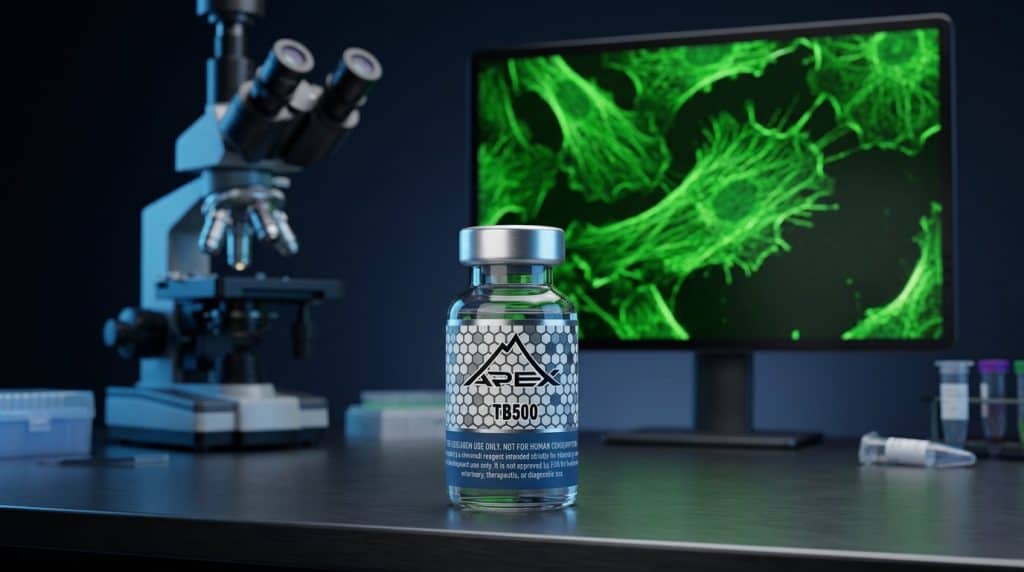
TB-500 is a synthetic peptide corresponding to the active region of Thymosin Beta-4 (Tβ4), one of the most abundant and highly conserved proteins in mammalian cells. While Thymosin Beta-4 was first identified as a thymic hormone in the 1960s, decades of subsequent research have revealed that its primary biological role extends far beyond immune function — Tβ4 is now recognized as a central regulator of actin dynamics, cell migration, angiogenesis, and tissue remodeling. TB-500 retains the key actin-binding properties of the full-length protein, making it one of the most widely used peptides in tissue repair research.
This guide provides a comprehensive overview of TB-500 for researchers — covering its molecular identity and relationship to full-length Thymosin Beta-4, its mechanism of action through the actin cytoskeleton, key published literature, proper handling protocols, and a detailed comparison to the complementary tissue-research peptide BPC-157.
What Is TB-500? Molecular Identity and Origin
TB-500 is a synthetic 43-amino acid peptide that corresponds to the biologically active region of Thymosin Beta-4, a 4,963 Da protein found in virtually every mammalian cell type. Thymosin Beta-4 is one of the most abundant intracellular proteins — present at concentrations of 0.1-0.5 mM in most nucleated cells — and is the primary G-actin (monomeric actin) sequestering protein in eukaryotic cells.
TB-500 Technical Specifications
- Full Name: Thymosin Beta-4 Fragment / TB-500
- Parent Protein: Thymosin Beta-4 (Tβ4)
- CAS Registry Number: 77591-33-4
- Molecular Weight: 4963.50 g/mol
- Amino Acid Count: 43 residues
- Key Active Sequence: LKKTETQ (amino acids 17-23) — the central actin-binding domain
- Physical Appearance: White to off-white lyophilized powder
- Solubility: Freely soluble in bacteriostatic water at neutral pH
The name “Thymosin Beta-4” originates from its initial isolation from calf thymus tissue in 1966 by Allan Goldstein’s laboratory at the Albert Einstein College of Medicine. While it was originally classified as a thymic hormone, subsequent research revealed that Tβ4 is expressed ubiquitously across virtually all cell types and tissues — its presence in the thymus was incidental rather than indicative of its primary function. The protein’s actual role as the major cellular actin-sequestering molecule was characterized in detail through subsequent decades of cell biology research.
Mechanism of Action: The Actin Cytoskeleton
TB-500’s biological activity centers on its interaction with the actin cytoskeleton — the dynamic structural network within cells that drives cell shape, motility, adhesion, and division. Understanding this mechanism requires a brief overview of actin biology.
Actin Dynamics and G-Actin Sequestration
Actin exists in two forms within cells: G-actin (globular, monomeric) and F-actin (filamentous, polymerized). The dynamic equilibrium between these two forms controls cell shape and movement. When cells need to migrate — as during wound closure, immune response, or tissue remodeling — they rapidly polymerize G-actin into F-actin filaments at the leading edge, physically pushing the cell membrane forward.
TB-500 binds G-actin through its central LKKTETQ sequence (amino acids 17-23), forming a 1:1 complex that sequesters G-actin monomers and prevents their premature polymerization. This might seem counterintuitive — why would preventing actin polymerization promote cell migration? — but the sequestration actually serves as a regulatory reservoir. By maintaining a pool of readily available G-actin monomers, TB-500 ensures that when the cell signals for rapid actin assembly (such as during migration or wound closure), there is an abundant supply of monomers immediately available for directed polymerization at the leading edge. Published characterization of this mechanism can be found in Goldstein et al. (2012), Annals of the New York Academy of Sciences.
Cell Migration Promotion
Beyond its actin-sequestering role, research has demonstrated that TB-500 directly promotes cell migration through multiple mechanisms. It upregulates the expression of matrix metalloproteinases (MMPs), which degrade extracellular matrix barriers to allow cells to move through tissue. It also activates Rac1 and Cdc42 — small GTPases that control the formation of lamellipodia and filopodia (the cellular “feet” that drive directed migration). Published studies by Philp et al. (2006) documented these migration-promoting effects in corneal and dermal wound models.
Angiogenesis Stimulation
TB-500 promotes the formation of new blood vessels (angiogenesis) by stimulating endothelial cell migration and tube formation. Published research has documented upregulation of VEGF (vascular endothelial growth factor) expression and direct effects on endothelial progenitor cell recruitment to sites of tissue damage. This pro-angiogenic activity is critical for tissue repair, as new blood vessel formation is required to deliver oxygen and nutrients to regenerating tissue.
Anti-Inflammatory Signaling
Research has identified anti-inflammatory properties of TB-500 that complement its pro-migratory and pro-angiogenic effects. Published studies demonstrate modulation of inflammatory cytokine profiles — specifically, downregulation of pro-inflammatory mediators including IL-1β, TNF-α, and NFκB pathway activity. This anti-inflammatory component may help create an environment conducive to constructive tissue remodeling rather than destructive inflammation at injury sites.
Buy TB-500 from Apex Laboratory
Available in multiple vial sizes · BPC-157 + TB-500 Blend — All ≥99% purity, HPLC & Mass Spec verified, same-day shipping.
Published Research: Key Studies and Applications
Thymosin Beta-4 and its active fragments have been investigated across a wide range of preclinical research models. Below is an overview of the major published research areas:
Wound Healing and Dermal Research
Some of the earliest tissue-repair studies on Thymosin Beta-4 focused on dermal wound healing. Published research in the Journal of Investigative Dermatology (Philp et al., 2006) demonstrated accelerated wound closure in full-thickness dermal wound models, with documented increases in keratinocyte migration, angiogenesis, and collagen deposition. Subsequent studies confirmed these effects across multiple wound model types including excisional wounds, incisional wounds, and burn models.
Cardiac Tissue Research
A significant body of published literature examines Thymosin Beta-4 in cardiac tissue models. Research published in Annals of the New York Academy of Sciences (Goldstein et al., 2012) reviewed cardiac applications including post-ischemic tissue protection, epicardial progenitor cell activation, and reduction of scar formation following experimental myocardial injury. The cardiac research has been particularly notable because it suggests that Tβ4 may promote regenerative repair rather than fibrotic scarring — a distinction with significant implications for cardiovascular research.
Corneal and Ocular Research
TB-500’s effects on corneal epithelial cell migration have been extensively studied. Published data demonstrates promotion of corneal wound closure through increased epithelial cell migration, reduced inflammatory infiltrate, and decreased corneal scarring. This research led to clinical investigation of Thymosin Beta-4 as a potential therapeutic for corneal wound healing.
Musculoskeletal Research
Research in musculoskeletal tissue models has examined TB-500’s effects on tendon and muscle repair. Published studies document enhanced tenocyte migration to tendon injury sites, increased collagen organization during tendon healing, and improved muscle fiber regeneration following crush injury. The actin-regulation mechanism is particularly relevant in musculoskeletal contexts because cell migration to injury sites is a critical early step in the repair cascade.
Neurological Research
An emerging area of Thymosin Beta-4 research involves the nervous system. Published studies have examined its effects on oligodendrocyte precursor cell migration (relevant to myelination), neurite outgrowth, and post-traumatic brain injury recovery in animal models. The mechanism appears to involve the same actin-mediated cell migration promotion that drives effects in other tissue types, applied to neural progenitor and glial cells.
TB-500 vs BPC-157: A Detailed Comparison
TB-500 and BPC-157 are the two most frequently studied tissue-repair research peptides, and researchers often ask how they compare. While both are investigated in tissue remodeling contexts, they operate through fundamentally different molecular mechanisms and come from entirely different biological origins. For an in-depth analysis of BPC-157 specifically, see our BPC-157 Research Guide.
Key Differences at a Glance
- Origin: TB-500 derives from Thymosin Beta-4, a ubiquitous intracellular protein involved in cytoskeletal regulation. BPC-157 derives from Body Protection Compound, a protein found in human gastric juice.
- Size: TB-500 is 43 amino acids (MW: 4,963 g/mol) — more than three times larger than BPC-157’s 15 amino acids (MW: 1,419 g/mol).
- Primary Mechanism: TB-500 works through G-actin sequestration, actin polymerization regulation, and direct cell migration promotion. BPC-157 works through nitric oxide (NO) system modulation, growth factor upregulation (VEGF, EGF, FGF), and FAK-paxillin signaling.
- Acid Stability: BPC-157 is remarkably stable in gastric acid conditions (suitable for oral research). TB-500 is a standard peptide that degrades in acidic environments.
- Anti-Inflammatory Pathway: TB-500 modulates NFκB and pro-inflammatory cytokines directly. BPC-157 modulates inflammation primarily through the NO system.
Why Researchers Combine TB-500 and BPC-157
Because these two peptides target fundamentally different and complementary pathways, they are frequently studied together to investigate potential synergistic effects. TB-500 promotes the cytoskeletal reorganization and physical cell migration needed for cells to reach an injury site. BPC-157 promotes the angiogenesis and growth factor signaling at the site that supports those arriving cells. This biological complementarity makes the combination scientifically logical, which is why Apex Laboratory offers a pre-blended BPC-157 + TB-500 Blend for research groups investigating this combination approach.
Storage, Handling, and Reconstitution
Lyophilized Storage
Store lyophilized TB-500 at -20°C in its original sealed vial, protected from moisture and light. At 43 amino acids, TB-500 is a medium-sized peptide that maintains good lyophilized stability for 12-18+ months at proper freezer temperature. For comprehensive storage guidance, see our Peptide Storage Guide.
Reconstitution
TB-500 dissolves readily in bacteriostatic water at neutral pH — no acidified solvent is needed. For a 5 mg vial, adding 2 mL of bacteriostatic water produces a working concentration of 2.5 mg/mL (2,500 mcg/mL). Use our Peptide Reconstitution Calculator to compute exact concentrations for any volume, or follow our complete step-by-step reconstitution protocol.
After Reconstitution
Store at 2-8°C and use within 14 days. For longer storage, aliquot into single-use volumes immediately after reconstitution and freeze at -20°C. Each aliquot should be thawed only once. Always sterilize the vial stopper with an alcohol swab before each withdrawal.
Purchasing Research-Grade TB-500
At Apex Laboratory, our TB-500 is verified to ≥99% purity through dual HPLC and Mass Spectrometry analysis, confirming both chromatographic purity and correct molecular weight (4,963.50 g/mol). We offer TB-500 in multiple vial sizes, as well as the pre-blended BPC-157 + TB-500 Blend for combination research. All products ship same-day with temperature-controlled packaging. Learn more about our quality process on our About page, or read our guide to reading Certificates of Analysis to understand exactly what our analytical verification confirms.
Frequently Asked Questions
What is the relationship between TB-500 and Thymosin Beta-4?
TB-500 is a synthetic peptide corresponding to the biologically active region of Thymosin Beta-4 (Tβ4), a naturally occurring 43-amino acid protein found in virtually all mammalian cells. TB-500 retains the key LKKTETQ actin-binding domain and the full-length protein’s biological properties related to actin regulation, cell migration, and tissue remodeling. The terms are often used interchangeably in research contexts, though strictly speaking, TB-500 refers to the synthetic research-grade compound while Thymosin Beta-4 refers to the endogenous protein.
What is the CAS number and molecular weight of TB-500?
TB-500 has CAS registry number 77591-33-4 and a molecular weight of 4,963.50 g/mol. It consists of 43 amino acid residues.
Can TB-500 be taken orally like BPC-157?
No. Unlike BPC-157, which demonstrates unusual stability in gastric acid conditions due to its origin as a gastric juice component, TB-500 is a standard peptide that would be degraded by stomach acid and digestive enzymes. TB-500 research is conducted using parenteral (non-oral) administration routes. For oral peptide research, consider BPC-157 oral capsules instead.
How does TB-500 differ from other tissue-repair peptides like GHK-Cu?
TB-500 acts primarily through actin cytoskeleton regulation and cell migration promotion. GHK-Cu (copper peptide) acts through a completely different mechanism — stimulating collagen synthesis, glycosaminoglycan production, and antioxidant pathways via copper-dependent enzymatic activity. They target different aspects of tissue biology and are sometimes used in combination research. For more on GHK-Cu, see our peptide catalog.
Is TB-500 approved for human therapeutic use?
No. TB-500 is classified as a research chemical and has not been approved by the FDA or any regulatory agency for human therapeutic use. All TB-500 sold by Apex Laboratory is intended strictly for in-vitro laboratory research and is not for human consumption, veterinary use, or any therapeutic application.
Continue Your Research
- BPC-157 Peptide: Mechanism, Research Applications & Published Studies
- How to Reconstitute Peptides: A Complete Step-by-Step Lab Protocol
- Peptide Storage Guide: Temperature, Stability & Shelf Life
- Semaglutide vs Tirzepatide: Mechanism, Research Data & Key Differences
Research Use Disclaimer
This article is provided for educational and research reference purposes only. TB-500 and all products sold by Apex Laboratory are intended exclusively for in-vitro laboratory research use and are not for human consumption. Researchers should consult the primary peer-reviewed literature cited throughout this article for complete methodological details and experimental data.