
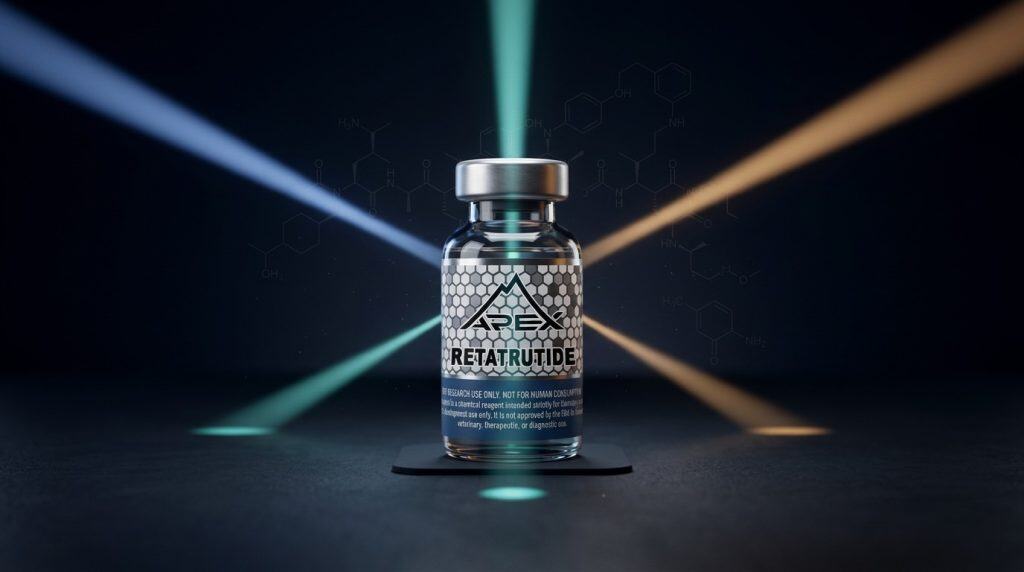
Retatrutide represents the most significant advancement in incretin peptide pharmacology since the introduction of Tirzepatide. As the first-in-class triple receptor agonist — simultaneously activating GIP, GLP-1, and glucagon receptors — it opens an entirely new dimension of metabolic signaling that no prior compound has achieved. While Semaglutide targets one receptor and Tirzepatide targets two, Retatrutide targets three — and the Phase 2 clinical trial data, published in the New England Journal of Medicine, demonstrated the most substantial metabolic effects ever reported for any compound in this class.
This guide provides a detailed, evidence-based overview of Retatrutide for researchers — covering its molecular design, triple receptor mechanism, the landmark Phase 2 trial results, how it compares to existing dual and single agonists, and its significance in the evolving landscape of multi-agonist metabolic peptide research.
What Is Retatrutide? Molecular Identity
Retatrutide (also known as LY3437943 during development) is a synthetic 39-amino acid peptide engineered to simultaneously activate three distinct metabolic hormone receptors. It was developed by Eli Lilly and Company as a next-generation incretin-based compound designed to explore whether adding a third receptor pathway — glucagon — to the dual GIP/GLP-1 approach pioneered by Tirzepatide would produce additional metabolic effects.
Retatrutide Technical Specifications
- Name: Retatrutide (LY3437943)
- CAS Registry Number: 2381089-83-2
- Molecular Weight: 4,471.5 g/mol
- Peptide Length: 39 amino acids
- Classification: Triple GIP/GLP-1/Glucagon receptor agonist (first in class)
- Half-Life Extension: Fatty acid modification enabling albumin binding for extended research duration
- Receptor Targets: GIP receptor (full agonism), GLP-1 receptor (agonism), Glucagon receptor (agonism)
- Physical Form: White to off-white lyophilized powder
- Solubility: Soluble in bacteriostatic water
The Triple Agonist Mechanism: Three Receptors, Three Pathways
To understand what makes Retatrutide unique, it helps to understand each of the three receptor pathways it engages and what each one contributes to the overall metabolic signaling profile:
Pathway 1: GIP Receptor (GIPR) — Incretin Potentiation
GIP (glucose-dependent insulinotropic polypeptide) is the dominant incretin hormone in healthy human physiology, responsible for approximately 60-70% of the postprandial incretin effect. GIP receptor activation enhances glucose-dependent insulin secretion from pancreatic beta cells and has documented effects on lipid metabolism in adipose tissue. This is the same GIP pathway that gives Tirzepatide its advantage over GLP-1-only compounds like Semaglutide.
Pathway 2: GLP-1 Receptor (GLP-1R) — Appetite and Glucose Regulation
GLP-1 receptor activation is the established foundation of incretin-based metabolic research. It promotes glucose-dependent insulin secretion, suppresses glucagon from alpha cells, decelerates gastric emptying, and reduces appetite through hypothalamic signaling. This is the pathway targeted by Semaglutide, Liraglutide, and Dulaglutide, and the secondary pathway activated by Tirzepatide.
Pathway 3: Glucagon Receptor (GCGR) — The Novel Addition
This is what makes Retatrutide fundamentally different from every prior metabolic peptide. Glucagon receptor activation stimulates hepatic energy expenditure through increased fatty acid oxidation in the liver, promotes thermogenesis (heat production that burns calories), and activates lipolysis in adipose tissue through cAMP-PKA signaling. These are entirely distinct metabolic pathways that neither GIP nor GLP-1 receptor activation can access. While glucagon might seem counterproductive because it raises blood glucose, the simultaneous GIP and GLP-1 activation counterbalances any glycemic effects, allowing researchers to study the energy expenditure and fat oxidation benefits of glucagon signaling without net glycemic disruption.
Published analysis of this triple mechanism was detailed in the New England Journal of Medicine (Jastreboff et al., 2023), which characterized Retatrutide’s pharmacological profile across all three receptor pathways.
Shop Multi-Agonist Metabolic Peptides at Apex Laboratory
Retatrutide · Tirzepatide · Semaglutide · CagriSema · Survodutide · Mazdutide — All ≥99% purity, HPLC & Mass Spec verified, same-day shipping.
Phase 2 Clinical Trial Data: The NEJM Publication
The most important published dataset for Retatrutide is the Phase 2 dose-finding trial published in the New England Journal of Medicine (Jastreboff et al., 2023). This randomized, double-blind, placebo-controlled study enrolled 338 adults with obesity (BMI ≥30) or overweight with at least one weight-related comorbidity, randomized across multiple Retatrutide dose levels (1, 4, 8, and 12 mg) versus placebo over 48 weeks.
Primary Results: Weight Reduction
The headline results were unprecedented in metabolic peptide research. The highest Retatrutide dose group (12 mg) achieved a mean body weight reduction of approximately 24.2% from baseline over 48 weeks. To put this in context: this surpassed the 22.5% weight reduction reported for Tirzepatide 15 mg in the SURMOUNT-1 trial (72 weeks) and substantially exceeded the 14.9% reported for Semaglutide 2.4 mg in the STEP 1 trial (68 weeks). Critically, the weight reduction trajectory at 48 weeks had not yet plateaued, suggesting that longer treatment durations may produce even greater effects.
The Evolutionary Trajectory
Viewed alongside published data from prior compounds, the progression is striking: Semaglutide (one receptor) → ~15% weight reduction. Tirzepatide (two receptors) → ~22.5% weight reduction. Retatrutide (three receptors) → ~24.2% weight reduction (and still declining at trial end). Each additional receptor pathway adds a meaningful increment, consistent with the hypothesis that broader metabolic pathway engagement produces compounding effects.
Hepatic Effects
A particularly notable finding from the Phase 2 data was Retatrutide’s effects on liver-related endpoints. The glucagon receptor component is hypothesized to drive hepatic fatty acid oxidation, and the trial data showed reductions in hepatic fat content that exceeded those seen with GIP/GLP-1-only compounds. This has generated significant interest in Retatrutide’s potential relevance to MASH (metabolic dysfunction-associated steatohepatitis) research — a liver condition for which effective research compounds are urgently needed. Separately, Survodutide, a dual GLP-1/glucagon agonist, is being studied specifically for this indication.
How Retatrutide Compares to Other Metabolic Peptides
Understanding where Retatrutide sits in the metabolic peptide landscape requires comparing it to both established and emerging compounds. For a detailed head-to-head analysis of Semaglutide and Tirzepatide specifically, see our comprehensive Semaglutide vs Tirzepatide comparison.
vs Semaglutide (Single Agonist — GLP-1 only)
Semaglutide activates only the GLP-1 receptor. It is the most extensively studied compound in this class with the largest published dataset (STEP, SUSTAIN, PIONEER programs). Retatrutide adds GIP and glucagon receptor activation on top of GLP-1 signaling, producing substantially greater metabolic effects in published data but with a less mature safety and efficacy dataset.
vs Tirzepatide (Dual Agonist — GIP + GLP-1)
Tirzepatide activates GIP and GLP-1 receptors but not the glucagon receptor. It was the first dual agonist and demonstrated superiority over Semaglutide in the SURPASS-2 head-to-head trial. Retatrutide adds glucagon receptor agonism to the dual-agonist foundation, with Phase 2 data suggesting additional metabolic effects particularly on hepatic endpoints.
vs CagriSema (Dual Pathway — Amylin + GLP-1)
CagriSema takes a different dual-pathway approach: combining Cagrilintide (amylin agonist) with Semaglutide (GLP-1 agonist). It targets amylin + GLP-1 rather than GIP + GLP-1 + glucagon, representing a fundamentally different combination strategy that targets brainstem satiety signaling alongside incretin pathways.
vs Survodutide and Mazdutide (Dual Agonists — GLP-1 + Glucagon)
Survodutide and Mazdutide both target GLP-1 and glucagon receptors (without GIP). They represent an intermediate step between single agonism and Retatrutide’s triple agonism, with particular research interest in liver-targeted metabolic effects from the glucagon component.
Storage, Handling, and Reconstitution
Lyophilized Storage
Store lyophilized Retatrutide at -20°C in its original sealed vial. As a 39-amino acid peptide with a molecular weight of 4,471.5 g/mol, it falls in the medium-size range and maintains good lyophilized stability for 12-18+ months at proper freezer temperature. For comprehensive storage guidance, see our Peptide Storage Guide.
Reconstitution
Retatrutide can be reconstituted with bacteriostatic water. For a 5 mg vial, adding 2.5 mL produces a working concentration of 2 mg/mL (2,000 mcg/mL). Due to its larger molecular size, allow up to 5 minutes for complete dissolution with gentle rolling. Use our reconstitution calculator for exact concentration computations, or follow our step-by-step reconstitution protocol.
After Reconstitution
Store at 2-8°C and use reconstituted material within 14 days. Aliquot into single-use volumes immediately after reconstitution for longer-term storage at -20°C.
Purchasing Research-Grade Retatrutide
At Apex Laboratory, our Retatrutide is verified to ≥99% purity through dual HPLC and Mass Spectrometry analysis, confirming both chromatographic purity and correct molecular weight (4,471.5 g/mol, CAS 2381089-83-2). Multiple dosage sizes are available from 5 mg to 60 mg, all shipping same-day. For researchers interested in the broader metabolic peptide landscape, we also carry Tirzepatide, Semaglutide, CagriSema, Survodutide, and Mazdutide. Visit our About page to learn about our quality verification process.
Frequently Asked Questions
What makes Retatrutide different from Tirzepatide?
Tirzepatide is a dual agonist targeting GIP and GLP-1 receptors. Retatrutide is a triple agonist targeting GIP, GLP-1, and glucagon receptors. The addition of glucagon receptor activation is designed to stimulate hepatic energy expenditure, fatty acid oxidation, and thermogenesis — metabolic pathways not accessible through GIP and GLP-1 signaling alone. Phase 2 data suggests this third pathway produces additional metabolic effects, particularly on liver-related endpoints.
What is the CAS number for Retatrutide?
Retatrutide has CAS registry number 2381089-83-2. Its molecular weight is 4,471.5 g/mol, and it is a 39-amino acid synthetic peptide also known by its development code LY3437943.
What did the Phase 2 trial show?
The Phase 2 trial published in NEJM (Jastreboff et al., 2023) enrolled 338 adults and studied multiple dose levels over 48 weeks. The highest dose (12 mg) produced approximately 24.2% mean body weight reduction — the highest ever reported for any anti-obesity compound in a Phase 2 trial, exceeding published results from both Tirzepatide and Semaglutide trials.
Is Retatrutide FDA-approved?
No. As of 2026, Retatrutide is in Phase 3 clinical trials (ClinicalTrials.gov) but has not yet received FDA approval. The research-grade Retatrutide sold by Apex Laboratory is classified as a chemical research reagent intended strictly for in-vitro laboratory research and is not for human consumption.
How should Retatrutide be stored?
Store lyophilized Retatrutide at -20°C. After reconstitution with bacteriostatic water, refrigerate at 2-8°C and use within 14 days. Aliquot reconstituted material into single-use volumes to avoid repeated freeze-thaw cycles. See our storage guide for detailed protocols.
Continue Your Research
- Semaglutide vs Tirzepatide: Mechanism, Research Data & Key Differences
- How to Reconstitute Peptides: A Complete Step-by-Step Lab Protocol
- Peptide Storage Guide: Temperature, Stability & Shelf Life
- How to Read a Certificate of Analysis (COA)
Research Use Disclaimer
This article is provided for educational and research reference purposes only. Retatrutide and all products sold by Apex Laboratory are intended exclusively for in-vitro laboratory research use and are not for human consumption. Researchers should consult the peer-reviewed NEJM publication cited in this article for complete clinical trial methodology and data.