About Apex Laboratory: HPLC + Mass-Spec Verified Peptide Supplier
Apex Laboratory was established to solve a critical failure in the research market: the lack of consistent, verified purity. We bridge the gap between pharmaceutical manufacturing and laboratory procurement.
Apex Laboratory Quality Standard
Every batch released under the Apex Laboratory name is subject to our internal quality standard before stocking approval. Our protocol follows quality management practices aligned with ISO 9001 principles, including documented batch verification, analytical data review, and traceability requirements for every compound in our catalog. We do not stock product that has not passed this standard.
Built on verification.
Not on marketing claims.
Apex Laboratory exists because the research-reagent market needed a vendor that could prove what it sells. Every compound in our catalog is screened by HPLC for chromatographic purity and ESI-MS for molecular identity before it enters inventory — and every release record is published, openly, for anyone to inspect. No paywall. No email gate. No hidden archives.
Dual-method verification
Every batch is screened on two orthogonal analytical instruments before release. HPLC quantifies purity. ESI-MS confirms molecular identity. Neither alone is sufficient — running both is the point.
Open analytical record
Every product page links the live HPLC trace and Mass Spec report for the batch currently shipping. The full archive of 74 verified compounds is public — searchable, filterable, and free to inspect.
Research-grade standards
≥99% purity by HPLC. Endotoxin testing by LAL. Lyophilized in sterile, temperature-controlled conditions. Every release carries an analyst sign-off documenting chain of custody and dual review.
Two instruments. Two questions. One release record.
How pure is it?
Reverse-phase chromatography separates the sample on a C18 column. Purity is reported as the percentage of total UV-absorbing peak area attributable to the target compound. A "≥99%" specification means the main peak accounts for at least 99% of the integrated area, with retention time matching the reference standard.
Is it the right molecule?
Electrospray ionization mass spectrometry confirms molecular identity by measuring mass-to-charge. Smaller compounds are identified by the [M+H]⁺ ion and isotope envelope; larger peptides are confirmed across multiple charge states that all back-calculate to the same parent mass.
We supply chemical reagents for in-vitro laboratory research. We don't make therapeutic claims. We don't dose, prescribe, or recommend. What we do is publish the data — fully, openly, batch by batch — so the researchers we serve can verify what they're working with before they ever open a vial.
That's the standard. It hasn't changed since day one.
Our Story
How verification
actually works.
What we get asked most about our analytical methodology, public archive, and operating standards. If your question isn't covered here, email editorial@apexlaboratory.org — we respond within one business day.
01 Who is Apex Laboratory?
Apex Laboratory is a U.S.-based supplier of research-grade peptides, reagents, and bacteriostatic solutions for in-vitro laboratory applications. We exist because the research-reagent market needed a vendor that could prove what it sells — every batch dual-verified, every release record publicly archived, every analytical method openly documented. Our team includes research coordinators, quality control staff, analytical chemists, and editorial reviewers.
02 How does Apex differ from other research peptide suppliers?
Three structural differences. First, every batch is screened on two orthogonal instruments — HPLC for chromatographic purity and ESI-MS for molecular identity — before release. Most suppliers run only one method or rely on reference COAs from their wholesale source. Second, every release record is published openly in our Lab Verified archive. Most suppliers gate COAs behind email signups or post a single historical example as marketing. Third, we operate as a U.S.-registered LLC with public business registration. Many research peptide vendors operate through anonymized international fronts with no traceable accountability.
03 What does ≥99% purity actually mean?
It is a chromatographic specification, not a mass percentage. Reverse-phase HPLC separates the sample on a C18 column and reports purity as the percentage of total UV-absorbing peak area attributable to the target compound at the analytical wavelength. A ≥99% specification means the main compound peak accounts for at least 99% of the integrated absorbance area, with retention time matching the reference standard and baseline resolution from any minor peaks. The remaining ≤1% reflects synthesis-related impurities, residual solvent peaks, or instrumental noise.
04 How does your in-house testing work with independent third-party testing?
Independent third-party testing remains the gold standard in analytical chemistry, and we are explicit about that. In-house HPLC and ESI-MS on every batch is the first analytical layer — fast enough to catch off-spec material before it enters inventory, and rigorous enough to publish openly. Apex works with Janoshik as our third-party testing partner for independent analytical verification, a second source on top of that in-house release record. Every report on our public archive is the actual release record for the lot currently shipping, not a representative sample or a marketing template.
05 Do you publish certificates of analysis publicly?
Yes. Every compound in our catalog has its Certificate of Analysis published openly in our Lab Verified archive — searchable by name or batch ID, filterable by category, and free to inspect. There is no email gate, no paywall, and no hidden archive. The published record reflects the batch currently shipping. When a new batch is released, the archive updates with that batch's analytical record.
06 How often is each batch tested?
Each lot is tested once at release. Inventory is not re-screened on a rolling schedule because the analytical signature of a properly stored compound does not drift in a sealed, lyophilized vial held at -20°C. Lots are re-tested if storage conditions are compromised, if a vial is returned for QA review, or if a new analytical method warrants re-verification of historical inventory. The COA published for each compound reflects the analytical record of the batch currently shipping.
07 What is HPLC and why does it matter?
High-Performance Liquid Chromatography is a separation technique that quantifies how pure a sample is. The sample passes through a chromatography column under high pressure, and components separate based on their interaction with the column's stationary phase. A UV detector measures absorbance as each component elutes, producing a chromatogram. Purity is reported as the percentage of total absorbance area attributable to the target compound. HPLC answers the question "how pure is this sample?" — but it cannot tell you whether the dominant peak is actually the molecule you intended to make.
08 What is ESI-MS and what does it tell you?
Electrospray Ionization Mass Spectrometry confirms molecular identity by measuring mass-to-charge ratios. The sample is ionized at atmospheric pressure and the resulting ions are mass-analyzed against the expected molecular weight. Smaller compounds are identified by the [M+H]⁺ ion and isotope envelope; larger peptides (≥3,000 Da) are confirmed across multiple charge states — typically [M+2H]²⁺, [M+3H]³⁺, [M+4H]⁴⁺ — that all back-calculate to the same parent mass. ESI-MS answers the question "is this the right molecule?" A compound can be 99.9% pure by HPLC and still be the wrong molecule. Running both methods is the point.
09 What does "research use only" actually mean?
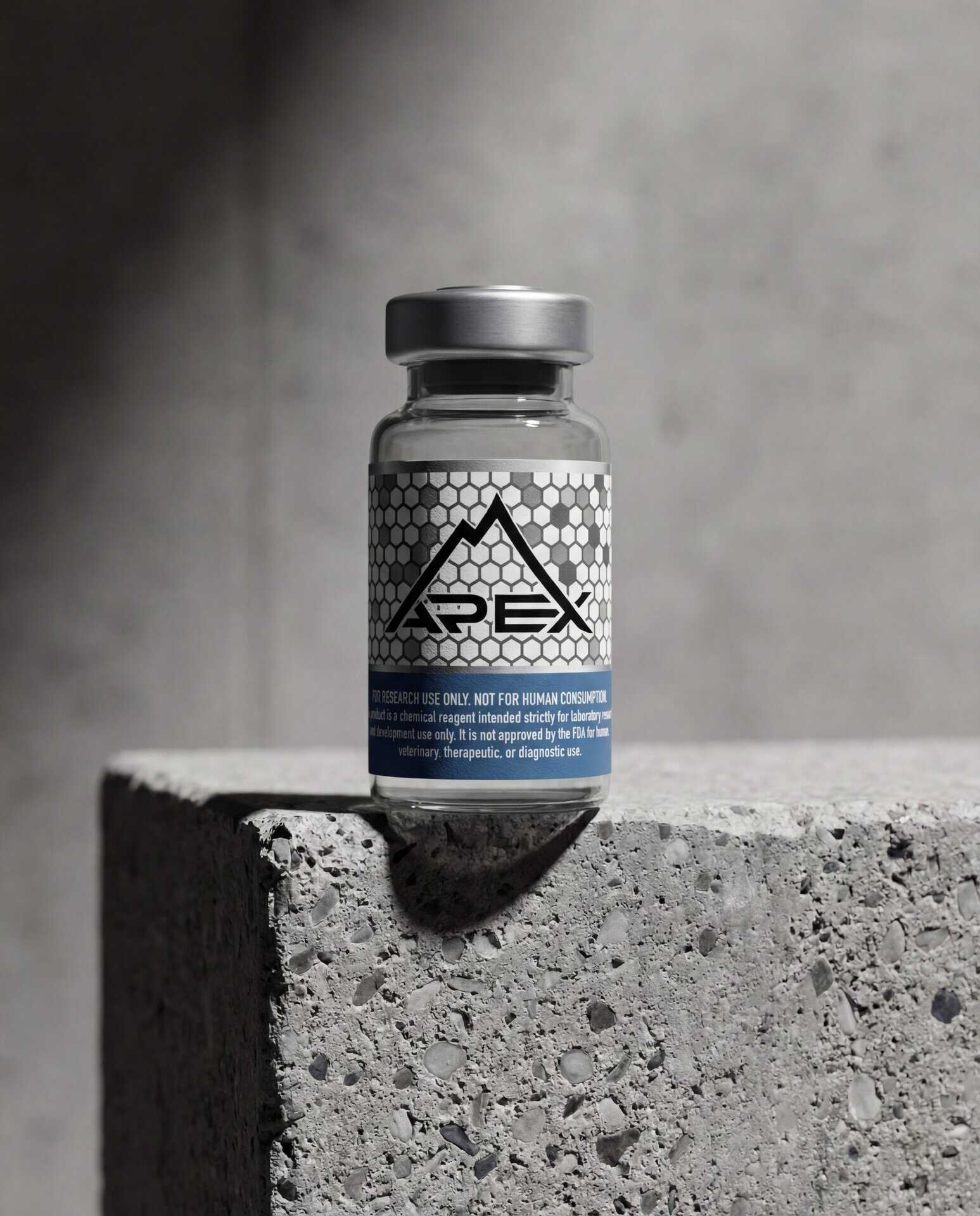
All Apex Laboratory products are supplied as chemical reagents for in-vitro laboratory research applications. They are not approved for human consumption, veterinary use, or any therapeutic application, and are not approved by the FDA for any clinical purpose. Purchasers assume full responsibility for safe handling, proper storage, and compliance with all applicable federal, state, and local laws governing the purchase and use of chemical research reagents. The "research use only" designation is both a regulatory classification and a statement of intended audience: researchers, academic professionals, and laboratory personnel evaluating compounds for in-vitro work.
10 Do you use independent third-party verification?
Yes — Apex works with Janoshik as our third-party testing partner for independent analytical verification. This independent third-party layer operates as a second source alongside the in-house HPLC and ESI-MS release that every batch already passes, and does not replace our internal release records.
Still have a question? Email editorial@apexlaboratory.org
See the Public COA Archive