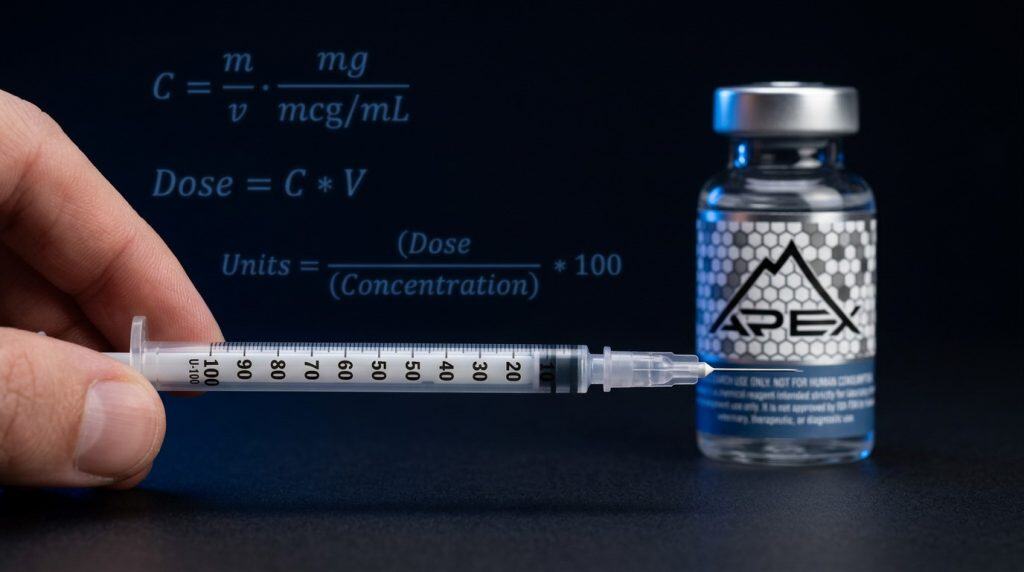
Peptide concentration math converts a target amount in micrograms or milligrams into a measured volume from two values: peptide mass (mg) in the vial and reconstitution-solvent volume (mL). The core calculation is concentration = mass ÷ volume; measured volume = target amount ÷ concentration. Unit conversions between mg, mcg, and mL drive most peptide-research measurement errors.
Getting peptide concentration math wrong is one of the most common sources of error in peptide research — and it is completely preventable. The calculations themselves are straightforward, but the unit conversions between milligrams, micrograms, milliliters, and U-100 syringe units create confusion, especially for researchers new to working with peptides. A single decimal point error can result in a 10-fold measurement mistake that invalidates an entire experiment.
This guide covers every calculation you need to work confidently with research peptides — from computing your reconstituted concentration, to converting between mg and mcg, to determining exactly how many syringe units of volume to draw for a specific microgram target amount. We also provide a free interactive tool that does all the math instantly: the Apex Laboratory Peptide Reconstitution Calculator.
The Three Core Calculations in Peptide Research
Every peptide measurement workflow involves three sequential calculations. Master these three formulas and you can work with any peptide at any concentration with complete confidence.
Calculation 1: Concentration After Reconstitution
When you dissolve a lyophilized peptide in bacteriostatic water, you need to know the resulting concentration. The formula is:
Concentration (mg/mL) = Peptide amount in vial (mg) ÷ Volume of solvent added (mL)
This is the foundation — every subsequent calculation builds on this number. Write it on the vial label immediately after reconstitution.
Worked Examples
- BPC-157 5 mg vial + 2 mL BAC water → 5 ÷ 2 = 2.5 mg/mL
- Ipamorelin 5 mg vial + 2.5 mL BAC water → 5 ÷ 2.5 = 2.0 mg/mL
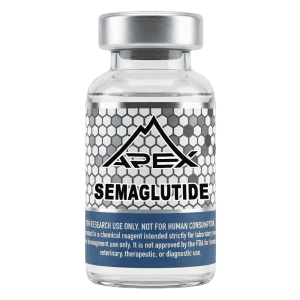
- Semaglutide 5 mg vial + 1 mL BAC water → 5 ÷ 1 = 5.0 mg/mL
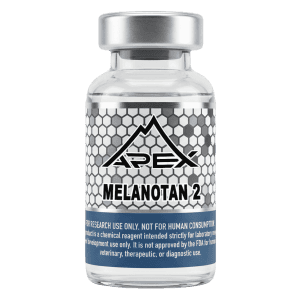
- Melanotan II 10 mg vial + 2 mL BAC water → 10 ÷ 2 = 5.0 mg/mL
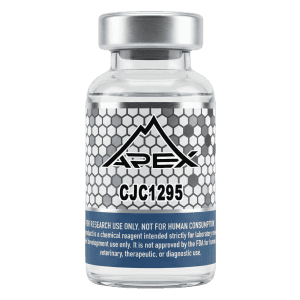
- CJC-1295 2 mg vial + 2 mL BAC water → 2 ÷ 2 = 1.0 mg/mL
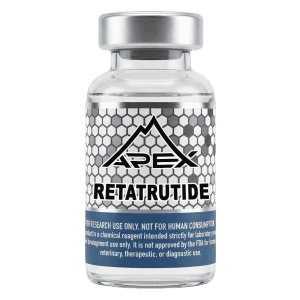
- Retatrutide 10 mg vial + 2 mL BAC water → 10 ÷ 2 = 5.0 mg/mL
Sterile, 0.9% benzyl-alcohol preserved water supports multiple research withdrawals up to 28 days after first puncture.
Shop Bacteriostatic Water →
Calculation 2: Converting mg/mL to mcg/mL
Most peptide research protocols specify target amounts in micrograms (mcg) rather than milligrams (mg), because working amounts are typically in the microgram range. The conversion is simple:
Concentration (mcg/mL) = Concentration (mg/mL) × 1,000
One milligram equals 1,000 micrograms. So a concentration of 2.5 mg/mL is the same as 2,500 mcg/mL. A concentration of 1.0 mg/mL equals 1,000 mcg/mL.
Calculation 3: Micrograms to Insulin Syringe Units
This is where most researchers get confused. Insulin syringes are marked in “units” (IU), not milliliters. On a standard U-100 insulin syringe (the type used in most peptide research), 100 units equals exactly 1 mL. The formula to determine how many syringe units of volume correspond to a target microgram amount is:
Syringe units to draw = (Target amount in mcg ÷ Concentration in mcg/mL) × 100
Worked Examples — Full Start-to-Finish
Example 1: BPC-157, 250 mcg target amount
- Vial: BPC-157 5 mg, reconstituted with 2 mL BAC water
- Concentration: 5 ÷ 2 = 2.5 mg/mL = 2,500 mcg/mL
- Target amount: 250 mcg
- Syringe units: (250 ÷ 2,500) × 100 = 10 units
- Draw to the 10-unit mark on the U-100 syringe
Example 2: Ipamorelin, 300 mcg target amount
- Vial: Ipamorelin 5 mg, reconstituted with 2.5 mL BAC water
- Concentration: 5 ÷ 2.5 = 2.0 mg/mL = 2,000 mcg/mL
- Target amount: 300 mcg
- Syringe units: (300 ÷ 2,000) × 100 = 15 units
- Draw to the 15-unit mark on the U-100 syringe
Example 3: Semaglutide, 500 mcg target amount
- Vial: Semaglutide 5 mg, reconstituted with 2.5 mL BAC water
- Concentration: 5 ÷ 2.5 = 2.0 mg/mL = 2,000 mcg/mL
- Target amount: 500 mcg
- Syringe units: (500 ÷ 2,000) × 100 = 25 units
- Draw to the 25-unit mark on the U-100 syringe
Example 4: CJC-1295, 100 mcg target amount
- Vial: CJC-1295 2 mg, reconstituted with 2 mL BAC water
- Concentration: 2 ÷ 2 = 1.0 mg/mL = 1,000 mcg/mL
- Target amount: 100 mcg
- Syringe units: (100 ÷ 1,000) × 100 = 10 units
- Draw to the 10-unit mark on the U-100 syringe
Reading Volume on a U-100 Graduated Syringe
The U-100 designation means the syringe is calibrated for a solution containing 100 units per milliliter. For peptide research purposes, the important conversion is simply:
- 100 units = 1.00 mL
- 50 units = 0.50 mL
- 25 units = 0.25 mL
- 10 units = 0.10 mL
- 5 units = 0.05 mL
- 1 unit = 0.01 mL
Standard U-100 insulin syringes come in three sizes: 0.3 mL (30 units), 0.5 mL (50 units), and 1.0 mL (100 units). The 1.0 mL size is the most versatile for peptide research. Each size has graduation marks in 1-unit increments (on 0.3 and 0.5 mL syringes) or 2-unit increments (on 1.0 mL syringes). For target amounts requiring precision below 2 units, use the smaller 0.3 mL syringe which has finer graduations.
mcg per Syringe Unit (0.01 mL) Reference Table
Once you know your concentration in mcg/mL, you can quickly determine how many micrograms each single syringe unit delivers. This saves you from recalculating every time you draw a volume:
mcg per unit = Concentration (mcg/mL) ÷ 100
Common concentrations and their per-unit values:
| Concentration | Equivalent | Each U-100 syringe unit delivers |
|---|---|---|
| 1,000 mcg/mL | 1 mg/mL | 10 mcg |
| 2,000 mcg/mL | 2 mg/mL | 20 mcg |
| 2,500 mcg/mL | 2.5 mg/mL | 25 mcg |
| 5,000 mcg/mL | 5 mg/mL | 50 mcg |
| 10,000 mcg/mL | 10 mg/mL | 100 mcg |
Worked-example basis & references: Every example above uses the universal relationship concentration = peptide mass ÷ solvent volume, with syringe-unit values derived from the U-100 insulin-syringe standard of 100 units per 1 mL. The bacteriostatic water used as the solvent in each example meets the United States Pharmacopeia (USP) Bacteriostatic Water for Injection standard, and its benzyl-alcohol preservative is catalogued by the NCBI PubChem compound database (CID 244). For the full reconstitution method see the reconstitution guide, or run the figures directly in the reconstitution calculator.
With this table memorized (or written on a lab card), you can instantly convert syringe units to micrograms in your head. If your BPC-157 is at 2,500 mcg/mL, you know each unit is 25 mcg, so 10 units = 250 mcg, 20 units = 500 mcg, and so on.
Common Measurement & Calculation Mistakes and How to Avoid Them
Mistake 1: Confusing mg and mcg
This is the most dangerous error because it produces a 1,000-fold difference. One milligram (mg) equals 1,000 micrograms (mcg). If a protocol calls for 250 mcg and you accidentally measure 250 mg equivalent, you have used 1,000 times the intended amount. Always double-check which unit your protocol specifies, and always label reconstituted vials in both mg/mL and mcg/mL to avoid confusion.
Mistake 2: Forgetting to account for reconstitution volume
A common error: assuming that a “5 mg vial” means every syringe draw contains 5 mg. It does not — the 5 mg is the total peptide in the vial. The concentration depends entirely on how much solvent you added. A 5 mg vial reconstituted with 1 mL is 5 mg/mL. The same vial reconstituted with 5 mL is 1 mg/mL — a 5-fold difference in concentration.
Mistake 3: Using the wrong syringe type
U-100 insulin syringes are calibrated for 100 units per mL. U-40 syringes (sometimes used in veterinary settings) are calibrated for 40 units per mL. If you use a U-40 syringe but calculate amounts assuming U-100, you will draw 2.5 times too much. Always verify you are using U-100 syringes for peptide research calculations.
Mistake 4: Not accounting for dead space
Every syringe has a small amount of “dead space” — liquid that remains in the hub and needle after the plunger is fully depressed. In a standard insulin syringe, this is approximately 0.5-1 unit (0.005-0.01 mL). For most research purposes, this amount is negligible. However, for extremely precise measurement of potent compounds, low dead-space syringes are available.
Mistake 5: Mental math instead of written calculation
Always write out your calculations or use the calculator tool. Mental math errors are easy to make and hard to catch. Keep a lab notebook or calculation sheet where you record: vial size (mg), solvent volume added (mL), resulting concentration (mg/mL and mcg/mL), target amount (mcg), and calculated syringe units. This creates a traceable record and catches errors before they affect your experiments.
How to Choose Your Reconstitution Volume for Convenient Measurement
You have freedom to choose how much bacteriostatic water to add, so pick a volume that creates a concentration making your target amount easy to measure. The goal is a target amount that corresponds to a whole number (or easy fraction) of syringe units.
For example, if your standard research target amount will be 250 mcg of BPC-157 and you have a 5 mg vial, reconstituting with 2 mL gives 2,500 mcg/mL, making 250 mcg = exactly 10 units. Clean, easy, no rounding needed. If you instead reconstituted with 3 mL, your concentration would be 1,667 mcg/mL, and 250 mcg would be 15.0 units — still manageable but less elegant. The reconstitution calculator lets you experiment with different volumes to find the most convenient concentration for your specific protocol.
For a complete step-by-step reconstitution protocol covering all the physical technique aspects (vial handling, solvent addition, dissolution, storage), see our detailed How to Reconstitute Peptides guide.
Frequently Asked Questions
What does mcg stand for and how does it relate to mg?
mcg stands for micrograms. One microgram is one-millionth of a gram, or one-thousandth of a milligram. The conversion is: 1 mg = 1,000 mcg. In peptide research, target amounts are almost always specified in micrograms because the effective research quantities are typically in the tens to hundreds of micrograms range. Some sources use the abbreviation “µg” instead of “mcg” — they mean the same thing.
How many measured amounts can I prepare from one vial?
Divide the total peptide in the vial by your per-measurement amount. For example, a 5 mg (5,000 mcg) vial of BPC-157 at a target of 250 mcg per measurement yields 5,000 ÷ 250 = 20 measurements. A 10 mg vial of Melanotan II at 500 mcg per measurement yields 10,000 ÷ 500 = 20 measurements. The calculator can help you plan this.
What if my calculated amount falls between two syringe unit marks?
On a 1 mL (100 unit) syringe with 2-unit graduations, you cannot precisely measure odd-numbered units like 7 or 13. You have three options: round to the nearest even number (introducing small, usually acceptable imprecision); switch to a 0.3 mL or 0.5 mL syringe that has 1-unit graduations for finer measurement; or adjust your reconstitution volume so that your target amount corresponds to an even syringe unit number.
Is there a difference between IU (International Units) and syringe units?
In the context of insulin syringes and peptide research, “units” on the syringe refer to volumetric graduations (100 units = 1 mL). International Units (IU) are a pharmacological measurement based on biological activity and are used for specific compounds like HCG and HMG. For most research peptides (BPC-157, Semaglutide, Ipamorelin, etc.), amounts are measured in mass units (mcg or mg), not International Units. Do not confuse syringe unit marks with IU pharmacological units — they measure different things.
Why do different online sources show different reconstitution volumes for the same peptide?
Because there is no single “correct” volume — the choice depends on the researcher’s desired working concentration and experimental protocol. A 5 mg BPC-157 vial reconstituted with 1 mL, 2 mL, or 3 mL is equally valid — each simply produces a different concentration. The key is to choose a volume that makes your specific target amount easy to measure on a syringe, then calculate and record the resulting concentration accurately.
Continue Your Research
Research Use Disclaimer
This guide is provided for educational and laboratory reference purposes only. All peptides and research supplies sold by Apex Laboratory are intended strictly for in-vitro research use and are not for human consumption. Researchers are responsible for following their institution’s protocols and all applicable regulations when calculating and measuring research compounds.