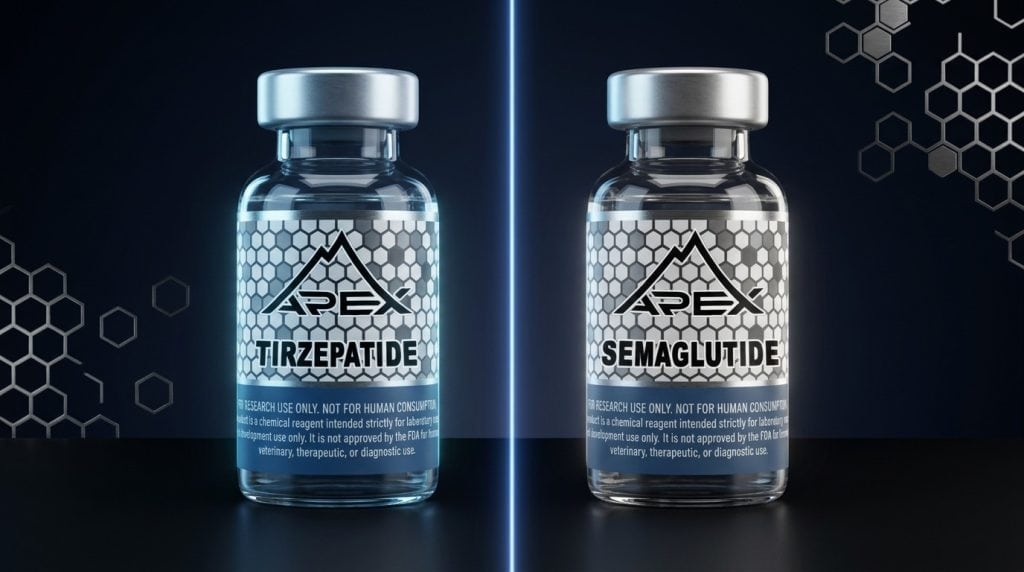
Semaglutide and Tirzepatide are incretin-system research peptides differing in receptor scope. Semaglutide is a selective GLP-1 receptor agonist; Tirzepatide is a dual GIP/GLP-1 receptor agonist whose simultaneous engagement of both pathways underlies the larger metabolic effect sizes seen in head-to-head SURPASS-2 trial data. Both are studied across glucose-regulation, body-composition, and cardiometabolic-outcome research domains.
Semaglutide and Tirzepatide are two of the most consequential peptides in modern metabolic research. Both target the incretin signaling system — the hormonal pathway that regulates insulin secretion, appetite signaling, gastric motility, and energy homeostasis — but they do so through fundamentally different receptor mechanisms. Semaglutide activates a single receptor. Tirzepatide activates two simultaneously. This architectural difference in molecular design translates to measurably distinct pharmacological profiles, which is why the comparison between these compounds has become one of the most actively investigated questions in metabolic peptide pharmacology today.
This guide provides a detailed, evidence-based, side-by-side comparison of Semaglutide and Tirzepatide for researchers — covering molecular structures, receptor pharmacology, published head-to-head clinical trial data, practical reconstitution differences, and the emerging landscape of next-generation multi-agonist peptides including Retatrutide, CagriSema, Survodutide, and Mazdutide.
Molecular Identity: Structural Comparison
Both compounds are synthetic peptides engineered from the incretin hormone family, but their structural foundations, modification strategies, and receptor targets differ significantly. Understanding these molecular differences is essential for researchers designing experiments, interpreting published data, or selecting compounds for specific signaling pathway studies.
Semaglutide — Technical Profile
- Classification: Selective GLP-1 (glucagon-like peptide-1) receptor agonist
- CAS Number: 910463-68-2
- Molecular Weight: 4113.58 g/mol
- Peptide Length: 31 amino acids
- Structural Basis: 94% sequence homology to native human GLP-1(7-37)
- Half-Life Extension: C-18 fatty diacid chain conjugated to Lys26 via a mini-PEG linker, enabling non-covalent albumin binding in circulation
- DPP-4 Resistance: Aib (alpha-aminoisobutyric acid) substitution at position 8 prevents enzymatic cleavage by dipeptidyl peptidase-4
- Receptor Target: GLP-1 receptor (GLP-1R) exclusively
Tirzepatide — Technical Profile
- Classification: Dual GIP/GLP-1 receptor agonist (first-in-class)
- CAS Number: 2023788-19-2
- Molecular Weight: 4813.45 g/mol
- Peptide Length: 39 amino acids
- Structural Basis: Built on the native GIP (glucose-dependent insulinotropic polypeptide) peptide backbone, engineered with GLP-1R cross-reactivity
- Half-Life Extension: C-20 fatty diacid moiety for albumin binding, providing an extended research half-life
- Receptor Targets: GIP receptor (GIPR, primary and full agonism) AND GLP-1 receptor (GLP-1R, secondary agonism with biased signaling)
The Critical Structural Difference
The single most important distinction between these compounds is their receptor architecture. Semaglutide was engineered from the GLP-1 peptide backbone and activates only GLP-1 receptors — making it a selective, single-target agonist. Tirzepatide was built from the GIP peptide backbone and was specifically engineered to retain cross-reactivity with GLP-1 receptors while maintaining full GIP receptor agonism — making it a dual-target agonist that engages two independent metabolic signaling pathways simultaneously. This is not merely a quantitative difference (more receptor activation); it is a qualitative difference that opens entirely distinct signaling cascades not accessible through GLP-1-only compounds.
Mechanism of Action: Single vs Dual Incretin Pathway Activation
Semaglutide: GLP-1 Receptor Signaling
Semaglutide selectively binds and activates the GLP-1 receptor (GLP-1R), a class B G-protein coupled receptor expressed on pancreatic beta cells, hypothalamic appetite-regulating neurons, gastrointestinal epithelial cells, and cardiac tissue. Upon receptor binding, GLP-1R activation triggers intracellular cyclic AMP (cAMP) production through Gαs-coupled adenylyl cyclase, followed by protein kinase A (PKA) activation and downstream effects on insulin granule exocytosis, glucagon suppression from alpha cells, deceleration of gastric emptying, and central appetite regulation through hypothalamic POMC/CART neuron activation.
Semaglutide’s C-18 fatty diacid modification binds serum albumin non-covalently, creating a circulating drug reservoir that extends the compound’s effective half-life to approximately 7 days. This extended duration was characterized in the landmark SUSTAIN-6 cardiovascular outcomes trial (Marso et al., 2016, NEJM), which also demonstrated cardiovascular risk reduction — making Semaglutide the first GLP-1 agonist with published cardioprotective outcomes data.
Tirzepatide: Dual GIP + GLP-1 Receptor Signaling
Tirzepatide simultaneously activates two distinct incretin receptor systems. The GIP receptor (GIPR) mediates the other major arm of the incretin effect — in healthy physiology, GIP signaling accounts for approximately 60–70% of the total postprandial incretin response, making it the dominant incretin pathway under normal conditions. By activating both GIPR and GLP-1R at once, Tirzepatide engages a substantially broader spectrum of metabolic signaling than any GLP-1-only compound can access.
Critically, published pharmacological analysis has revealed that Tirzepatide exhibits biased agonism at the GLP-1 receptor — it preferentially activates cAMP/PKA signaling while showing reduced recruitment of beta-arrestin compared to native GLP-1 or Semaglutide. This signaling bias is scientifically significant because beta-arrestin recruitment is the primary pathway that leads to GLP-1 receptor internalization and desensitization. By producing less beta-arrestin signaling, Tirzepatide may maintain GLP-1R responsiveness longer than compounds with balanced signaling profiles. This biased agonism was characterized in detail in published data from the SURPASS-2 trial (Frias et al., 2021, NEJM).
Shop GLP-1 Research Peptides at Apex Laboratory
Semaglutide · Tirzepatide · Retatrutide · CagriSema · Liraglutide · Dulaglutide — All ≥99% purity, HPLC & Mass Spec verified, same-day shipping.
Head-to-Head Clinical Trial Data: SURPASS-2
The most important published dataset for directly comparing these two compounds is the SURPASS-2 trial — a randomized, open-label, Phase 3 study that compared Tirzepatide (at three dose levels: 5mg, 10mg, and 15mg) directly against Semaglutide 1mg in patients with type 2 diabetes over 40 weeks. The results were published in the New England Journal of Medicine (Frias et al., 2021) and enrolled 1,879 participants across 128 sites.
Primary Endpoint: HbA1c Reduction
All three Tirzepatide doses achieved statistically superior HbA1c reduction compared to Semaglutide 1mg. The Tirzepatide 15mg group showed an estimated mean HbA1c reduction of 2.46 percentage points from baseline, compared to 1.86 points for Semaglutide 1mg — a statistically significant difference of approximately 0.6 percentage points. Even the lowest Tirzepatide dose (5mg) was non-inferior to Semaglutide 1mg, while the 10mg and 15mg doses were both statistically superior.
Secondary Endpoint: Body Weight Reduction
The weight reduction data showed an even more pronounced separation between compounds. The Tirzepatide 15mg group achieved a mean body weight reduction of approximately 12.4 kg, compared to 6.2 kg for Semaglutide 1mg — effectively doubling the weight reduction. The 10mg Tirzepatide group showed approximately 9.6 kg reduction. These differences provide direct evidence that dual GIP/GLP-1 receptor activation produces additive metabolic effects beyond what GLP-1-only agonism achieves in clinical research settings.
Tolerability Profile
Gastrointestinal adverse events (nausea, vomiting, diarrhea) were the most common side effects in both treatment groups, consistent with the known GLP-1R activation profile. Interestingly, some published analyses suggest that Tirzepatide may produce a modestly lower incidence of nausea at comparable efficacy levels, potentially because GIP receptor co-activation partially counteracts the nausea-inducing effects of GLP-1R stimulation. However, this observation requires further investigation to confirm.
Complementary Trial Programs
STEP Trials (Semaglutide)
The STEP clinical trial program is the most comprehensive dedicated dataset for Semaglutide. The STEP 1 trial (Wilding et al., 2021, NEJM) evaluated Semaglutide 2.4mg in participants without diabetes and demonstrated a mean body weight reduction of 14.9% from baseline over 68 weeks. The STEP program spans multiple trials across different populations — including STEP 2 (with type 2 diabetes), STEP 3 (with intensive behavioral therapy), STEP 4 (withdrawal design), and subsequent studies — collectively establishing Semaglutide as the benchmark GLP-1 agonist against which all newer metabolic peptides are measured.
SURMOUNT Trials (Tirzepatide)
The SURMOUNT program evaluated Tirzepatide in populations without diabetes. The SURMOUNT-1 trial (Jastreboff et al., 2022, NEJM) reported a mean body weight reduction of 22.5% with Tirzepatide 15mg over 72 weeks — the highest percentage weight reduction reported for any anti-obesity compound in a Phase 3 trial at the time of publication. This result substantially exceeded the STEP 1 Semaglutide data and demonstrated the clinical potential of adding GIP receptor agonism to GLP-1-based metabolic signaling.
Practical Research Considerations: Reconstitution and Handling
Use the peptide reconstitution calculator to convert vial mass and bacteriostatic-water volume into concentration and syringe-unit values for research preparations.
Both compounds are supplied as lyophilized powders and require reconstitution before use. There are a few practical differences worth noting for laboratory protocols:
Solubility
Tirzepatide generally dissolves well in standard bacteriostatic water without difficulty. Semaglutide, due to its specific physicochemical profile, may show reduced solubility at higher concentrations in neutral-pH solvents. If Semaglutide does not dissolve completely in bacteriostatic water within 5 minutes of gentle rolling, switching to 0.6–1% acetic acid solution will typically resolve the issue. For a complete step-by-step reconstitution protocol applicable to both compounds, see our detailed guide: How to Reconstitute Peptides.
Storage After Reconstitution
Both compounds should be stored at 2–8°C after reconstitution. Semaglutide’s albumin-binding fatty acid chain provides enhanced stability in solution, with published data supporting approximately 28 days of refrigerated storage. Tirzepatide should be used within approximately 21 days of reconstitution when refrigerated. Both compounds benefit from aliquoting into single-use volumes at the time of reconstitution to avoid repeated freeze-thaw damage.
Beyond Semaglutide and Tirzepatide: The Multi-Agonist Frontier
For broader GLP-1 cluster navigation, see GLP-1 / metabolic research peptides, GLP-1 agonists compared, and Retatrutide vs Tirzepatide.
The clinical success of Semaglutide (single agonist) and Tirzepatide (dual agonist) has catalyzed a wave of research into peptides targeting three or more metabolic receptor pathways simultaneously. This progression from single to dual to triple receptor agonism represents one of the most dynamic research areas in peptide pharmacology. Researchers working in this space can explore these next-generation compounds at Apex Laboratory:
Retatrutide — Triple GIP/GLP-1/Glucagon Agonist
Retatrutide (CAS 2381089-83-2) is a 39-amino acid triple receptor agonist targeting GIP, GLP-1, and glucagon receptors simultaneously. The addition of glucagon receptor agonism is designed to stimulate hepatic energy expenditure, fatty acid oxidation, and thermogenesis — metabolic pathways not accessed by either Semaglutide or Tirzepatide. Phase 2 trial data published in the NEJM (Jastreboff et al., 2023) reported body weight reductions exceeding 24% — the highest ever published for any anti-obesity compound, surpassing even Tirzepatide’s SURMOUNT-1 results.
CagriSema — Amylin/GLP-1 Dual Pathway
CagriSema takes a different approach to dual-pathway signaling by combining Cagrilintide (a long-acting amylin receptor agonist) with Semaglutide (GLP-1 agonist). Rather than adding GIP or glucagon receptor agonism, this combination targets the amylin pathway — which regulates satiety and gastric emptying through distinct brainstem signaling — alongside GLP-1. Phase 2 data published by Frias et al. (2023) demonstrated that the combination outperformed either component individually.
Survodutide and Mazdutide — GLP-1/Glucagon Dual Agonists
Survodutide (BI 456906) and Mazdutide (IBI362) both target GLP-1 and glucagon receptors without GIP involvement — a different dual combination than Tirzepatide’s GIP/GLP-1 approach. The glucagon receptor component is of particular interest for liver-targeted research, as hepatic glucagon signaling drives fatty acid oxidation and energy expenditure. Survodutide’s Phase 2 data from the SYNCHRONIZE program and Mazdutide’s trials published in Lancet Diabetes & Endocrinology both show promising results for metabolic and hepatic endpoints.
The Incretin Evolution Timeline
Viewed chronologically, the research progression is clear: from selective GLP-1 agonism (Semaglutide, Liraglutide, Dulaglutide) → to dual GIP/GLP-1 agonism (Tirzepatide) → to dual GLP-1/glucagon agonism (Survodutide, Mazdutide) → to dual amylin/GLP-1 combination (CagriSema) → to triple GIP/GLP-1/glucagon agonism (Retatrutide). Each generation expands the number of metabolic signaling pathways engaged, and the published efficacy data has consistently increased in parallel. This trajectory makes the incretin peptide space one of the most actively evolving fields in pharmaceutical research.
Purchasing Research-Grade Incretin Peptides
The validity of any comparative or mechanistic research depends on the purity and molecular authenticity of the compounds used. At Apex Laboratory, every incretin peptide — including Semaglutide, Tirzepatide, Retatrutide, Liraglutide, Dulaglutide, Cagrilintide, CagriSema, Survodutide, and Mazdutide — is verified to ≥99% purity through dual HPLC and Mass Spectrometry analysis. Multiple dosage sizes are available for all compounds, with same-day shipping and batch documentation upon request. Visit our About page to learn about our dual-verification quality process, or browse our complete peptide catalog.
Frequently Asked Questions
Is Tirzepatide more effective than Semaglutide in research settings?
In the SURPASS-2 head-to-head clinical trial, all three Tirzepatide doses demonstrated statistically superior HbA1c reduction and weight reduction compared to Semaglutide 1mg over 40 weeks. However, “effectiveness” is protocol-dependent. Semaglutide remains the benchmark GLP-1 agonist with the most extensive published dataset in its class, and it is the appropriate choice for experiments specifically studying isolated GLP-1 receptor signaling. Tirzepatide is the appropriate choice for studying dual incretin pathway activation. The research question should dictate compound selection.
Can Semaglutide and Tirzepatide be reconstituted using the same protocol?
The general reconstitution process is the same for both — add sterile solvent to the lyophilized powder, dissolve gently without shaking, and refrigerate. The one practical difference is that Semaglutide at higher concentrations may benefit from reconstitution with 0.6–1% acetic acid solution rather than bacteriostatic water, due to its solubility profile at neutral pH. Tirzepatide generally dissolves well in standard bacteriostatic water. See our complete reconstitution guide for detailed step-by-step protocols.
What is the fundamental difference between a GLP-1 agonist and a GIP/GLP-1 dual agonist?
A GLP-1 agonist activates only the GLP-1 receptor, engaging one incretin signaling pathway. A dual GIP/GLP-1 agonist activates both the GIP receptor and the GLP-1 receptor simultaneously, engaging two independent incretin pathways. GIP is the dominant incretin in healthy physiology — responsible for approximately 60–70% of the postprandial incretin effect — so adding GIP receptor activation substantially broadens the metabolic signaling spectrum beyond what GLP-1-only compounds can achieve.
What is Retatrutide and how does it fit into this comparison?
Retatrutide represents the next evolution: a triple receptor agonist targeting GIP, GLP-1, and glucagon receptors simultaneously. While Semaglutide targets one receptor and Tirzepatide targets two, Retatrutide targets three — adding glucagon receptor agonism to stimulate hepatic energy expenditure and fatty acid oxidation. Phase 2 data showed the highest weight reduction published for any compound in this class, exceeding both Semaglutide and Tirzepatide results.
Are these research peptides the same as the FDA-approved pharmaceutical products?
No. While Semaglutide and Tirzepatide are the active ingredients in FDA-approved pharmaceutical products (Ozempic/Wegovy and Mounjaro/Zepbound respectively), the research-grade peptides sold by Apex Laboratory are classified as chemical research reagents manufactured for in-vitro laboratory research use. They are not FDA-approved pharmaceutical products, not manufactured under pharmaceutical GMP conditions, and are not intended for human consumption, veterinary use, or any therapeutic application.
Continue Your Research
- How to Reconstitute Peptides: A Complete Step-by-Step Lab Protocol
- BPC-157 Peptide: Mechanism, Research Applications & Published Studies
- Tirzepatide Research Guide
- Retatrutide Research Guide
Research Use Disclaimer
This article is provided for educational and research reference purposes only. All peptides and research compounds sold by Apex Laboratory are intended exclusively for in-vitro laboratory research use and are not for human consumption. Researchers should consult the peer-reviewed clinical trial publications cited throughout this article for complete study designs, methodological details, statistical analyses, and full data tables.