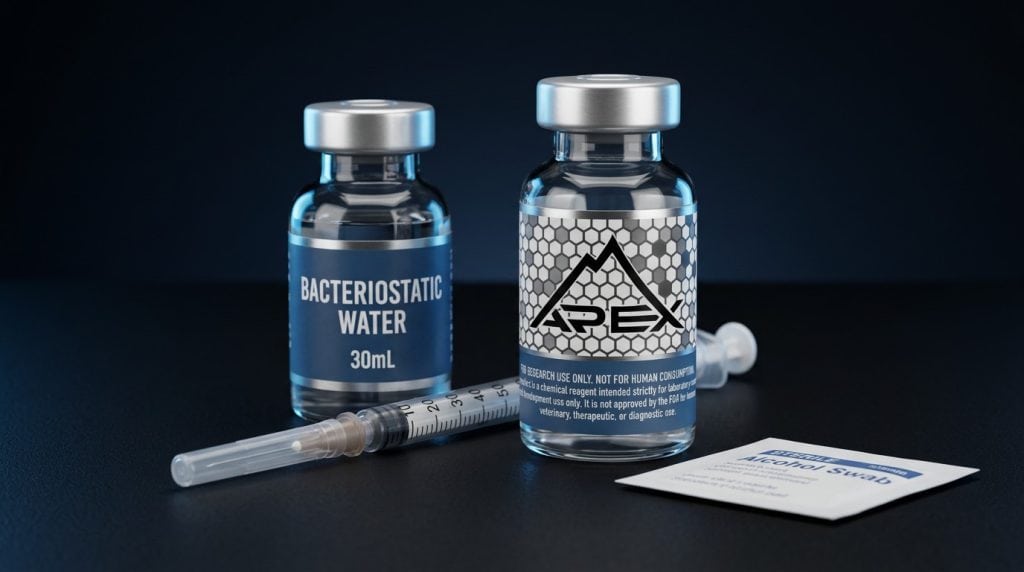
Peptide reconstitution is the controlled process of dissolving a lyophilized research peptide in a measured sterile solvent so the vial has a known working concentration. The critical variables are solvent selection, exact volume, slow transfer down the vial wall, complete dissolution without shaking, clear labeling, and cold storage. Because peptides are generally less stable in aqueous solution than in the dry lyophilized state, reconstitute only when the material is ready for use; poor solvent choice, heat, light, agitation, or repeated freeze-thaw cycles can accelerate degradation and create concentration errors.
Reconstituting lyophilized peptides is one of the most fundamental procedures in peptide research, yet it is also where many experimental errors originate. Peptide stability in aqueous solution is influenced by sequence, pH, concentration, excipients, temperature, light exposure, and physical stress (PMID: 36986796; PMID: 20143256). Improper reconstitution can therefore lead to peptide degradation, inaccurate concentrations, contamination, and unreliable data. This guide provides a complete, step-by-step protocol for reconstituting research peptides from their freeze-dried (lyophilized) form into a working solution — covering materials, solvent choice, concentration calculations, storage, troubleshooting, and quality verification before any solvent touches the vial.
Whether you are working with BPC-157, Semaglutide, Ipamorelin, or any other lyophilized compound from our research catalog, the core principles are the same. Follow this protocol carefully for consistent, reproducible results.
What Does Reconstitution Mean in Peptide Research?
Reconstitution is the process of dissolving a lyophilized (freeze-dried) peptide powder back into liquid form to create a working solution for experimental use. Peptides are supplied in lyophilized form because drying and frozen storage are core stability strategies for protein and peptide materials; lyophilization quality and storage conditions influence the final product attributes (PMID: 21426937; PMID: 20143256). A properly stored lyophilized peptide can remain stable for months to years at -20°C, while a reconstituted aqueous solution typically has a usable window of only days to weeks, depending on the compound, solvent, concentration, light exposure, and temperature.
The process involves adding a precise volume of sterile solvent — most commonly bacteriostatic water — to the vial containing the lyophilized peptide cake, allowing it to dissolve completely, and then calculating the resulting concentration for accurate experimental measurements. For quick concentration checks, use the Apex peptide reconstitution calculator alongside the manual formula below.
Materials Needed Before You Begin
Gather all materials before starting reconstitution. Working in a clean, organized environment minimizes contamination risk and procedural errors. Here is everything you need:
Required Materials
- Lyophilized peptide vial — your sealed vial containing freeze-dried peptide from Apex Laboratory
- Bacteriostatic water (BAC water) — sterile water preserved with 0.9% benzyl alcohol, the standard reconstitution solvent for most peptides. Benzyl alcohol is among the antimicrobial preservatives used in parenteral product formulations (PMID: 17722087), and the preservative supports multiple sterile withdrawals from a single vial when aseptic technique is maintained. For a deeper solvent primer, see What Is Bacteriostatic Water?
- Insulin syringes — 1 mL (100 unit) U-100 insulin syringes with 29–31 gauge needles are standard. The fine gauge minimizes rubber stopper damage and reduces coring risk.
- Alcohol prep pads — 70% isopropyl alcohol swabs for sterilizing vial stoppers before each needle insertion.
- Clean work surface — wipe your workspace with 70% isopropyl alcohol before beginning.
- Labels — for marking reconstituted vials with compound name, concentration, date, and initials.
- Sharps disposal container — for safe disposal of used needles and syringes.
When to Use an Alternative Solvent
Most research peptides dissolve readily in bacteriostatic water at neutral pH. However, certain compounds — particularly larger, more hydrophobic peptides or those with low isoelectric points — may require an alternative solvent for complete dissolution. Aqueous peptide formulation strategy commonly weighs pH, ionic environment, solubility, aggregation risk, and degradation pathways (PMID: 36986796). If you add bacteriostatic water to a vial and notice that the powder does not dissolve after gentle swirling (remaining cloudy, forming gel, or leaving visible particles after 5 minutes), the peptide likely needs an acidified solvent.
Acetic acid solution (0.6–1%) is the most common alternative. The mildly acidic pH protonates charged residues and disrupts hydrophobic aggregation, allowing stubborn peptides to enter solution. For extremely hydrophobic sequences, a small volume of DMSO (dimethyl sulfoxide) can be used as an initial co-solvent before diluting with aqueous solution — though DMSO should be kept to a minimum as it can interfere with certain biological assays.
As a general guideline: GLP-1 analogs like Semaglutide and Liraglutide may benefit from acetic acid reconstitution at higher concentrations. Most smaller peptides like BPC-157, Ipamorelin, and CJC-1295 dissolve easily in standard bacteriostatic water.
Step-by-Step Reconstitution Protocol
Step 1 — Allow the Peptide Vial to Reach Room Temperature
Remove the lyophilized peptide vial from your freezer (-20°C storage) and place it on your work surface at room temperature for approximately 10 to 15 minutes. This gradual warming prevents condensation from forming on the inside of the vial when you remove the cap, which could introduce moisture droplets directly onto the lyophilized cake and cause localized degradation. Do not attempt to speed up warming by placing the vial in warm water, holding it in your hands, or using any heat source. Patience here protects your compound.
Step 2 — Sterilize All Vial Tops
Using a fresh alcohol prep pad, thoroughly wipe the rubber stopper on the top of your peptide vial. Apply firm, even pressure and swab in one consistent direction across the entire stopper surface. Repeat with a second fresh alcohol pad on your bacteriostatic water vial. Allow both stoppers to air-dry completely — approximately 15 to 20 seconds — before inserting any needle. Inserting a needle through a wet alcohol surface can wick trace amounts of isopropyl alcohol into the solution, which may interfere with certain peptides.
Step 3 — Calculate Your Desired Concentration
Before drawing up any solvent, determine exactly how much bacteriostatic water you want to add. This decision determines the concentration of your final working solution. The formula is straightforward:
Concentration (mg/mL) = Total peptide in vial (mg) ÷ Volume of solvent added (mL)
For example, if you have a 5 mg vial of BPC-157 and add 2 mL of bacteriostatic water, the resulting concentration is 5 ÷ 2 = 2.5 mg/mL (equivalent to 2,500 mcg/mL). If you add only 1 mL instead, the concentration doubles to 5 mg/mL. Choose a volume that gives you a convenient, easy-to-measure concentration for your specific experimental protocol.
Quick Concentration Reference Table
Use this reference table to double-check common vial and solvent combinations before using the calculator. Concentration is calculated as total peptide mass divided by solvent volume.
| Peptide in vial | 1 mL solvent | 2 mL solvent | 3 mL solvent |
|---|---|---|---|
| 2 mg | 2 mg/mL | 1 mg/mL | 0.67 mg/mL |
| 5 mg | 5 mg/mL | 2.5 mg/mL | 1.67 mg/mL |
| 10 mg | 10 mg/mL | 5 mg/mL | 3.33 mg/mL |
Common Reconstitution Volumes by Compound
The following are standard reconstitution volumes widely used in research settings for common peptides from Apex Laboratory. Adjust based on your protocol requirements:
- BPC-157 (5 mg vial) — Add 2 mL BAC water → 2.5 mg/mL (2,500 mcg/mL)
- TB-500 (5 mg vial) — Add 2 mL BAC water → 2.5 mg/mL
- Ipamorelin (5 mg vial) — Add 2.5 mL BAC water → 2 mg/mL
- CJC-1295 No DAC (2 mg vial) — Add 2 mL BAC water → 1 mg/mL
- Semaglutide (5 mg vial) — Add 2.5 mL BAC water → 2 mg/mL (use acetic acid if solubility is poor)
- Retatrutide (5 mg vial) — Add 2.5 mL BAC water → 2 mg/mL
- Melanotan II (10 mg vial) — Add 2 mL BAC water → 5 mg/mL
- AOD9604 (5 mg vial) — Add 2.5 mL BAC water → 2 mg/mL
Step 4 — Draw Up the Bacteriostatic Water
Remove a clean insulin syringe from its sterile packaging. Pull back the plunger slightly to draw a small amount of air into the syringe (equal to the volume of liquid you plan to withdraw). Insert the needle through the rubber stopper of the bacteriostatic water vial, push the air in (this equalizes pressure inside the vial), then invert the vial and slowly draw up your desired volume of bacteriostatic water. Withdraw the needle and check for air bubbles. If present, hold the syringe needle-up, tap the barrel gently to float bubbles to the top, and push the plunger slightly to expel them. Confirm the volume is precisely what you calculated.
Step 5 — Add the Solvent to the Peptide Vial (Critical Step)
Insert the needle through the rubber stopper of the peptide vial. Here is where technique matters most: do not squirt the water directly onto the lyophilized powder cake. Instead, angle the needle tip toward the inside glass wall of the vial and depress the plunger slowly and steadily. Allow the bacteriostatic water to trickle down the wall of the vial and pool at the bottom, gently reaching the powder from below. This controlled approach prevents mechanical disruption of the peptide structure, minimizes foaming, and promotes even dissolution. A rushed, forceful injection directly onto the powder can increase physical stress and aggregation risk; protein and peptide formulations are sensitive to both chemical and physical instability pathways (PMID: 20143256).
Step 6 — Allow the Peptide to Dissolve Completely
After all the solvent has been added, set the vial upright on a flat surface. Do not shake the vial. Vigorous shaking introduces air bubbles, creates foam, and can physically stress peptide molecules at air-liquid interfaces. Instead, allow the vial to sit undisturbed for 1 to 2 minutes. If undissolved powder remains after this period, gently roll the vial between your palms using slow, even motion — or tilt it slowly back and forth at a 45-degree angle. Most lyophilized peptides will fully dissolve within 1 to 5 minutes using this gentle approach.
The resulting solution should be clear, colorless, and free of visible particles. Any cloudiness, gel formation, visible particulate matter, or unusual coloration indicates a potential problem — see the troubleshooting section below before using the solution.
Step 7 — Label, Document, and Store
Once the peptide is fully dissolved, immediately label the vial with: compound name, concentration (mg/mL), date of reconstitution, volume of solvent added, and your initials. Store the reconstituted vial upright in your laboratory refrigerator at 2–8°C, protected from direct light. Proper documentation is critical for research reproducibility — record all reconstitution details in your laboratory notebook alongside the batch number from the vial label.
Shop Reconstitution Supplies at Apex Laboratory
Get everything you need in one order: Bacteriostatic Water · Acetic Acid Solution 1% · Browse All Research Peptides — ≥99% purity, HPLC & Mass Spec verified, same-day shipping.
Reconstituted Peptide Stability: How Long Does It Last?
The stability window after reconstitution varies by compound, solvent, concentration, light exposure, and storage conditions. Published formulation reviews emphasize that peptides in aqueous solution can degrade through multiple sequence- and environment-dependent pathways (PMID: 36986796), while biotechnology products commonly carry light and temperature sensitivity recommendations because these stressors can affect quality (PMID: 37022633). The timelines below are conservative research-use planning guidelines, not universal guarantees; see the Peptide Storage Guide for deeper storage handling.
- Bacteriostatic water, stored at 2–8°C: 14–28 days for most peptides (the benzyl alcohol preservative prevents bacterial growth across multiple needle punctures)
- Sterile water (no preservative), stored at 2–8°C: Use within 24–48 hours, single puncture only (no preservative means bacterial contamination begins immediately after first needle insertion)
- Acetic acid reconstitution, stored at 2–8°C: 14–21 days for most peptides
- Frozen aliquots at -20°C: Several months for most peptides, but each aliquot should be thawed only once
To maximize the usable life of your reconstituted compound, consider aliquoting immediately after reconstitution. Divide the solution into smaller, single-use volumes in sterile microcentrifuge tubes, then freeze the aliquots at -20°C. Each time you need material, thaw only one aliquot and use it entirely. This reduces two major avoidable stressors: repeated freeze-thaw handling and repeated needle punctures through the rubber stopper.
Understanding Syringe Volume Measurements: Units and Milliliters
Insulin syringes are marked in “units” (IU), not milliliters, which can confuse researchers unfamiliar with this convention. A standard U-100 insulin syringe holds exactly 1 mL total volume, divided into 100 equal graduations. The conversion is simple:
- 100 units = 1.00 mL
- 50 units = 0.50 mL
- 25 units = 0.25 mL
- 10 units = 0.10 mL
- 1 unit = 0.01 mL
To calculate how many syringe units (volume) correspond to a target mass of reagent, use this formula:
Units to draw = (Target mass in mcg ÷ Concentration in mcg/mL) × 100
Worked example: Your reconstituted BPC-157 has a concentration of 2,500 mcg/mL. You want to measure out 250 mcg for an experiment. The calculation is: (250 ÷ 2,500) × 100 = 10 units on the insulin syringe. Another example: Your Ipamorelin is at 2,000 mcg/mL and you need 300 mcg. Calculation: (300 ÷ 2,000) × 100 = 15 units.
Use the Reconstitution Calculator for Fast Checks
The manual formula above is the source of truth, but unit mistakes are common when converting between milligrams, micrograms, milliliters, and U-100 syringe units. Before preparing a working solution, cross-check the vial amount, solvent volume, concentration, target amount, and syringe volume with the Apex peptide reconstitution calculator.
Calculate precise concentrations, solvent volumes, and syringe measurements for your research peptide workflow.
Sterile, 0.9% benzyl-alcohol preserved — supports multiple withdrawals up to 28 days.
Shop Bacteriostatic WaterUse the calculator as a verification aid, not as a substitute for your lab notebook. Record the vial label amount, solvent lot, solvent volume, final mg/mL concentration, date of reconstitution, and any deviations from the standard protocol.
Troubleshooting Common Reconstitution Problems
The powder will not dissolve after several minutes
First, wait a full 5 minutes with no agitation — some larger peptides dissolve slowly. If undissolved material remains, gently roll the vial between your palms (never shake). If the powder still refuses to dissolve, the compound likely requires an acidified solvent. Prepare a fresh vial and reconstitute with 0.6–1% acetic acid solution instead of bacteriostatic water. This is most common with GLP-1 analogs and larger hydrophobic peptides.
The solution appears cloudy or contains visible particles
Cloudiness indicates peptide aggregation, which can result from an incompatible solvent pH, excessive concentration, or contamination. Try gently rolling the vial first. If cloudiness persists, the compound may need a different solvent or a more dilute concentration (add more solvent). Do not use a cloudy or particulate-containing solution in experiments — aggregated peptides produce unpredictable and unreliable data.
Excessive foaming has occurred
Foaming results from injecting solvent too forcefully or shaking the vial. While the foam itself may not irreversibly damage the peptide, active compound can become trapped in the foam layer, leading to concentration inaccuracy. Set the vial upright on a flat surface and leave it completely undisturbed for 10 to 15 minutes. The foam will dissipate naturally through gravity. Do not try to pop or agitate the foam.
The reconstituted vial was accidentally frozen
A single freeze-thaw event is generally tolerable for most peptides, though some potency loss may occur depending on the compound. If you used bacteriostatic water, the benzyl alcohol preservative remains effective after thawing. Allow the vial to thaw slowly in the refrigerator (not at room temperature or in warm water). To prevent this in the future, always aliquot your reconstituted solution before freezing.
I am unsure which solvent to use for my specific peptide
Start with bacteriostatic water — it is the correct choice for the vast majority of research peptides. If the peptide does not dissolve within 5 minutes of gentle rolling, switch to acetic acid solution. If you are still uncertain, contact our support team at support@apexlaboratory.org with the compound name and we can advise on the optimal reconstitution solvent for your specific product.
Best Practices for Peptide Handling and Storage
These laboratory best practices apply to all peptides regardless of the specific compound. Following them consistently will maximize the quality and longevity of your research materials:
- Always sterilize vial tops with a fresh alcohol swab before every single needle insertion — no exceptions, even if you just swabbed it minutes ago.
- Use a new, sterile syringe for each withdrawal from the vial to prevent cross-contamination between draws.
- Never touch the needle with your fingers, gloves, or any unsterilized surface. If the needle contacts anything non-sterile, discard it and use a fresh syringe.
- Store unreconstituted (lyophilized) peptides at -20°C in their original sealed vials, away from light and moisture. Avoid unnecessary temperature cycling before reconstitution.
- Store reconstituted peptides at 2–8°C (standard laboratory refrigerator), upright, protected from light.
- Protect light-sensitive compounds by storing them in the original amber vial or wrapping in aluminum foil. Many peptides — including melanocortin analogs like Melanotan II — are photosensitive.
- Document everything — record reconstitution date, solvent used, volume added, resulting concentration, lot number, and expiration date in your laboratory notebook for complete experimental traceability.
- Minimize temperature cycling — every time a frozen vial is brought to room temperature and returned to the freezer, the peptide undergoes stress. Aliquoting eliminates this problem entirely.
Why COA-Verified Material Matters Before Reconstitution
Reconstitution can make a peptide measurable and usable in solution, but it cannot correct a problem in the starting material. If the vial is impure, misidentified, degraded, contaminated, or stored poorly before reconstitution, perfect solvent technique will not rescue the experiment. The concentration math assumes that the vial label, compound identity, and purity are already reliable.
This is where Apex’s quality-control workflow matters. Each research peptide lot is reviewed through a documentation chain that includes a lot-level Certificate of Analysis, HPLC purity testing, and mass spectrometry identity verification. The practical benefit is simple: reconstitution starts with a peptide whose identity and purity have been checked before solvent, syringe handling, and concentration calculations add their own variables.
- Purity baseline: HPLC helps quantify the principal peptide peak and related impurities before the vial enters a research workflow. See why ≥99% purity matters for repeatable peptide research.
- Identity confirmation: ESI-MS confirms the measured mass aligns with the expected peptide, reducing the risk that a clean-looking powder is the wrong compound.
- Solvent planning: A verified compound identity helps researchers choose the correct solvent strategy for hydrophilic, hydrophobic, GLP-1 analog, or larger peptide sequences.
- Traceability: Lot numbers, COAs, reconstitution date, solvent volume, and storage conditions should all be recorded together so results can be reproduced or audited later.
For this reason, treat reconstitution as the final step in a chain of controls rather than an isolated mixing task: verify the lot, select the solvent, calculate the concentration, dissolve gently, label immediately, and store cold.
Sourcing Quality Peptides and Reconstitution Supplies
The reliability and reproducibility of your reconstitution results depend directly on the purity and quality of your starting materials. Degraded, impure, or incorrectly stored peptides can produce failed reconstitutions and unreliable experimental data regardless of how carefully you follow the protocol above.
At Apex Laboratory, every peptide is verified to ≥99% purity through High-Performance Liquid Chromatography (HPLC) and Mass Spectrometry (MS) analysis before entering inventory. We also supply bacteriostatic water and acetic acid solution so researchers can source peptides and reconstitution solvents from the same documented supplier. Learn how to review lot documentation in our COA guide, then cross-check method details in the HPLC purity guide and mass spectrometry verification guide.
Selected PubMed References
- Nugrahadi PP, Hinrichs WLJ, Frijlink HW, Schöneich C. Designing Formulation Strategies for Enhanced Stability of Therapeutic Peptides in Aqueous Solutions: A Review. 2023. PMID: 36986796
- Manning MC, Chou DK, Murphy BM, Payne RW, Katayama DS. Stability of protein pharmaceuticals: an update. 2010. PMID: 20143256
- Kasper JC, Friess W. The freezing step in lyophilization: physico-chemical fundamentals, freezing methods and consequences on process performance and quality attributes of biopharmaceuticals. 2011. PMID: 21426937
- Meyer BK, Ni A, Hu B, Shi L. Antimicrobial preservative use in parenteral products: past and present. 2007. PMID: 17722087
- Kim JJ, Pritts JD, Ngo M, Estoll CR, et al. Trends in Light and Temperature Sensitivity Recommendations among Licensed Biotechnology Drug Products. 2023. PMID: 37022633
Frequently Asked Questions
What is peptide reconstitution?
Peptide reconstitution is the controlled process of dissolving a lyophilized research peptide in a measured sterile solvent so the vial has a known working concentration. A good protocol controls solvent choice, exact volume, gentle transfer, full dissolution, labeling, and cold storage.
How much bacteriostatic water should I add to a peptide vial?
Choose the solvent volume that creates the working concentration your protocol needs. The formula is: total peptide in the vial (mg) ÷ solvent added (mL) = concentration (mg/mL). For example, 5 mg plus 2 mL produces 2.5 mg/mL. If you want a faster check, use the peptide reconstitution calculator.
Can I use regular sterile water instead of bacteriostatic water?
You can, but it is not recommended for multi-use research protocols. Sterile water contains no antimicrobial preservative, so it should be treated as a short-duration, single-puncture solvent. Tap water should never be used. Bacteriostatic water contains 0.9% benzyl alcohol, which supports multi-withdrawal research workflows when aseptic technique is maintained.
How do I calculate the concentration of my reconstituted peptide?
Divide the total peptide amount listed on the vial label (in milligrams) by the total volume of solvent you added (in milliliters). The result is your concentration in mg/mL. For example, a 10 mg peptide vial reconstituted with 2 mL of bacteriostatic water yields a concentration of 10 ÷ 2 = 5 mg/mL, which equals 5,000 mcg/mL. This concentration value is what you use to calculate how many syringe units correspond to a specific microgram amount.
Can I use tap water to reconstitute peptides?
No. Tap water is not sterile, has uncontrolled mineral and microbial content, and is not appropriate for peptide research handling. Use a sterile research-grade diluent such as bacteriostatic water, sterile water for single-use workflows, or a compound-specific solvent recommended for that peptide.
What is the difference between bacteriostatic water and normal saline?
Bacteriostatic water is sterile water preserved with 0.9% benzyl alcohol — the preservative is what makes it suitable for multiple-use vials. Normal saline (0.9% sodium chloride solution) is a different product entirely: it contains salt but no antimicrobial preservative. Some specialized research protocols may call for normal saline as a diluent, but for standard peptide reconstitution, bacteriostatic water is the correct and most widely used choice due to its multi-use preservative properties.
Should I shake the vial to help the peptide dissolve faster?
Never shake a peptide vial. Vigorous shaking creates foam, introduces air-liquid interfaces where surface denaturation occurs, and can physically unfold the peptide’s three-dimensional structure — permanently reducing its biological activity. Instead, gently roll the vial between your palms with slow, even motion, or slowly tilt the vial back and forth at a 45-degree angle until the powder dissolves completely. This gentle approach preserves the peptide’s molecular integrity.
What happens if a peptide is reconstituted incorrectly?
Incorrect reconstitution can produce concentration errors, incomplete dissolution, foaming, aggregation, contamination risk, and faster degradation. Those problems can make downstream research unreliable even if the original vial was high quality. If the solution is cloudy, particulate, discolored, or handled outside your SOP, stop and review the protocol before proceeding.
How can I tell if my reconstituted peptide has degraded?
Signs of degradation include: the solution becoming cloudy or hazy when it was previously clear; visible particles or flakes forming; an unexpected color change; or an unusual odor. If you observe any of these signs, do not use the solution — discard it and reconstitute a fresh vial. Proper refrigerated storage at 2–8°C, light protection, minimal agitation, and consistent aseptic technique are the most effective ways to reduce premature degradation risk.
Why does COA-verified peptide material matter before reconstitution?
Reconstitution cannot fix an impure, degraded, or misidentified starting material. Lot-level COA review, HPLC purity testing, and mass spectrometry identity checks reduce uncertainty before solvent choice, concentration math, and storage conditions add additional variables.
Continue Your Research
- Peptide Reconstitution Calculator
- Peptide Concentration & Reconstitution Math (mg/mL, mcg/mL)
- What Is Bacteriostatic Water?
- Peptide Storage Guide
- How to Read a Peptide COA
- HPLC Testing for Peptide Purity
- Mass Spectrometry for Peptide Verification
- Why ≥99% Purity Matters in Research Peptides
- BPC-157 Peptide: Mechanism, Research Applications & Published Studies
- Semaglutide vs Tirzepatide: Mechanism, Research Data & Key Differences
- Retatrutide Research Guide
Research Use Disclaimer
This guide is provided for educational and laboratory reference purposes only. All peptides and research supplies sold by Apex Laboratory are intended strictly for in-vitro research use and are not for human consumption, veterinary use, or any therapeutic application. Researchers are responsible for following their institution’s safety protocols, standard operating procedures, and all applicable regulations when handling research compounds.