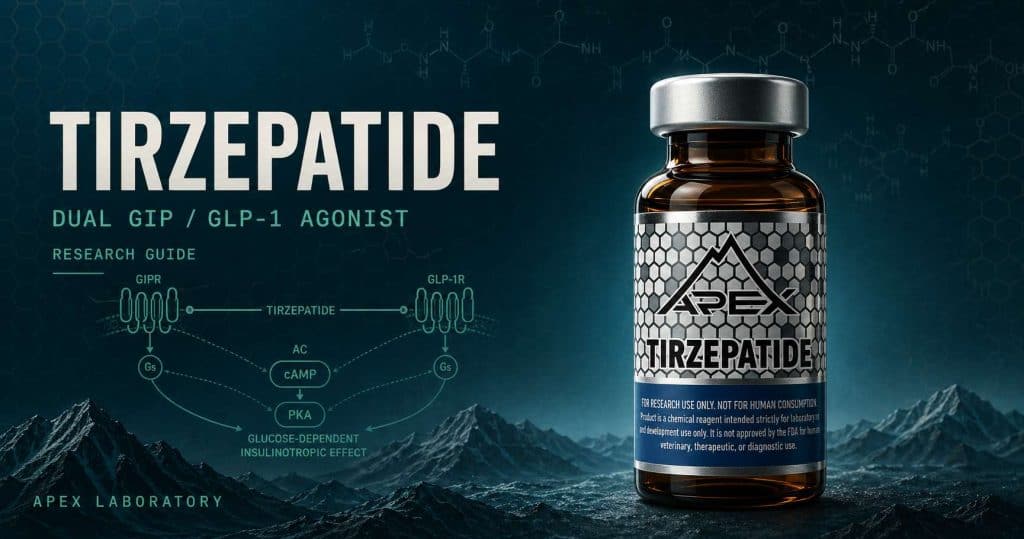
Tirzepatide is a synthetic dual receptor agonist studied for its effects on glucose regulation and body composition through simultaneous activation of the GIP and GLP-1 receptor pathways. Its modified-GIP backbone produces biased GLP-1R agonism with reduced beta-arrestin recruitment relative to native GLP-1. Trial evidence comes from the SURPASS type-2-diabetes program and the SURMOUNT chronic-weight-management program; the molecule received FDA approval as Mounjaro and Zepbound, and Apex’s tirzepatide is for research use only.
Tirzepatide is the first dual GIP and GLP-1 receptor agonist approved for clinical use — and the structural fact that defines it begins with what it is not. Semaglutide, Liraglutide, and Dulaglutide all belong to the single-agonist GLP-1 class: each is a modified GLP-1 backbone engaging a single incretin receptor. Tirzepatide is a different class of molecule. It is a 39-amino-acid synthetic peptide built on a modified GIP backbone — not a modified GLP-1 backbone — with a C20 fatty-diacid moiety acylated to a lysine residue to enable albumin binding, and it engages the GIP and GLP-1 receptors on a single molecule simultaneously. That dual-vs-single distinction is the reason tirzepatide research occupies its own page in the Apex library.
This guide provides an evidence-based overview of Tirzepatide for researchers — covering its molecular identity as a 39-amino-acid synthetic peptide, the dual GIP/GLP-1 receptor pharmacology including biased agonism at GLP-1R, the pharmacokinetic profile supporting once-weekly subcutaneous administration, the full SURPASS T2D Phase 3 program (SURPASS-1 through 5), the SURMOUNT obesity Phase 3 program (SURMOUNT-1 through 4), the Mounjaro and Zepbound regulatory framing under Apex’s Cerebrolysin-precedent precision, and Tirzepatide’s position within the next-generation multi-agonist landscape.
Tirzepatide at a Glance
- Tirzepatide is a 39-amino-acid synthetic peptide on a modified GIP backbone (not a modified GLP-1 backbone) with a C20 fatty-diacid moiety enabling albumin binding for an approximately 5-day plasma half-life and once-weekly subcutaneous administration in trial protocols
- It is the first dual GIP/GLP-1 receptor agonist characterized in the published literature, with research documented by Willard et al. (2020) showing imbalanced and biased agonism at GLP-1R — preferential Gαs-protein over β-arrestin recruitment, distinct from the balanced single-receptor engagement of Semaglutide
- The SURPASS T2D Phase 3 program (SURPASS-1 through 5) and the SURMOUNT obesity Phase 3 program (SURMOUNT-1 through 4) constitute the registrational evidence base spanning monotherapy, head-to-head versus Semaglutide, insulin combinations, high-cardiovascular-risk T2D populations, and obesity research at 72-week durations
- Tirzepatide is the active ingredient in Mounjaro (FDA-approved May 13, 2022 for type 2 diabetes) and Zepbound (FDA-approved November 8, 2023 for chronic weight management); Apex Laboratory’s research-grade Tirzepatide is classified as a chemical research reagent and is distinct from these approved pharmaceutical formulations
- Tirzepatide sits chronologically between the single-agonist GLP-1 generation (Semaglutide, Liraglutide, Dulaglutide) and the next-generation triple-agonist frontier exemplified by Retatrutide; the Apex catalog supplies it for in-vitro and preclinical research at ≥99% purity verified by HPLC and mass spectrometry
What Tirzepatide Is — Molecular Identity
For the broader incretin cluster, see GLP-1 / metabolic research peptides.
Structurally, Tirzepatide is a 39-amino-acid synthetic peptide engineered to engage two incretin receptors at once. The molecular vocabulary that describes it rests on three facts: the backbone identity (GIP-derived, not GLP-1-derived), the acyl-chain modification that drives plasma residence, and the discovery context that places it as the first member of a new mechanism class.
39-Amino-Acid Synthetic Backbone
Tirzepatide’s backbone is a modified GIP sequence — a structural distinction from the single-agonist GLP-1 class, where Semaglutide (a 31-amino-acid modified GLP-1 backbone), Liraglutide, and Dulaglutide all derive their sequences from native GLP-1. The 39-amino-acid length, non-canonical 2-aminoisobutyric acid residues at positions that resist dipeptidyl peptidase-IV degradation, and the C20 fatty-diacid moiety acylated to a lysine residue together describe the engineered scaffold. The C20 acylation drives albumin binding and underlies the once-weekly subcutaneous dosing schedule documented in every SURPASS and SURMOUNT trial.
Discovery and First-in-Class Characterization
The compound — originally designated LY3298176 within Eli Lilly’s discovery program — was first characterized by 1 Coskun and colleagues at Eli Lilly in Molecular Metabolism in 2018, in a discovery-to-clinical-proof-of-concept paper covering molecular pharmacology, dual receptor engagement, preclinical efficacy, and Phase 1 healthy-subject pharmacokinetics. Coskun et al. (2018) is the structural anchor for every subsequent description of Tirzepatide as a first-in-class dual GIP/GLP-1 receptor co-agonist.
Class Position vs Single-Agonist GLP-1 Compounds
For adjacent GLP-1 family catalog context, see Liraglutide, Dulaglutide, Survodutide, and Mazdutide.
Single-agonist GLP-1 compounds — Semaglutide, Liraglutide, Dulaglutide — engage GLP-1R alone through modified GLP-1 backbones. Tirzepatide engages GLP-1R and GIPR on a single molecule with a modified GIP backbone. The full comparison sits in the table below.
Dual GIP/GLP-1 Receptor Pharmacology
Critically, published pharmacological analysis has revealed that Tirzepatide does not engage its two receptors symmetrically, and does not engage GLP-1R the way Semaglutide does. Both GIPR (glucose-dependent insulinotropic polypeptide receptor) and GLP-1R are class B G-protein-coupled receptors; characterizing how Tirzepatide signals through each is the pharmacological work that distinguishes the dual-agonist class from its single-agonist predecessors.
GIPR Engagement: A Distinctive Receptor Profile
GIPR engagement contributes glucose-dependent insulin secretion, alongside modulation of glucagon secretion and adipose-tissue lipid handling that single-agonist GLP-1 compounds do not address. Published in Molecular Metabolism, 1 Coskun et al. (2018) characterized Tirzepatide’s GIPR engagement alongside its GLP-1R profile, documenting the dual-engagement signature in receptor-binding assays, cAMP accumulation assays, and preclinical glucose-tolerance models. The combined GIPR plus GLP-1R footprint on a single molecule is the structural innovation the dual-agonist class introduced.
GLP-1R Engagement and Biased Agonism
The article’s most pharmacologically distinctive section sits at GLP-1R. Research documented by 2 Willard et al. (2020) in JCI Insight characterizes Tirzepatide as “an imbalanced and biased dual GIP and GLP-1 receptor agonist.” Two distinct findings sit inside that phrase. First, Tirzepatide engages GIPR and GLP-1R with different affinity and signaling balance — receptor engagement is imbalanced across the two targets. Second, at GLP-1R, Tirzepatide preferentially recruits Gαs-protein over β-arrestin — a biased agonism signature. Balanced-agonist GLP-1R compounds, including Semaglutide, recruit Gαs and β-arrestin in more equivalent proportions. Willard 2020 is the canonical reference for biased agonism in this class.
Why Dual Agonism: Mechanistic Rationale
The proposed rationale for dual GIP/GLP-1 agonism is additive incretin signaling beyond what single-agonist GLP-1R engagement delivers — engaging the second incretin receptor alongside the biased Gαs-skewed engagement at GLP-1R. Research suggests this combined signature underlies the trial-attributed differences observed in the SURPASS and SURMOUNT programs.
Pharmacokinetic Profile
Pharmacokinetically, Tirzepatide is characterized by the long plasma residence and once-weekly administration cadence that the C20 fatty-diacid acylation engineering was designed to deliver.
Half-Life, Albumin Binding, and Weekly Dosing
Tirzepatide’s plasma half-life is approximately 5 days (~120 hours). The mechanism is the C20 fatty-diacid moiety: acylated to a lysine residue, it enables non-covalent binding to circulating albumin, extending plasma residence by reducing renal clearance and protecting the peptide from rapid proteolytic degradation. Across every SURPASS and SURMOUNT Phase 3 trial, this PK profile supports once-weekly subcutaneous administration. Discovery-program PK data first reported by 1 Coskun et al. (2018) was extended by dedicated clinical PK characterization — research documented by 3 Urva et al. (2021) in Clinical Pharmacokinetics — which characterized AUC, Cmax, and t½ across healthy subjects and across mild, moderate, and severe renal impairment plus ESRD following a single 5 mg subcutaneous dose. No clinically meaningful PK alterations were observed across the renal-impairment categories tested.
Trial-Protocol Dose Ranges (Research-Context Attribution)
Trial protocols across the SURPASS and SURMOUNT programs documented administration of 5, 10, and 15 mg weekly subcutaneous doses, in nearly all cases following an initial titration phase. These ranges are descriptive trial-attribution facts — what the Phase 3 protocols administered — not consumption guidance for any setting outside trial-protocol research. Researchers planning experiments anchored to trial conditions should consult the primary peer-reviewed literature cited throughout and the research-context dosing calculation and peptide reconstitution protocol references in the Apex library.
SURPASS T2D Clinical Research Program
The SURPASS Phase 3 program enumerated tirzepatide’s profile across five registrational T2D trials — spanning monotherapy, head-to-head versus Semaglutide, comparison against insulin degludec, comparison against insulin glargine in a high-CV-risk T2D population, and add-on to titrated insulin glargine. The program is the registrational evidence base supporting Mounjaro’s May 13, 2022 FDA T2D approval.
SURPASS-1 (Rosenstock 2021): Monotherapy
SURPASS-1 is the monotherapy registrational trial. Research documented by 4 Rosenstock et al. (2021) in Lancet studied 478 T2D participants inadequately controlled on diet and exercise, randomized to tirzepatide 5, 10, or 15 mg or placebo for 40 weeks under a double-blind design. The trial reported HbA1c reductions of approximately −1.87% to −2.07% across the dose arms, alongside body weight reductions of approximately 7.0–9.5 kg.
SURPASS-2 (Frías 2021): Head-to-Head vs Semaglutide
SURPASS-2 is the trial the dual-agonist class is most often defined by at the trial-evidence layer. Phase 3 head-to-head data published in NEJM — research documented by 5 Frías et al. (2021) — randomized 1,879 patients with T2D on metformin to tirzepatide 5/10/15 mg or semaglutide 1 mg, all once-weekly subcutaneous, over 40 weeks. In SURPASS-2, tirzepatide 5/10/15 mg produced HbA1c reductions of −2.01, −2.24, and −2.30 percentage points versus −1.86 for semaglutide 1 mg, alongside greater body weight reductions at all three tirzepatide doses. A dedicated head-to-head SURPASS-2 comparison of Semaglutide and Tirzepatide covers the data at comparison-page depth.
SURPASS-3 (Ludvik 2021): vs Insulin Degludec
SURPASS-3 extended the program to combination contexts. Research documented by 6 Ludvik et al. (2021) in Lancet compared once-weekly tirzepatide against once-daily insulin degludec as add-on to metformin (with or without an SGLT2 inhibitor) under an open-label parallel-group design. The trial reported greater HbA1c reduction with tirzepatide than insulin degludec across the dose range, alongside body weight reduction with tirzepatide versus weight gain with insulin.
SURPASS-4 (Del Prato 2021): High-CV-Risk Population
SURPASS-4 studied tirzepatide against insulin glargine in a high-CV-risk T2D population. Research documented by 7 Del Prato et al. (2021) in Lancet reported greater HbA1c reduction with tirzepatide than insulin glargine over 52 weeks. SURPASS-4 is most accurately characterized as a high-CV-risk population context — it was not a dedicated cardiovascular outcomes trial, and findings should be read as glycemic and weight-trajectory comparisons within a CV-enriched population.
SURPASS-5 (Dahl 2022): Add-on to Titrated Insulin
SURPASS-5 closed the background-therapy combinations leg. Research documented by 8 Dahl et al. (2022) in JAMA studied tirzepatide against placebo as add-on to titrated insulin glargine in T2D under a placebo-controlled design at 40 weeks — establishing evidence in the titrated-background-insulin setting.
SURMOUNT Obesity Clinical Research Program
Beyond the SURPASS T2D program, the SURMOUNT obesity-research program enumerated tirzepatide’s profile across four Phase 3 trials in adults with obesity or overweight plus weight-related comorbidity — the registrational evidence base supporting Zepbound’s November 8, 2023 FDA chronic-weight-management approval.
SURMOUNT-1 (Jastreboff 2022): Foundational Obesity Trial
SURMOUNT-1 is the foundational obesity Phase 3 trial. Research documented by 9 Jastreboff et al. (2022) in NEJM randomized 2,539 adults with obesity (without T2D) to once-weekly tirzepatide 5, 10, or 15 mg or placebo over 72 weeks. The trial reported body weight reductions of −15.0% (5 mg), −19.5% (10 mg), and −20.9% (15 mg) versus −3.1% placebo at the primary endpoint. Per-protocol analyses among treatment-adherent participants reported approximately 22.5% body weight reduction at the highest tolerated dose; the −15.0/−19.5/−20.9% figures are the primary trial-attributed numbers, with ~22.5% paired with its per-protocol qualifier.
SURMOUNT-2 (Garvey 2023): Obesity in T2D-Comorbid Population
SURMOUNT-2 bridged the SURPASS T2D and SURMOUNT obesity programs by studying tirzepatide in adults with obesity and concomitant T2D. Research documented by 10 Garvey et al. (2023) in Lancet under a double-blind multicentre placebo-controlled Phase 3 design at 72 weeks reported body weight reductions with tirzepatide versus placebo in the T2D-comorbid population.
SURMOUNT-3 (Wadden 2023): After Intensive Lifestyle Intervention
SURMOUNT-3 addressed tirzepatide initiation after intensive lifestyle intervention. Research documented by 11 Wadden et al. (2023) in Nature Medicine randomized adults with overweight or obesity to tirzepatide or placebo after a 12-week lifestyle lead-in, reporting additional body weight reductions on tirzepatide beyond the lifestyle-baseline reduction.
SURMOUNT-4 (Aronne 2024): Continuation vs Withdrawal
SURMOUNT-4 closed the enumeration with a continuation-versus-withdrawal design. Research documented by 12 Aronne et al. (2024) in JAMA administered open-label tirzepatide for a 36-week lead-in, then randomized participants to continued tirzepatide or placebo withdrawal under a double-blind design. The withdrawal arm produced substantial body weight regain, while the continued-treatment arm preserved the lead-in reductions — a trial-attributed finding, not a recommendation for any individual setting.
Comparison: Tirzepatide vs Semaglutide vs Liraglutide
| Attribute | Tirzepatide | Semaglutide | Liraglutide |
|---|---|---|---|
| Mechanism | Dual GIP/GLP-1 receptor agonist (modified GIP backbone, 39 amino acids) | Single GLP-1 receptor agonist (modified GLP-1 backbone, 31 amino acids) | Single GLP-1 receptor agonist (modified GLP-1 backbone) |
| Receptor engagement | GIPR + GLP-1R; biased agonism at GLP-1R (Willard 2020) | GLP-1R only; balanced agonism | GLP-1R only; balanced agonism |
| Dosing frequency | Once-weekly subcutaneous | Once-weekly subcutaneous (injectable) or once-daily oral (Rybelsus formulation) | Once-daily subcutaneous |
| Phase 3 trial program | SURPASS-1 through 5 (T2D); SURMOUNT-1 through 4 (obesity research) | SUSTAIN program (T2D); STEP program (obesity); PIONEER program (oral) | LEAD program (T2D); SCALE program (obesity) |
| Apex catalog status | Available as research-grade chemical reagent | Available as research-grade chemical reagent | Available as research-grade chemical reagent |
Regulatory Framing: Mounjaro and Zepbound
Tirzepatide is the active ingredient in two FDA-approved pharmaceutical formulations marketed under distinct trade names for distinct indications. Apex’s editorial standard is the Cerebrolysin-precedent pattern applied across the Cerebrolysin research guide: name the trade name, indication, jurisdiction, and exact date for each event, then distinguish Apex’s research-grade reagent from the approved formulations.
Mounjaro (FDA-Approved May 13, 2022 — Type 2 Diabetes)
Mounjaro is Eli Lilly’s trade name for tirzepatide marketed for type 2 diabetes. The FDA approved Mounjaro on May 13, 2022 as an adjunct to diet and exercise to improve glycemic control in adults with T2D. The approval is supported by the SURPASS program above — SURPASS-1 (Rosenstock et al., 2021) and SURPASS-2 (Frías et al., 2021) anchor the evidence base. The approved formulation is a pre-filled subcutaneous pen at 2.5, 5, 7.5, 10, 12.5, and 15 mg strengths.
Zepbound (FDA-Approved November 8, 2023 — Chronic Weight Management)
Zepbound is Eli Lilly’s distinct trade name for tirzepatide marketed for chronic weight management — FDA-approved November 8, 2023 for adults with obesity (BMI ≥30) or overweight (BMI ≥27) with at least one weight-related comorbidity. The approval is supported by the SURMOUNT program above, with SURMOUNT-1 (Jastreboff et al., 2022) anchoring the evidence base. Mounjaro and Zepbound are separate FDA approvals under separate trade names for separate indications; the dates and indications must not be conflated.
Apex Research-Grade Tirzepatide: Cerebrolysin-Precedent Distinction
Tirzepatide is the active ingredient in Mounjaro (FDA-approved May 13, 2022 for type 2 diabetes) and Zepbound (FDA-approved November 8, 2023 for chronic weight management); Apex Laboratory’s research-grade Tirzepatide is a chemical research reagent distinct from these approved pharmaceutical formulations — supplied at ≥99% purity verified by HPLC and mass spectrometry for in-vitro and preclinical research only, categorically separate from the pen and vial formulations.
Position Within the Multi-Agonist Landscape
Viewed chronologically, the metabolic-research progression is straightforward: from single-agonist GLP-1R engagement (Semaglutide, Liraglutide, Dulaglutide) → to dual GIP/GLP-1 co-agonism (Tirzepatide) → to next-generation triple agonism and parallel dual-receptor combinations under active development.
Triple-Agonism: Retatrutide as Next-Generation Contrast
Retatrutide is the next-generation triple-agonist under active Phase 2 / Phase 3 development by Eli Lilly, engaging GLP-1R, GIPR, and the glucagon receptor on a single molecule. The full mechanism and trial-program framing sits at the dedicated Retatrutide research guide. For researchers comparing the dual-agonist generation against the triple-agonist generation, a dedicated Retatrutide vs Tirzepatide comparison is forthcoming in the Apex research library.
Dual GLP-1/Glucagon Frontier: Survodutide and Mazdutide
Beyond the triple-agonist frontier, the dual GLP-1/glucagon receptor agonist class — coupling GLP-1R with GCGR while leaving GIPR alone — is exemplified by Survodutide (Boehringer Ingelheim) and Mazdutide (Innovent Biologics with Eli Lilly). Mazdutide carries NMPA approval in China for chronic weight management and T2D, marketed as Xinermei®, with research-only status in all other jurisdictions. The full per-jurisdiction regulatory framing and the broader six-family receptor-agonism taxonomy sits in the forthcoming GLP-1 / Metabolic Research Peptides pillar.
Sourcing Research-Grade Tirzepatide
The validity of any tirzepatide research depends on the purity and molecular authenticity of the compound used. Degraded or impure tirzepatide will produce unreliable data regardless of how carefully the experiment is designed. Apex Laboratory supplies research-grade Tirzepatide as a tirzepatide peptide reagent for in-vitro and preclinical research at ≥99% purity, verified through dual HPLC and mass spectrometry on every batch under the editorial standards and lab-verified COA archive. The full Apex research library indexes the broader incretin catalog, and procedural references on peptide cold-chain storage, Certificate of Analysis verification, and HPLC purity verification document the analytical chain.
Tirzepatide
Apex Laboratory Tirzepatide is supplied as a research-grade chemical reagent at ≥99% purity, verified by HPLC and mass spectrometry on every batch and documented in the lab-verified COA archive. Sizes available: 5, 10, 15, 20, 30, 40, 50, 60, and 80 mg. For in-vitro and preclinical research only — not for human consumption.
Frequently Asked Questions
What is tirzepatide and how does it work?
Tirzepatide is a 39-amino-acid synthetic peptide — the first dual GIP and GLP-1 receptor agonist characterized in the published literature. Built on a modified GIP backbone with a C20 fatty-diacid moiety enabling albumin binding, it engages the GIP and GLP-1 receptors simultaneously, producing a combined incretin-receptor signaling profile distinct from single-agonist GLP-1 compounds.
What does dual GIP/GLP-1 receptor agonism mean?
Dual GIP/GLP-1 agonism describes a single molecule engaging both the GIP receptor and the GLP-1 receptor at once. Single-agonist GLP-1 compounds — Semaglutide, Liraglutide, Dulaglutide — engage only GLP-1R. Tirzepatide, the first dual-agonist class member, engages both incretin receptors on a single 39-amino-acid synthetic peptide backbone.
Is tirzepatide FDA-approved?
Tirzepatide is the active ingredient in Mounjaro (FDA-approved May 13, 2022 for type 2 diabetes) and Zepbound (FDA-approved November 8, 2023 for chronic weight management); Apex Laboratory’s research-grade Tirzepatide is classified as a chemical research reagent and is distinct from these approved pharmaceutical formulations. The two approvals are separate events under separate trade names for separate indications.
What is the difference between Mounjaro and Zepbound?
Mounjaro and Zepbound are two distinct FDA-approved tirzepatide formulations marketed by Eli Lilly. Mounjaro received FDA approval on May 13, 2022 for T2D glycemic control. Zepbound received FDA approval on November 8, 2023 for chronic weight management in adults with obesity or overweight with a weight-related comorbidity. Same active ingredient, different trade names, indications, and approval dates.
What is tirzepatide’s half-life and dosing schedule?
Tirzepatide’s plasma half-life is approximately 5 days (~120 hours), driven by C20 fatty-diacid albumin binding. Across the SURPASS and SURMOUNT Phase 3 programs, trial protocols administered tirzepatide as a once-weekly subcutaneous dose titrated to 5, 10, or 15 mg. Trial-protocol dose ranges are descriptive trial-attribution facts, not consumption guidance for any non-trial setting.
What is research-grade tirzepatide?
Research-grade tirzepatide is a chemical research reagent for in-vitro and preclinical research only. Apex Laboratory’s Tirzepatide is supplied at ≥99% purity verified by HPLC and mass spectrometry on every batch, documented through the lab-verified COA archive. It is categorically distinct from the FDA-approved Mounjaro and Zepbound formulations and is not for human consumption.
Continue Your Research
Researchers building broader Tirzepatide context across the Apex library may find the following references useful, alongside the forthcoming GLP-1 / Metabolic Research Peptides pillar:
- Head-to-head SURPASS-2 comparison of Semaglutide and Tirzepatide — single-agonist vs dual-agonist clinical-data comparison
- Retatrutide research guide and triple-agonist mechanism — next-generation triple-agonist contrast
- Cerebrolysin research guide — parallel Cerebrolysin-precedent regulatory framing example
- Tissue repair research peptide pillar — lateral pillar covering BPC-157, TB-500, and the tissue-repair family
- CNS research peptide pillar — lateral pillar covering Selank, Semax, and the broader CNS research-peptide landscape
- Selank Research Guide
- BPC-157 Research Guide
- TB-500 (Thymosin Beta-4) Research Guide
Research Use Disclaimer
This article is provided for educational and research reference purposes only. Tirzepatide and all products sold by Apex Laboratory are intended exclusively for in-vitro laboratory research use and are not for human consumption. Researchers should consult the primary peer-reviewed literature cited throughout this article for detailed methodological protocols, experimental designs, and complete data sets.